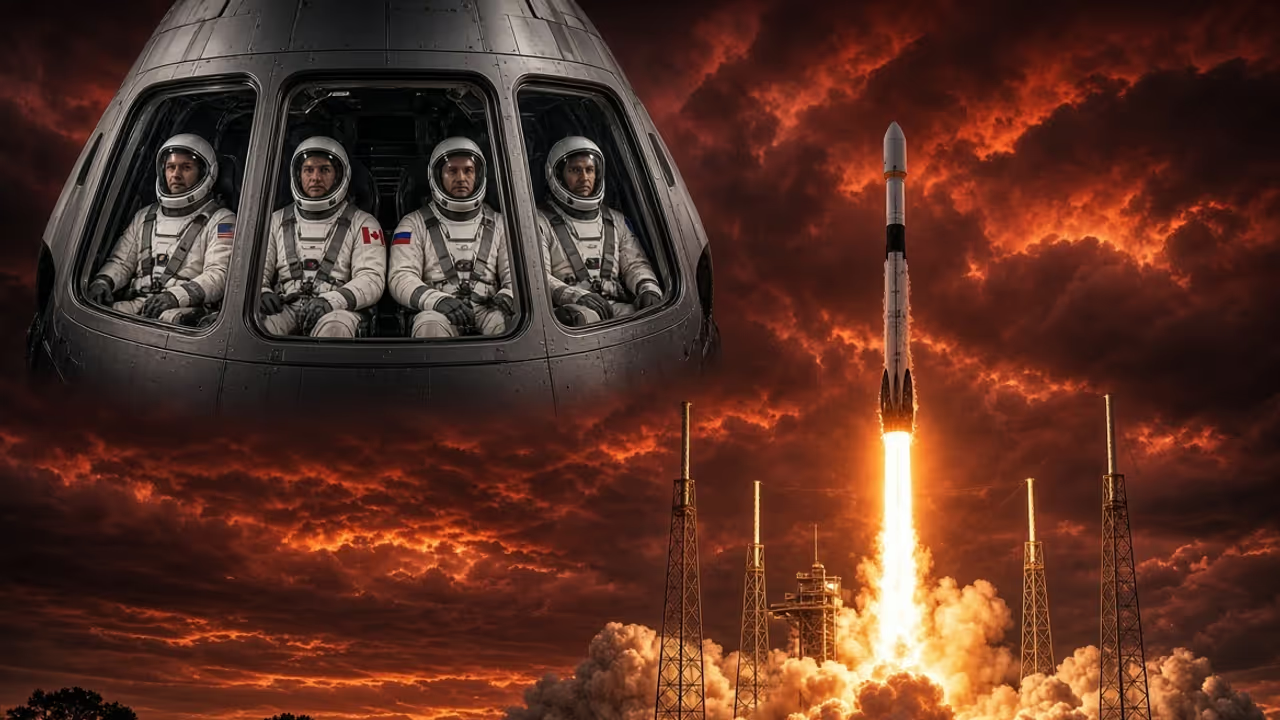
The four travellers of SpaceX's Crew-13 mission, flown for NASA, come from three nations. Jessica Watkins and Luke Delaney are NASA astronauts, Joshua Kutryk represents the Canadian Space Agency, and Sergey Teteryatnikov belongs to Roscosmos, Russia's space agency.
At 4:35 a.m. IST on October 2, while most of India was still asleep, a capsule named Grace met the International Space Station (ISS) about 400 km overhead and sealed itself to a door. Inside were four people who had left the ground only 7 hours and 55 minutes earlier. No American spacecraft, with or without people on board, has ever travelled from launch pad to the station so quickly.
The four travellers of SpaceX's Crew-13 mission, flown for NASA, come from three nations. Jessica Watkins and Luke Delaney are NASA astronauts, Joshua Kutryk represents the Canadian Space Agency, and Sergey Teteryatnikov belongs to Roscosmos, Russia's space agency. For about six months the station will be their home, laboratory and workplace. They will run scientific experiments and share the everyday chores that keep the station alive, far from family, fresh air and everything familiar.
Their arrival also frees the team already living there. NASA's Jessica Meir and Jack Hathaway, Europe's Sophie Adenot and Russia's Andrey Fedyaev have been on the station since February as Crew-12. With replacements aboard, NASA says the four could start for Earth as early as October 5.
Related Articles

Why was this trip so quick? Think of trying to board a moving train. If it is pulling into the platform just as you arrive, you step in at once. If it has just left, you must wait or chase it. The ISS is that train, circling Earth without ever stopping, and a spacecraft usually spends many hours going round the planet to catch up.
A SpaceX official who runs Dragon flights for NASA, Julianna Scheiman, said the team "got lucky this time". The station was passing through exactly the right point in its orbit at liftoff. You cannot simply fly straight up and park. The capsule and the station must be moving on almost the same path, at almost the same speed. This time that match was unusually good, so the trip came close to the shortest the laws of motion allow.
The gap over earlier flights is large. The previous American best was 12 hours and 33 minutes, set in November 2024 by a Dragon cargo ship on the CRS-31 mission. It carried no astronauts. It was essentially a delivery van in space, bringing food, equipment, supplies and experiments, and joining the station automatically. Among American flights carrying people, the quickest had been Crew-11 in August 2025, at 14 hours and 43 minutes. Crew-13 has nearly halved that.
The overall record, however, remains elsewhere. In May 2020, a Russian Soyuz delivered three astronauts to the station in just 3 hours and 3 minutes. This does not mean the Soyuz is naturally the swifter machine. The difference lies in the path that mission controllers choose. Russia has traditionally preferred shorter "fast-track" routes, rather like taking an express road instead of a longer, more relaxed one.
The journey began at Cape Canaveral Space Force Station on Florida's Atlantic coast, part of the famous Space Coast. A Falcon 9 rocket, about as tall as a 25-storey building, roared off the pad on the power of nine engines in its lower portion. The Falcon 9 is built in two parts, called stages, that do their work one after the other, like runners in a relay race.
In under three minutes the first stage had finished its lap. It separated, and instead of being thrown away, it turned around and flew itself back to a safe landing. This booster was already a veteran. It had earlier launched Crew-12 and a batch of Starlink satellites, making this its third flight. Reusing a rocket is like refuelling an aeroplane for its next trip rather than building a new one each time.
The second stage kept climbing until it reached the required orbit, then released Grace. NASA confirmed that the capsule had separated cleanly and was safely circling Earth. From there the Crew Dragon found its own way, firing small thrusters to adjust its speed, direction and orbit. The capsule can fly itself, so the astronauts did not have to steer at every moment. The chase had been planned for about eight hours, and it finished right on schedule.
Records are satisfying, but the deeper story is human. Four people trusted years of training, thousands of engineers and a previously flown rocket with their lives. Americans, a Canadian and a Russian now work shoulder to shoulder above a divided world. For every young mind in India looking up at the night sky, that is a quiet reminder that patience, preparation and cooperation can carry humanity remarkably far.