
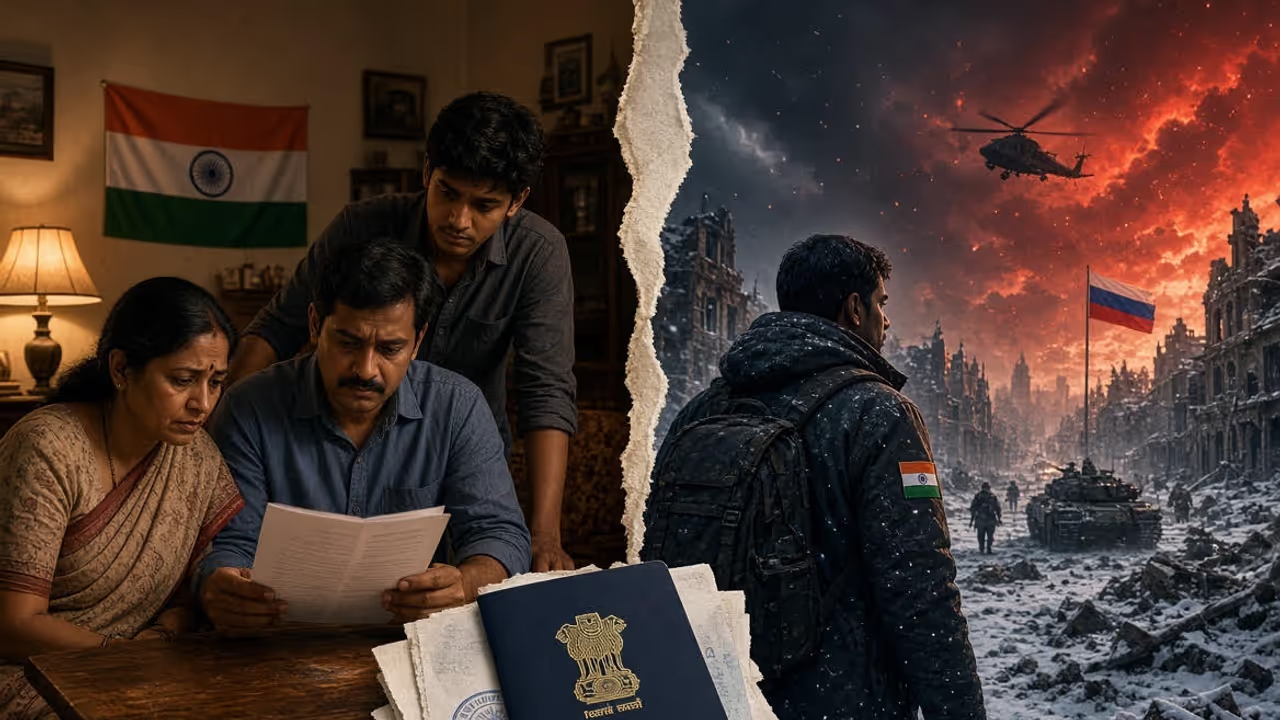
The Indian MEA has issued a strict advisory strongly discouraging citizens from joining the Russian Army amid the ongoing Ukraine war. Despite severe mortal dangers, many individuals are lured by lucrative but misleading job offers, false hopes of easy release, and promises of Russian citizenship facilitated by unofficial middlemen.
On Wednesday, September 30, the Ministry of External Affairs issued its toughest travel advisory yet on a tragedy that refuses to end. The government "strongly discouraged" Indians from travelling to Russia to join the Russian Army and warned of the "mortal dangers" awaiting them there. It is the sternest caution since the Indian Embassy in Moscow began detecting a growing number of Indian nationals being recruited to serve at the Russia-Ukraine warfront. The ministry admitted that reports of Indians signing up keep arriving despite several earlier warnings.
"It is reiterated that this is a dangerous path and is strongly discouraged by the government," the advisory said. It added: "It is advised that individuals should consider the gravity of such actions and understand the mortal dangers they are exposing themselves to." On the very same day, four men from Telangana said they had been duped into fighting Ukrainian forces.
So the question grows heavier each month. Why do our young men keep walking into another country's war?
The first answer is money. Officials say many in India continue to fall for job offers that look "attractive" but have been dressed up by recruiting agents who mislead them. How large the bait can be is seen in one family's account. They said their relative was handed an advance worth about 11,000 US dollars and a monthly salary of 2,800 dollars for a year, and he agreed because he believed he would only cook for soldiers. That is one case, not a standard contract, but for a household weighed down by loans and joblessness such promises can silence every doubt.
The second answer is a risky calculation. The advisory says that in "numerous instances" Indians joined the Russian armed forces willingly, believing that once they had received adequate monetary benefits they could approach the Indian government to secure their release. It is like jumping into a fast river on the assumption that a lifeguard will always be standing on the bank. A wartime military contract is not an office job one can resign from, and a foreign army has no duty to free a soldier because he has changed his mind.
The third answer is the dream of a new nationality. According to the ministry, some of those leaving India applied for Russian passports so that they could enlist, and only after facing hardship did they ask the Indian Embassy for support. This may be the cruellest trap of all. Once a person takes Russian citizenship, India has far less ground to demand his release, because Moscow can treat him as its own citizen.
The fourth answer lies with unofficial middlemen. The government has warned that recruitment is not limited to the Russian military's official agencies. Several "non-public entities, including voluntary groups" are also offering to enrol foreigners, and Indians who accept such informal offers are left with few protections. There is no dependable contract to hold up and no accountable office to complain to.
The price is counted in lives. By the ministry's account to Parliament last December, at least 202 Indians were believed to have been recruited since 2022, of whom 26 had been killed and seven were missing. The count has since risen. In May the government told the Supreme Court that 217 had enlisted and 49 had been killed. By the start of September, Foreign Secretary Vikram Misri said 227 had been recruited, 51 had died and 139 had been discharged. Behind each number is a mother waiting by the phone and a father who sold land to pay an agent.
New Delhi has not abandoned those already caught. The advisory says the government remains engaged with Russian authorities to ensure the safety and early discharge of all Indians in the Russian military. Yet diplomacy moves slowly and bullets do not. Every citizen stranded in a foreign trench also tests an old friendship between two nations, which is why the matter carries weight far beyond individual homes.
What stands out through this ordeal is the resilience of the families. They knock on every door, share every video and refuse to give up on sons who left only to lift their homes out of hardship. Their courage deserves an honest answer from the rest of us. No salary, however generous, is worth a life, and a job offer that ends at a battlefield is no job at all. Honest work at home, however modest, will always be worth more than a fortune promised on a foreign front.
(Girish Linganna is an award-winning science communicator and a Defence, Aerospace & Geopolitical Analyst. He is the Managing Director of ADD Engineering Components India Pvt. Ltd., a subsidiary of ADD Engineering GmbH, Germany.)
Disclaimer: The opinions expressed are solely those of the author and do not reflect the views or stance of the organization. The organization assumes no responsibility for the content shared.
