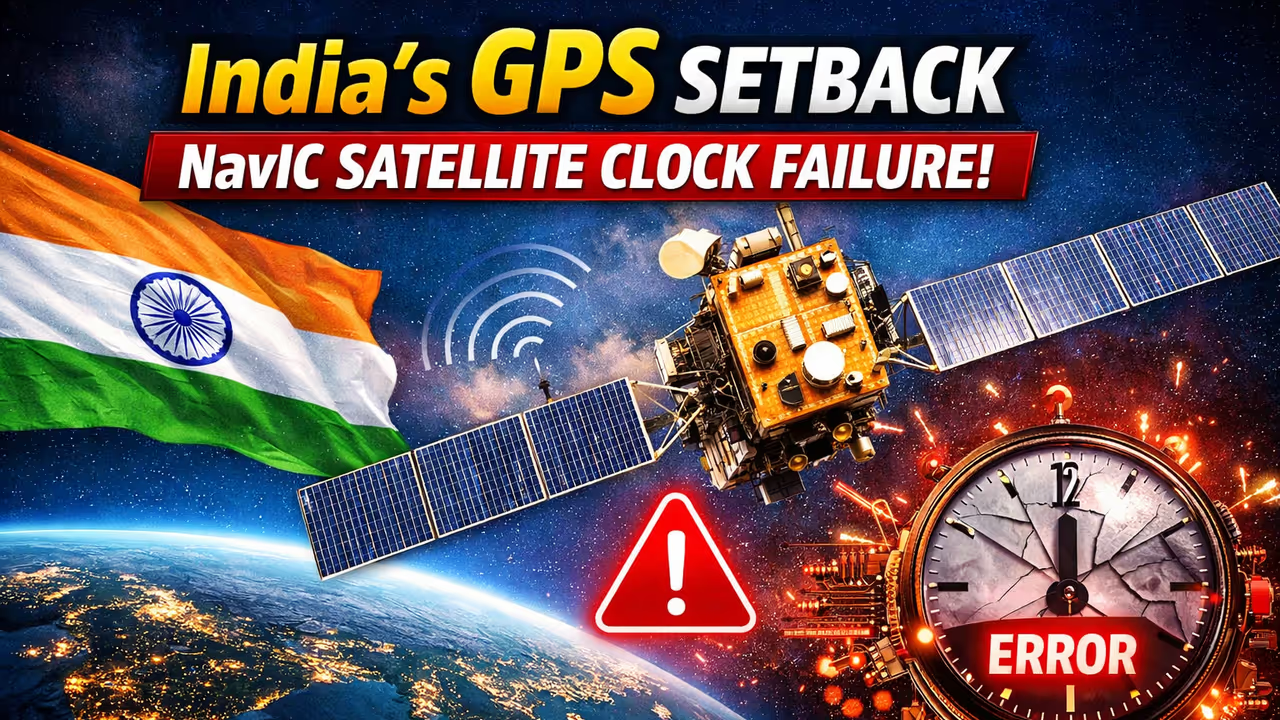
A significant setback has hit India’s NavIC satellite navigation system after an atomic clock failed on a key satellite. This failure has reduced the number of operational satellites below the minimum threshold, potentially affecting regional location services. The incident underscores recurring technical issues with the system's clocks.
India’s indigenous satellite navigation system NavIC has suffered a significant setback after the failure of an onboard atomic clock on one of its key satellites, raising concerns over the reliability of the country’s regional positioning network. The development has reduced the number of satellites capable of providing navigation services below the minimum required threshold, potentially affecting location-based services across the region.
According to officials from the Indian Space Research Organisation (ISRO), the satellite IRNSS-1F completed its design life earlier this month before the final atomic clock stopped functioning on March 13, 2026. While the spacecraft will continue to operate in orbit and transmit limited one-way messaging signals, it can no longer support navigation functions that depend on ultra-precise timing.
Navigation systems rely heavily on atomic clocks, which measure time with extraordinary precision to calculate the distance between satellites and receivers on Earth. Even tiny errors in timing can lead to large inaccuracies in determining a user’s position. With the clock failure, the number of satellites capable of providing Position, Navigation and Timing (PNT) services has dropped to just three — one short of the minimum required for reliable coverage.
Related Articles

Also Read: ISRO's CE20 cryogenic engine successfully tested at 22-tonne thrust
Space department sources have indicated that the reduced constellation strength could impact location services provided through NavIC, particularly in scenarios where uninterrupted satellite signals are essential. The setback also highlights longstanding technical challenges associated with atomic clock malfunctions, which have affected multiple satellites in the system since its early deployment.
NavIC was designed as India’s regional alternative to global navigation systems such as GPS and was intended to operate with a constellation of at least seven satellites. However, mission delays and technical anomalies have slowed the programme’s expansion. For instance, the replacement satellite NVS-02 launched in 2025 failed to reach its intended orbit due to a propulsion-related fault, leaving the constellation with limited backup capacity.
The latest setback has renewed focus on ISRO’s efforts to develop indigenous rubidium atomic clocks for second-generation satellites, a move aimed at reducing dependence on imported components that were blamed for earlier failures. The newer NVS-series spacecraft are expected to enhance system reliability once deployed successfully.
Also Read: AIIMS, ISRO sign MoU to advance research in space medicine in India
Experts say that despite the current challenges, NavIC remains strategically important for India’s navigation independence, supporting sectors ranging from transportation and telecommunications to disaster management and defence. Plans are already underway to launch additional satellites to restore full functionality and strengthen redundancy in the constellation.
As ISRO works to stabilise the network and expand the next generation of satellites, the incident underscores the growing importance of resilient space-based infrastructure in an increasingly technology-driven world, where precise positioning systems are critical to both economic activity and national security.