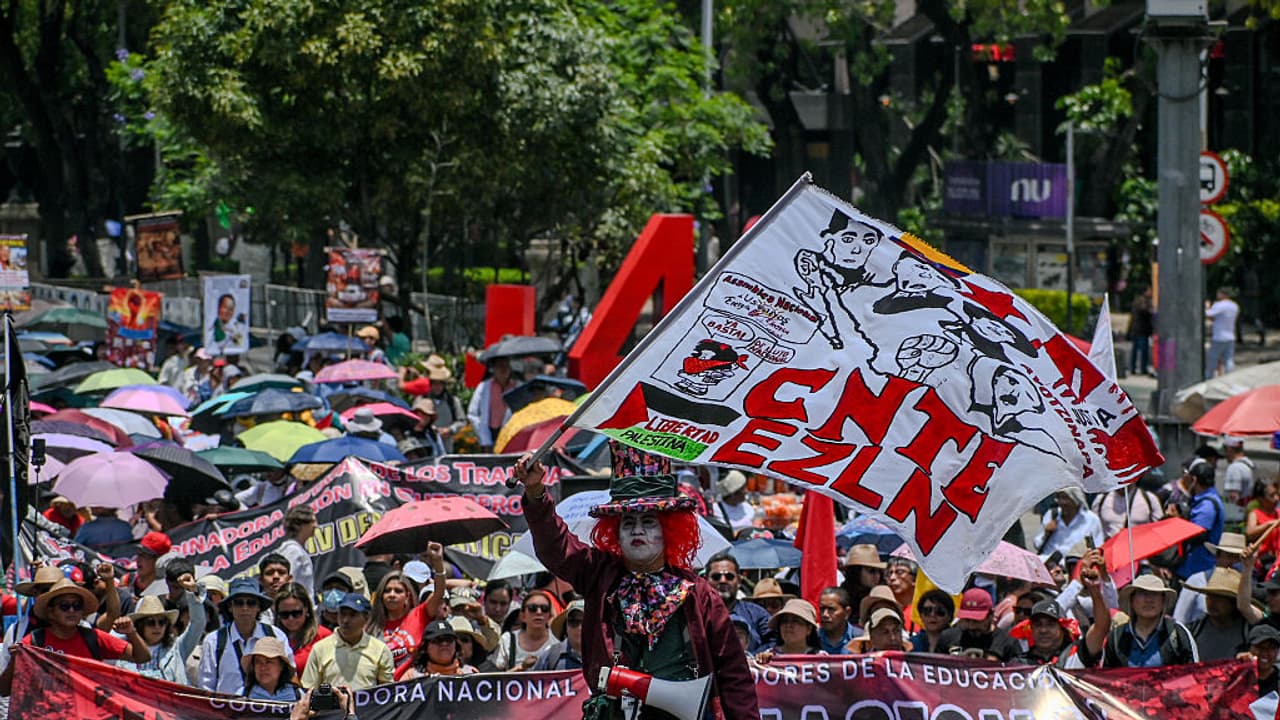
As Mexico prepares to co-host the FIFA World Cup 2026, it is grappling with massive labor protests from the National Coordinator of Education Workers (CNTE). The educators are demanding significant salary hikes and pension reforms, threatening to disrupt the tournament proceedings with the slogan, "If there is no solution, the ball won’t roll."
Mexico was selected among three countries, alongside the United States of America (USA) and Canada, to host the upcoming FIFA World Cup 2026. After 40 years, the prestigious football tournament returns to Mexican soil, marking the country's historic third time hosting the world’s biggest sporting event.
Mexico hosted the FIFA World Cup in 1970 and 1986, which saw Pele’s Brazil and Diego Maradona’s Argentina clinch the prestigious titles, with each tournament delivering legendary performances that remain etched in the sport's history. The return of the quadrennial extravaganza to North America has sparked massive excitement globally/
Mexico will host matches at three venues, namely the iconic Estadio Azteca in Mexico City, Estadio Akron in Guadalajara, and Estadio BBVA in Monterrey, and a total of 13 matches throughout the tournament.
Related Articles

Also Read: Indian Football: Federation Cup Making a Comeback? Buzz Around New Season Calendar
Mexico Faces Labour Protests - Here’s Why
As Mexico is set to host the opening match of the FIFA World Cup 2026 against South Africa at Estadio Azteca, the country has been grappling with a massive labour protest, which is causing significant logistical disruptions, forcing the authorities to implement strict travel corridors and heightening security concerns for international fans arriving for the highly anticipated tournament opener.
The massive protests were organised by the National Coordinator of Education Workers (CNTE), which has long campaigned for the reversal of educational reforms they argue marginalise the public sector staff. The educators are staging widespread protests across the country, demanding an increase in their salaries, 100% hike in wages to combat inflation, and a complete overhaul of the current pension system.
The demonstrators strategically opted to protest just days before the marquee event to maximise their leverage, knowing that the influx of international media, global football fans, and high-profile dignitaries would force the Claudia Sheinbaum Pardo-led government to prioritise a swift resolution to the unrest.
The educators in Mexico have been protesting since May this year, with the main aim of securing a significant salary increase, rejecting the government’s 9% offer in favour of a 100% wage hike to combat inflation, and achieving a complete reversal of the pension and educational reforms that marginalise public sector workers.
Since the FIFA World Cup is expected to garner global attention, the teachers' union, known as the CNTE (National Coordinator of Education Workers), is leveraging the tournament to amplify its voice.
The Protesting Teachers Threaten to Disrupt Tournament Proceedings
The protests by the National Coordinator of Education Workers (CNTE) turned violent after demonstrators attempted to breach the security perimeter of the Zocalo in Mexico City, prompting the riot police to deploy tear gas to prevent them from reaching the site where official FIFA ‘Fan Fest’ installations are currently under construction.
On Tuesday, a large number of protesters gathered outside the Interior Ministry to denounce the violence, chanting If there is no solution, the ball won’t roll”, in reference to the upcoming edition of the FIFA World Cup.
One of the union leaders, Filiberto Frausto, expressed his displeasure over what he described as the government's prioritisation of World Cup-related commercial interests over workers' rights, arguing that public spaces were handed over to private corporations associated with the tournament, while the concerns of the teachers and public-sector workers are being ignored.
“This shows that the spaces of the people can be privatised at the whim and for the benefit of the large corporations behind this World Cup, minimising the fight for workers’ rights,” Frausto said as quoted by The Guardian.
According to the report by The Guardian, several protestors and two police officers were left injured in the clashes, with reports of demonstrators being treated for tear gas inhalation and minor physical trauma following the forced dispersal from the Zócalo perimeter.
Government Offers Dialogue, But Educators Demand Action
As the protests take centre stage ahead of the FIFA World Cup 2026 in Mexico, authorities are insisting that they are actively seeking a resolution, with President Claudia Sheinbaum Pardo emphasising that the government remains committed to addressing "feasible" demands through ongoing dialogue.
However, the protesting teachers are not convinced, dismissing the government's approach as a series of stalled negotiations and "empty promises."
“All the government has done is hold meetings for dialogue, but there’s no progress. We are demanding justice.” Sergio Cruz, one of the protesting teachers, told the Guardian.
It was reported that the ongoing protests by the teachers impacted the businesses in Mexico, with local merchants in the downtown district reporting a sharp decline in foot traffic, forced temporary closures, and mounting anxieties as security perimeters and street blockades continue to deter both local customers and early-arriving international tourists.
It remains to be seen how Mexico Government will navigate this high-stakes impasse as the opening ceremony approaches.