
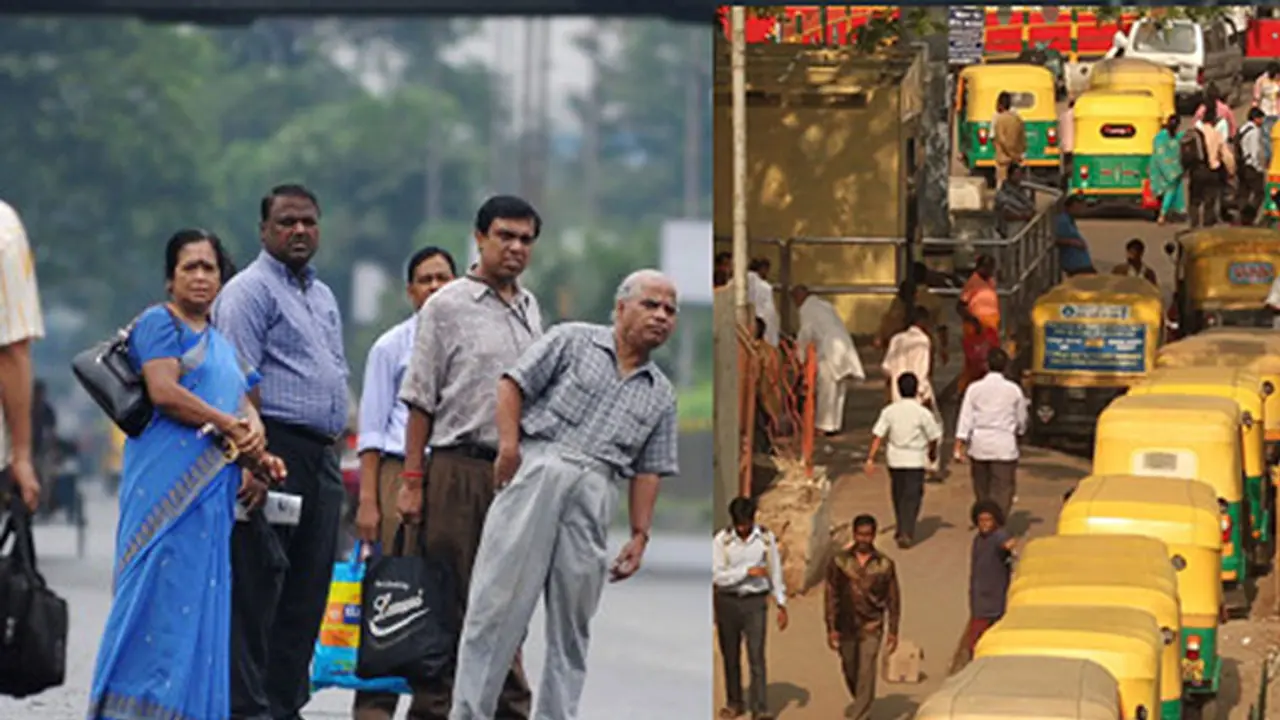
Demanding higher salaries, the workers’ unions of four Transport Corporations had observed a strike on July 25 and 26. It was followed by a bank employees strike opposing the merger of the State Bank of India with other five associates, among other demands.
In addition to this, an all-Karnataka bandh was observed following the Mahadayi Tribunal’s verdict. This bandh was supported by farmers, Kannada activists, and organisations.
Even all business in Sandalwood remained shut as the Karnataka Film Chamber of Commerce also extended its support to the strike, by cancelling all the film screenings and shooting.
All of this have cost the state a massive ₹9000 crore in lost business and profits.
Bengaluru accounts for 65% of the total transactions of the state, and the city incurred a loss of anywhere from ₹600 to ₹800 crore per day.
Government undertakings like the Karnataka State Road Transport Corporation and the Bengaluru Metropolitan Transport Corporation, along with scores of educational institutions, retails outlets, multiplexes, markets, industries, auto rickshaws, taxies and to some extent the Metro train service too came to a halt.
Apart from this, the heavy downpour that lashed Bengaluru from July 30 brought untold miseries to a large number of inhabitants.
All these seemed to have had an adverse impact on the Gross State Domestic Product (GSDP).
A small silver lining was for the railways. As 23,000 buses remained out of roads, rail traffic saw an increase of 20%.
Karnataka is said to be at the forefront of Value-Added Tax (VAT) collection in the entire country. ₹42,000 crore in revenue is generated in a year from VAT.
Owing to these strikes and agitations, the loss is estimated to be around ₹1,500 crore per day, opined M C Dinesh, President of the Federation of Karnataka Chamber of Commerce and Industry.
Speaking to Kannada Prabha, he said that Bengaluru has not just remained as the capital of Karnataka. Rather it has outgrown the state in many dimensions and has become a hub for more than 400 MNCs.
"Those who work here are not giving profits to Bengaluru only. Most of the items produced here are being sourced out to various cities and town of the country," he added.
