
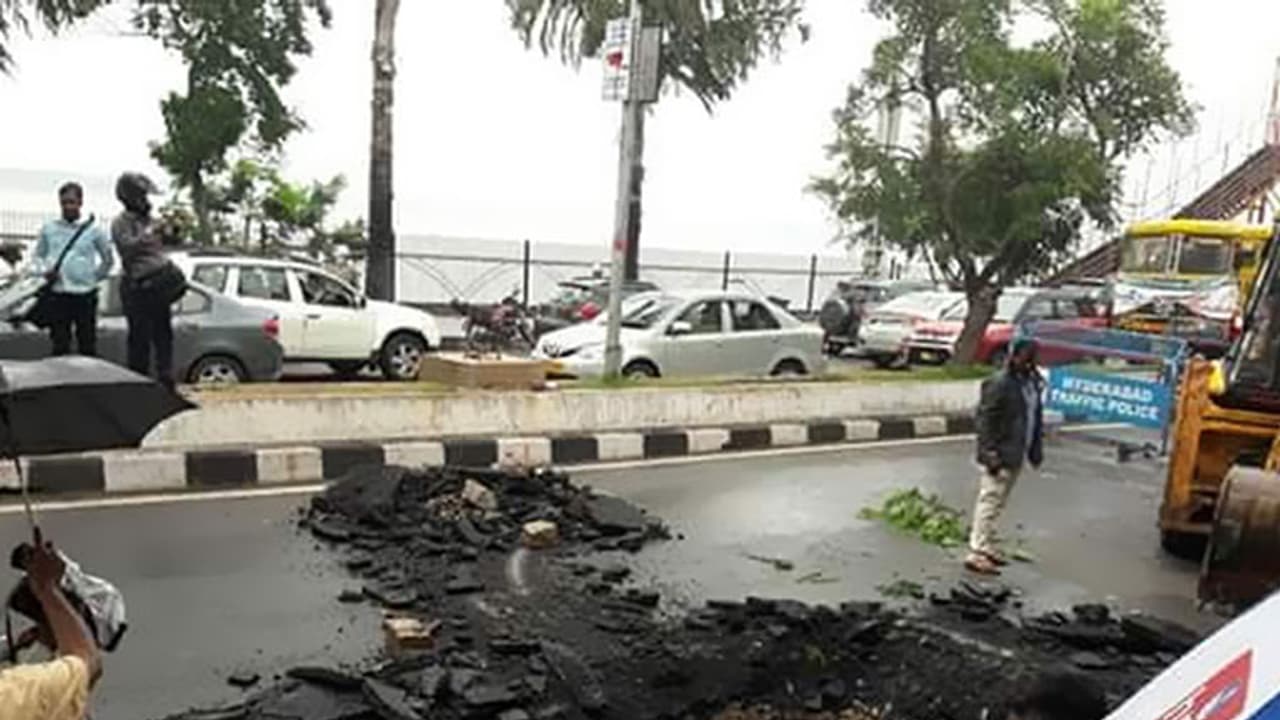
NTR Marg, abutting the Hussainsagar lake, leading upto the Telangana secretariat caved in, forming a giant crater due to heavy overnight rains. Thankfully, no accident occurred. Illegal constructions and massive piles of garbage choking the city's drainage system
The sun seems to have gone on long leave in Hyderabad. For the better part of the last 20 days, the city has received copious rainfall. The intervening night of Tuesday-Wednesday took the cake, with Qutbullapur receiving 16 cm rainfall. Almost without exception, all water bodies have breached and those constructions built on lake beds, have vehicles virtually floating on water.
Every such civic nightmare has an image and that image came on Wednesday from NTR Marg, abutting the Hussainsagar lake, where a significantly large crater was formed. Incidentally this is the road that leads you to the Telangana Secretariat. Peer inside and you would see water gushing underneath. Fortunately the crater was discovered in time to avoid any accidents.
The Greater Hyderabad Municipal Corporation (GHMC), as has been its wont every time Hyderabad gets flooded, has blamed the elements. The argument is that the city can take about 2 cm rainfall in an hour and at 16 cm, it is but natural for areas to go under water. The GHMC commissioner likens the night showers to a cloudburst.
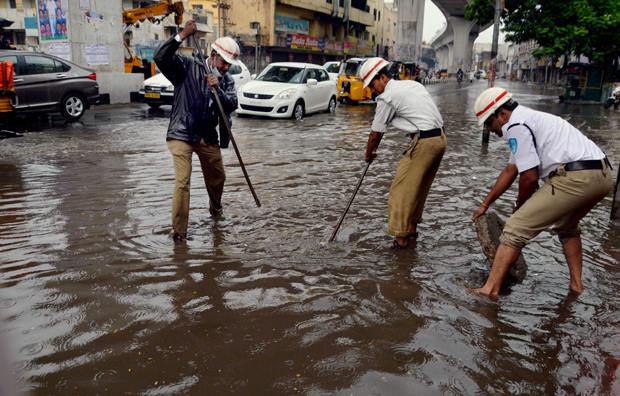
The GHMC which has been involved more in firefighting than fixing the problems points out that though Hyderabad has over 9000 km of road, only 1/6th of it has storm water drains running alongside. This means when Hyderabad woke up on Wednesday morning, it found more than 80 per cent of the city converted into a drain. What's worse is that the GHMC has no motors to pump water from flooded roads. So it waits for the Sun God's benevolence.
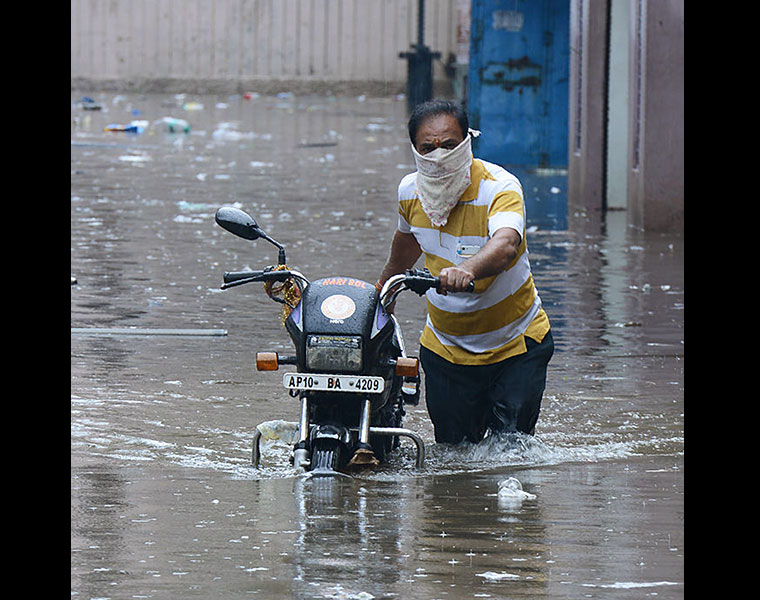
But the bigger problem, it says is with the residents. It quotes the Kirloskar Committee report that was submitted more than a decade ago, which says 390 km of major drains in Hyderabad are encroached by some 28000 properties. The bigger problem is the garbage they generate - roughly 56 MTs every day - finds its way into the drains choking them.
What is worse is that the GHMC has recorded that many of these localities are not even willing to pay Rs 50 per month to the tricyle puller to collect waste at the doorstep. In many areas, as a result, the waste collection agent has withdrawn his services.
The government says it is next to impossible to remove the illegal constructions that have come up over the last two decades or so. Demolishing them like the Bengaluru Municipal Corporation has done would be politically imprudent while slapping notices would only mean courts grant a stay. The city, as a result, is in a Catch 22 situation.
Much like in Bengaluru, in many such illegal localities, the GHMC has been collecting property tax for many years, giving them some kind of a quasi-legality. It makes the task of turning around and labelling them unauthorised one fine day, legally untenable.
The other issue again is because of population growth. The 2001 census recorded Hyderabad's population at 36 lakh. It jumped 87 per cent in the next decade to grow to 68 lakh people. Expected to be home to about one crore people now, the storm water drains have not kept pace as they were constructed to service a population of 30 to 50 lakh people.
Having given up on Hyderabad, the only solution the authorities have come up with is to tell the citizens to stagger their office going and leaving timings. The Traffic police gives regular updates on which routes to avoid and why it is not a good idea to step out into a flooded road, where traffic is already bumper to bumper.
