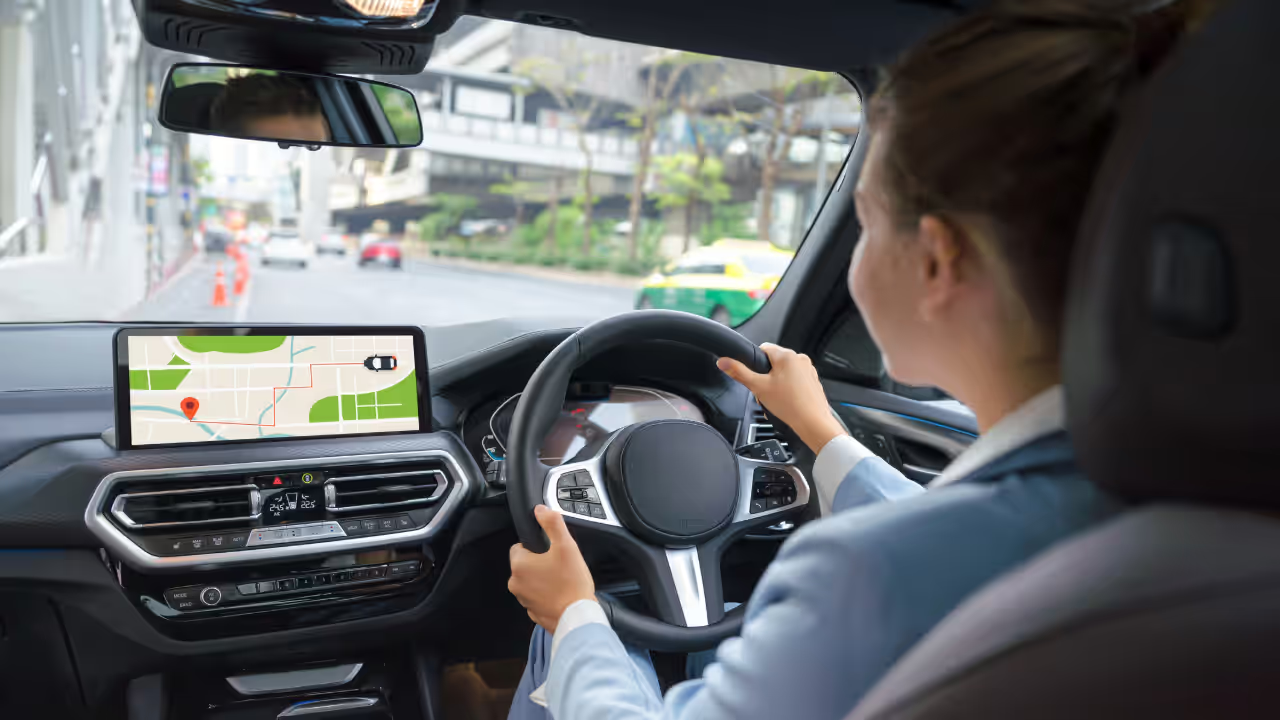
Are young drivers too reliant on Google maps? A new report reveals a generational divide in driving habits and a study shows how this dependency affects the brain. Discover why turning off your GPS might be a good idea.
A recent report by Carmoola highlights that younger drivers are becoming more reliant on sat nav systems. What was once a helpful tool has now become a necessity for many, particularly among Gen Z, who often ask on social media how people used to drive without Google maps.
Survey Findings
The study, conducted by Carmoola, surveyed 2,000 individuals across the UK to better understand driving habits. It revealed a clear generational divide. About 28 per cent of drivers aged 25 to 34 said using sat nav for every journey was a must, while 20 per cent admitted they even depend on it for short trips, such as going to the supermarket.
In contrast, older drivers seem more confident in navigating without technology. Among those over 45, only about two in ten used sat nav for every trip, and 15 per cent said they rarely used it at all.
Related Articles

Handling Problems
The survey also examined how drivers handle situations when technology fails. Among those aged 55 to 64, 57 per cent said they would rely on road signs and familiar landmarks if their sat nav stopped working. However, only 44 per cent of younger drivers said they would do the same, and a quarter admitted they would stop to ask someone for directions.
Aidan Rushby, founder and CEO of Carmoola, explained that modern drivers now expect everything to function smoothly and instantly. He said that navigation tools have become second nature because they make journeys easier, and this expectation now influences the overall driving experience.
Also read: Excessive Social Media Use Is Making Teens Unhappy, Stressed, and Anxious: Global Study
Younger drivers often talk about their dependence on navigation tools online. Many admit they use sat nav even for routes they already know, or they prepare by studying maps before travelling. This shows a wider trend where convenience often takes priority over learning traditional navigation skills.
Brain Impact
Although this reliance may seem harmless, research suggests it could affect how the brain works. A study by researchers at University College London, led by Dr Hugo Spiers, explored how people navigate using their own sense of direction compared to following digital instructions.
The study involved 24 volunteers who navigated a virtual version of Soho in central London while their brain activity was monitored. Scientists focused on two key areas: the hippocampus, linked to memory, and the prefrontal cortex, involved in planning and decision-making.
When participants found their own way, these brain areas became highly active, especially when entering unfamiliar or complex streets. However, when they simply followed directions, similar to using a sat nav, there was little to no increase in activity.
The findings suggest that over-reliance on navigation technology could reduce the brain’s natural engagement with the surroundings. So, to keep your brain sharp, it’s not a bad idea to turn off the sat nav and use your own navigational skills.
Also read: High-Intensity Daily Movement May Cut Risk of Diabetes and Dementia: Study