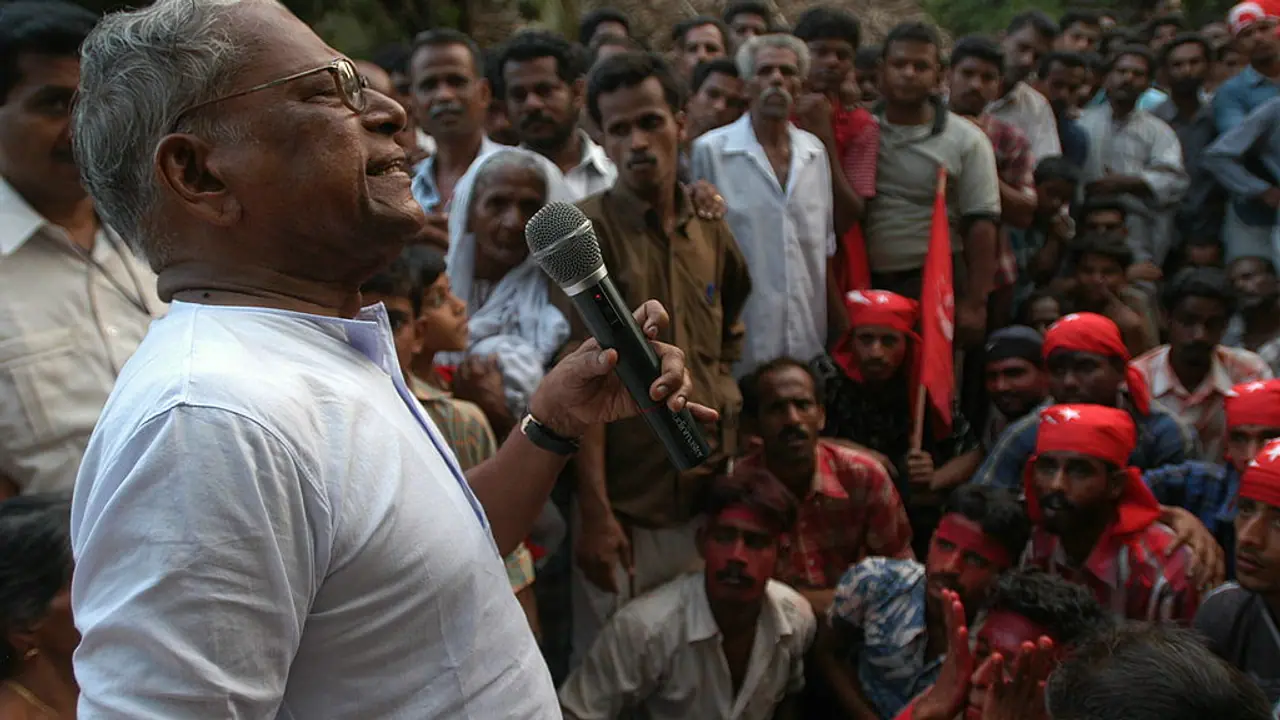
A seven-time MLA, VS Achuthanandan has contested ten elections during his political career and lost only three times. He became Kerala's oldest Chief Minister at the age of 82.
Thiruvananthapuram: VS Achuthanandan has passed away at the age of 101. He was former Kerala Chief Minister and the last alive founding member of the Communist Party of India (Marxist) after the party's split in 1964. VS was admitted to a private hospital on June 23 after suffering from a heart attack. He was put on ventilator support in the Intensive Care Unit (ICU) under supervision from cardiology, nephrology, and neurology specialists.
VS was diagnosed with Covid-19 in 2022 and had been battling age-related issues for some time now. He never recovered from the physical disability caused by the stroke that occurred on the night of October 25, 2019. VS was the Kerala Chief Minister from 2006-2011, after which Pinarayi Vijayan took over. A seven-time MLA, VS has contested ten elections during his political career and lost only three times. Since 2001, VS made Malampuzha constituency in Palakkad as his home turf and won all elections that he contested in.
An unapologetic Marxist
Known as the Fidel Castro of Kerala, VS Achuthanandan was born to Venthalathara Ayyan Shankaran and Accamma alias Karthyayani on October 20, 1923. He was born into an oppressed caste, the Ezhavas, and faced discrimination since early childhood. He was four years old when the tragedy of smallpox took his mother's life and 11-years-old when his father died.
VS joined the freedom movement through trade union struggles in 1938 at the age of 15 and joined the undivided Communist Party of India two years later while working at Aspinwall House, a British company. He spent more than five years in prison and around four years in hiding and was a major proponent in the Punnapra-Vayalar struggle, which was a communist-led workers’ uprising in October 1946 in present-day Alappuzha in Kerala. The agitation was sparked due to poor working conditions, economic exploitation, and political repression under the rule of erstwhile Travancore Diwan CP Ramaswami Iyer. The movement witnessed thousands of coir workers and peasants revolt against attempts to keep Travancore independent from the Indian Union.
In a Doordarshan documentary, Achuthanandan recounts his experience of being saved by two thieves after state forces under the Travancore Dewan’s rule almost killed him. He was about to be dumped in a forest near Pala, when one of the thieves refused to discard him and admitted him to a hospital. When he was the District Committee Secretary of CPIM in 1967, Achuthanandan married Vasumathiamma at a wedding hall in Alappuzha.
Related Articles

VS became CPIM state secretary three times from 1980 to 1991. When the ideological conflict within the party in the 1980s was rife, VS held sway with the support of EMS. VS ran all over Kerala to stop the influx of people following MV Raghavan, who showed revisionist tendencies and wanted to forge alliances with non-Communist parties, such as the Muslim League. He was suspended from the CPIM Polit Buro in 1985 for his hardline politics and later inducted again after he towed the party line. MV Raghavan was expelled from the party in 1986 and he joined the Congress--a move that validated concerns expressed by VS.
Kerala's eldest Chief Minister
VS Achuthanandan was expected to become the Chief Minister in 1996, but his unexpected loss at Mararikulam forced him to wait. Eventually, VS became Kerala’s 11th Chief Minister at age 82, becoming the state’s eldest CM. he had been denied a party ticket to contest elections just two months before he was sworn in. In the run-up to the elections, VS was denied a party ticket initially due to factional rivalry. This was seen as a move to sideline him from Kerala politics, resulting in a ‘Bring back VS’ campaign.
Achuthanandan's stand on the Lavalin issue (also known as the SNC-Lavalin corruption case) was firmly against party lines, and it became one of the defining moments of his image as an uncompromising anti-corruption crusader. he SNC-Lavalin case involves a ₹374 crore corruption scandal linked to a 1997 contract signed between the Kerala government and Canadian firm SNC-Lavalin for renovating three hydroelectric projects in Idukki. At the time, Kerala Chief Minister Pinarayi Vijayan (then Kerala’s power minister) was a key signatory to the deal.
VS openly supported the Central Bureau of Investigation’s probe into Pinarayi Vijayan, who was then the CPI(M) state secretary, and approved their request to prosecute him. The CPI(M) Politburo defended Pinarayi Vijayan and accused the CBI of acting with political bias, overruling VS. Following these incidents, VS was permanently removed from the Politburo in 2009, but was allowed to remain in the Central Committee. The Pinarayi Vijayan government later appointed him as the Chairman of the Administrative Reforms Commission from 2016 to 2021 after the assembly elections.
Major achievements
VS was instrumental in the fruition of the International Container Transhipment Project at Vizhinjam. It was during his time that the first phase of the project was inaugurated, in 2010. However, he alleged corruption during Congress rule and demanded a white paper from the LDF government. Achuthanandan had said that the construction of breakwater in Vizhinjam with concrete blocks instead of rocks was in violation of the agreement. He had also opposed handing over the project to Adani Ports.
VS also played a pivotal role in the Kochi Metro Rail project. The Kerala Cabinet approved the Rs 3000 crore project and sent it to the Centre for ratification in 2008, under the tenure of VS. VS became the common man's hero after he initiated action against encroachment on government land in the hill resort and tea plantation town of Munnar. He was also the first Communist Chief Minister to trek to Sabarimala, without any sort of physical or medical support, in 2007. VS also helped develop infopark projects across the state.