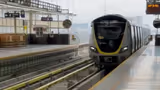
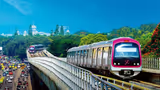
Namma Metro has become India’s costliest public transport system due to steep fare hikes, rising operating and maintenance costs, project delays, foreign loan repayments, and mounting debt, putting pressure on daily commuters.
Bengaluru, widely regarded as one of the world’s most congested cities, also operates India’s most expensive metro system. After a steep 71 per cent fare hike implemented last year, the Bangalore Metro Rail Corporation Limited (BMRCL) was expected to introduce an additional five per cent annual fare revision from February 9. However, following strong public opposition and growing criticism from commuters, the proposed increase has been put on hold, raising fresh questions about the financial sustainability of Namma Metro and the burden on daily passengers.
Who Decides On Metro Fare Revision?
The fare revision proposal was initiated by BMRCL, a 50:50 joint venture between the Government of India and the Government of Karnataka. Citing rising operational costs and concerns over long-term financial viability, BMRCL approached the Union Ministry of Housing and Urban Affairs (MoHUA) in September 2024 to constitute a mandatory Fare Fixation Committee (FFC) under Section 34 of the Metro Railways (Operation and Maintenance) Act.
How Namma Metro Became India’s Costliest Transport System?
Bengaluru’s metro emerged as the country’s most expensive urban rail system after the first Fare Fixation Committee, constituted in September 2024, recommended a 71 per cent fare hike. The committee cited mounting operational losses, rising costs, heavy loan repayment obligations, and the need to ensure BMRCL’s long-term financial sustainability. Notably, metro fares had remained unchanged since June 2017, even as expenses rose sharply over the years.
Related Articles

Impact Of Project Delays On Metro Finances
Project delays have further worsened BMRCL’s financial burden. Former Delhi Metro Rail Corporation (DMRC) chief E. Sreedharan had earlier warned that each day of delay could cost BMRCL between Rs 1.5 crore and Rs 2 crore. Phase-1 of the project, initially estimated at Rs 6,395 crore in 2005, eventually cost Rs 14,133 crore. Phase-2, approved at Rs 26,405 crore in 2014, escalated to Rs 40,614 crore by 2024, significantly increasing the corporation’s debt burden.
Surge In Operation And Maintenance Costs
According to BMRCL data, total operation and maintenance (O&M) costs rose by 133 per cent—from Rs 262.94 crore in 2017–18 to Rs 613.51 crore in 2023–24. Energy costs have doubled, staff expenses increased by nearly 150 per cent, outsourced services rose by 85 per cent, and repair and maintenance costs have quadrupled. These increases reflect inflation, network expansion, ageing infrastructure, and higher manpower requirements.
Metro Expansion Adds To Cost Pressures
The operational network expanded from 42.3 km in 2017 to 76.95 km in 2024 and is set to grow further with the commissioning of Phase-2, Phase-2A, and Phase-2B. Currently, about 96 km of metro lines are operational. A longer network inevitably requires additional staff, greater energy consumption, higher maintenance expenditure, and increased depreciation costs.
Mounting Debt Burden On BMRCL
BMRCL currently has outstanding external loans exceeding Rs 13,106 crore, along with subordinate debt of Rs 21,521 crore. The corporation pays around Rs 128 crore annually in interest, charged to O&M, and Rs 463 crore in principal repayments. By 2029–30, total interest and repayment obligations are projected to exceed Rs 2,700 crore, making debt servicing one of BMRCL’s largest cash outflows.
Foreign Loans And Currency Risks
The Government of India borrowed from multilateral agencies such as JICA, ADB, EIB, AfD, AIIB, and KfW and transferred these loans to BMRCL. Although repayments are made in rupees, they include exchange rate variations. BMRCL did not hedge its foreign currency exposure, leading to significantly higher repayment costs as the rupee weakened against currencies such as the euro over the years.
Can the Karnataka Government Step In?
The Karnataka government provides Shadow Cash Support (SCS) through budgetary allocations to cover cash losses and extends interest-free subordinate loans to assist with debt repayment. However, BMRCL has stated that such support cannot continue indefinitely, citing the state government’s financial constraints. The government is already spending an average of Rs 55,000 crore annually on its five election guarantee schemes.
Rolling Stock Shortage Limits Passenger Capacity
Despite strong demand on existing routes, BMRCL faces a shortage of rolling stock. Metro planning norms suggest one train per kilometre to maintain optimal service frequencies of three to four minutes. Currently, the 43-km Purple Line and the 33-km Green Line together operate with just 57 trains, while the 19-km Yellow Line has only eight trains, limiting service frequency and passenger capacity.
Automatic Fare Revision Formula Explained
The Fare Fixation Committee recommended an automatic annual fare revision mechanism, with five per cent increases taking effect one year after the FFC-recommended fares are implemented by the BMRCL board. These revisions would remain valid until the next Fare Fixation Committee submits its recommendations, with all fares rounded to the nearest rupee.
Has Delhi Metro Adopted a Similar Model?
The Delhi Metro Rail Corporation (DMRC) has constituted four fare fixation committees, with the most recent submitting its report in 2016. While an automatic fare revision formula was recommended, it has not been implemented. DMRC carried out only a nominal fare revision in 2025.
What Urban Mobility Experts Say?
Urban mobility experts, including Sathya Arikutharam, point to five structural challenges facing Namma Metro: chronic construction delays that stalled revenue growth, heavy reliance on foreign currency loans, failure to hedge against exchange rate risks, weak non-fare revenue streams, and the limited capacity of the state government to indefinitely cover operational losses.