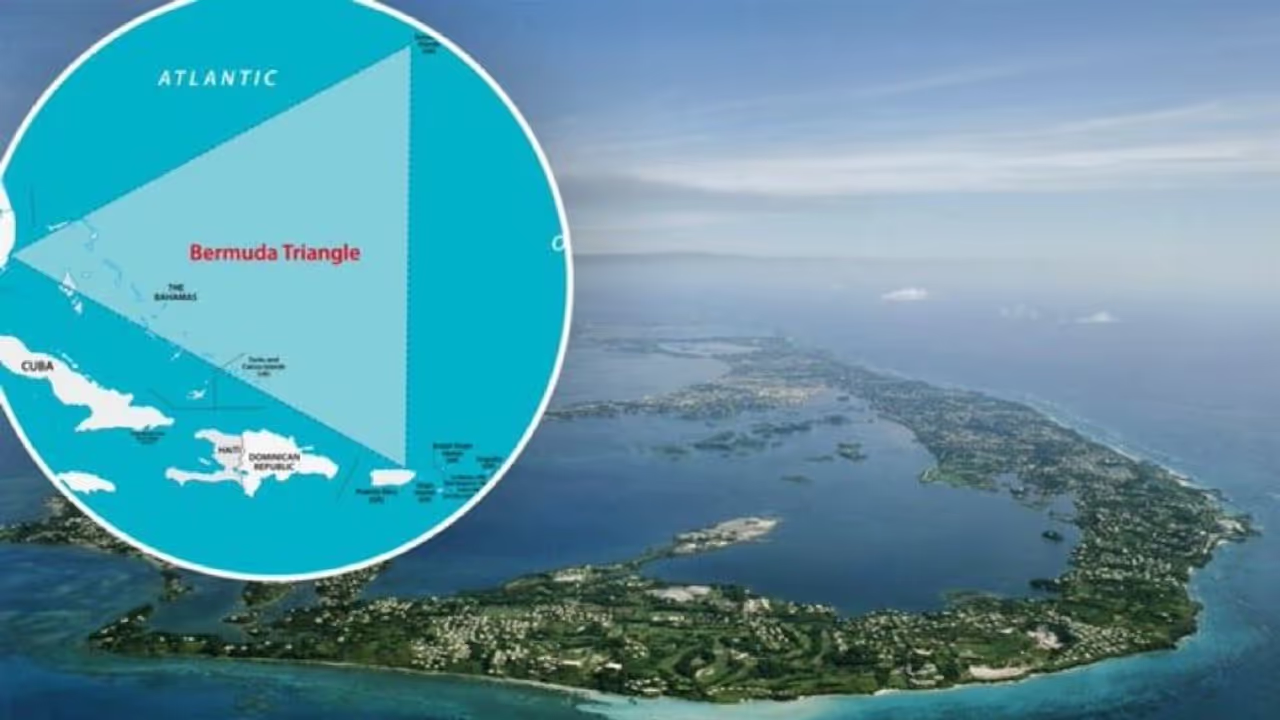
Researchers have identified an immense stone structure buried deep beneath Bermuda — a geological formation so unusual that experts say it is “unlike anything else on Earth.”
Researchers have identified an immense stone structure buried deep beneath Bermuda — a geological formation so unusual that experts say it is “unlike anything else on Earth.” Stretching an astonishing 12.4 miles (20km) thick, the rock layer lies concealed beneath the oceanic crust, dwarfing any similar structure ever documented.
Bermuda itself rests atop a raised section of oceanic crust known as an oceanic swell, a feature typically forged by volcanic forces. There is no evidence linking the island’s elevation to active volcanism, and no eruption has occurred there for over 31 million years — ample time for any volcanic swelling to have vanished.
Related Articles

The newly discovered structure, however, offers a compelling explanation. Scientists believe the island’s last eruption injected vast amounts of molten rock into the crust, where it cooled and solidified into a massive subterranean raft. This dense slab effectively hoisted Bermuda nearly 500 metres (1,640 feet) above sea level.
In a study published in Geophysical Research Letters, researchers analyzed seismic data recorded from a station on Bermuda, tracing how powerful earthquakes — occurring as far as 31 miles (50km) beneath the island — travelled through the Earth.
When those seismic waves unexpectedly bent and shifted, the team realised they had struck something extraordinary: an anomalously thick layer of rock buried within the tectonic plate itself.
Dr William Frazer, a seismologist at Carnegie Science, told Live Science: "Typically, you have the bottom of the oceanic crust and then it would be expected to be the mantle. But in Bermuda, there is this other layer that is emplaced beneath the crust, within the tectonic plate that Bermuda sits on."
For geologists, the finding could be a breakthrough in solving Bermuda’s most perplexing scientific puzzle — not the fate of vanished ships, but the persistence of its oceanic swell.
Island chains such as Hawaii form over mantle hotspots, where plumes of molten rock rise from deep within the Earth. As these hotspots punch through the crust, they not only build islands but also lift the surrounding tectonic plate, creating swells that gradually sink once the plate drifts away.
Bermuda, however, never fit that model. With no volcanic activity for tens of millions of years, scientists were left baffled as to why its swell remained intact.
The answer may lie in density. The newly discovered rock layer is lighter than the surrounding material, allowing it to deflect seismic waves while simultaneously pushing the island upward.
Earlier studies revealed that Bermuda’s ancient lava is unusually low in silicon — a chemical fingerprint suggesting it originated from a carbon-poor layer deep within the Earth’s mantle. That carbon likely surfaced during the dramatic breakup of the supercontinent Pangea, when the Atlantic Ocean was born between 900 and 300 million years ago.
This unique origin could explain why Bermuda stands apart from hotspot islands in the Pacific and Indian oceans, which formed in far older ocean basins.
Scientists are now widening their search, examining islands across the globe to determine whether Bermuda’s buried structure is a rare anomaly or part of a hidden geological pattern.
Dr Frazer says, “Understanding a place like Bermuda, which is an extreme location, is important to understand places that are less extreme and gives us a sense of what are the more normal processes that happen on Earth and what are the more extreme processes that happen.”
Spanning the waters between Florida, Puerto Rico and Bermuda, the region’s long record of wrecks has fuelled decades of supernatural speculation. Yet scientists argue the explanation may be far more earthly.
Dr Simon Boxall, an oceanographer at the University of Southampton, attributes the disappearances to rogue waves — massive, unpredictable walls of water born from violent storms.
Rising up to 100 feet (30 metres), these waves strike without warning, often from unexpected directions. According to Dr Boxall, a vessel caught in such a surge could “sink in a matter of two or three minutes.”
(This article has been curated with the help of AI)