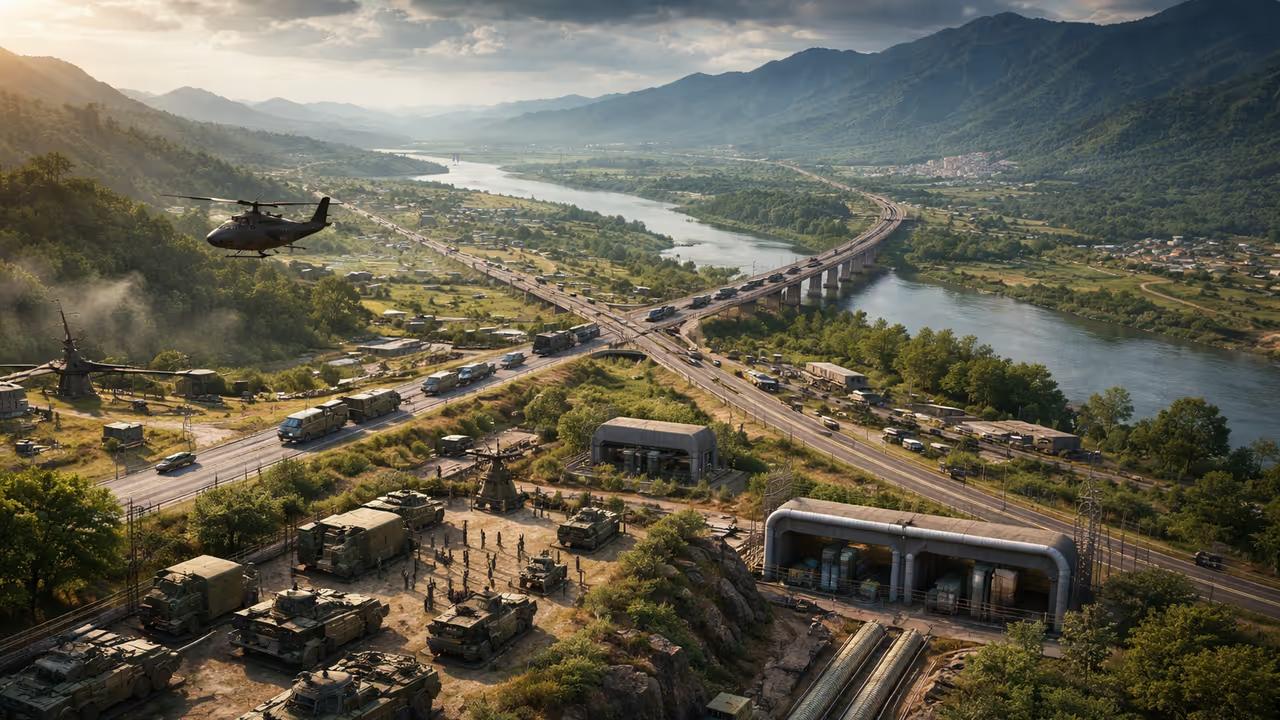
India’s vulnerable Siliguri Corridor demands urgent upgrades—alternate roads, forward military presence, and hardened utilities—to prevent a strategic chokehold on the Northeast.
New Delhi: There is a stretch of terrain in northern West Bengal that has kept Indian defence planners occupied for decades. The Siliguri Corridor, 22 kilometres wide at its narrowest point, is the sole overland connection between India's eight northeastern states and the mainland. Cut it for long enough, and what follows is a strategic, economic, and humanitarian crisis occurring simultaneously.
Kishanganj: The Strategic Gateway
Kishanganj sits at the western approach to this corridor. What happens in Kishanganj shapes what options India has in a crisis. Which is precisely why the infrastructure investment required here is not regional development work. It is national security planning with a geographic anchor.
The first requirement is road redundancy. The corridor's existing network offers limited alternatives when primary routes are disrupted. A major flood, a damaged bridge, a sustained standoff, any of these creates a chokepoint on a route that currently has few bypasses.
Related Articles

Constructing strategic alternate road networks within the Kishanganj zone and through the corridor proper gives the system the resilience it currently lacks. A single route is a single point of failure. Two or three routes, even if some carry lower capacity, reduce that failure from a crisis to a manageable disruption.
Forward Military Presence: Speed Over Distance
Forward military positioning is the second element. Rapid-deployment units based at permanent forward posts near Kishanganj can respond to a developing corridor scenario in hours rather than the days it takes to move forces from distant bases.
The Indian Army's Integrated Battle Groups concept, developed primarily around the China and Pakistan threat axes, envisions agile, forward-positioned capabilities that represent the kind of responsive military architecture the corridor's western approach requires.
Adapting that framework to anchor a credible fast-response presence in the Kishanganj zone would extend its logic to a vulnerability that has, so far, received less structured attention.
The Overlooked Threat: Utility Infrastructure
But there is a dimension of corridor defence that rarely surfaces in public discussion. Utility infrastructure: power lines, communication cables, fuel pipelines. These run through the corridor zone and are as operationally critical as any road or railway. And considerably more vulnerable. An underground utility corridor, built to dual civil-military specifications, protects these arteries from aerial action, sabotage, and natural disaster. An army that cannot communicate, cannot fuel its vehicles, and cannot power its equipment is operationally paralysed regardless of numbers. The utility layer is not incidental infrastructure. It is part of the defensive architecture.
India's defence budget for 2024-25 reached Rs 6.21 lakh crore, reflecting a sustained national commitment to security investment. A corridor-specific allocation within that framework for alternate road networks, forward basing, and utility hardening is not an exceptional ask. It is proportionate attention to one of the country's most documented strategic vulnerabilities.
Deterrence vs Escalation: Setting the Record Straight
The argument that fortification escalates regional tensions gets the logic backwards. A corridor with visible weaknesses invites pressure because adversaries see leverage. A corridor with demonstrated redundancy and visible military readiness communicates something different: that disrupting it carries a high cost and low probability of durable effect. Deterrence is not aggression. It is what makes aggression less likely.
The Chicken's Neck will not get wider. Twenty-two kilometres is twenty-two kilometres, and no infrastructure programme changes the underlying geography. But what is built around that geography, the bypasses, the forward posts, the hardened utilities, determines whether it remains a vulnerability defined by its narrowness or becomes a defensible, redundant position.
India has the capacity. What the corridor needs is the intent to match.