
Fishermen in Thoothukudi raise alarm as large seaweed quantities wash ashore, blaming climate change. Separately, 8,000-12,000-year-old marine fossils were discovered inland, revealing the region's ancient geological history.
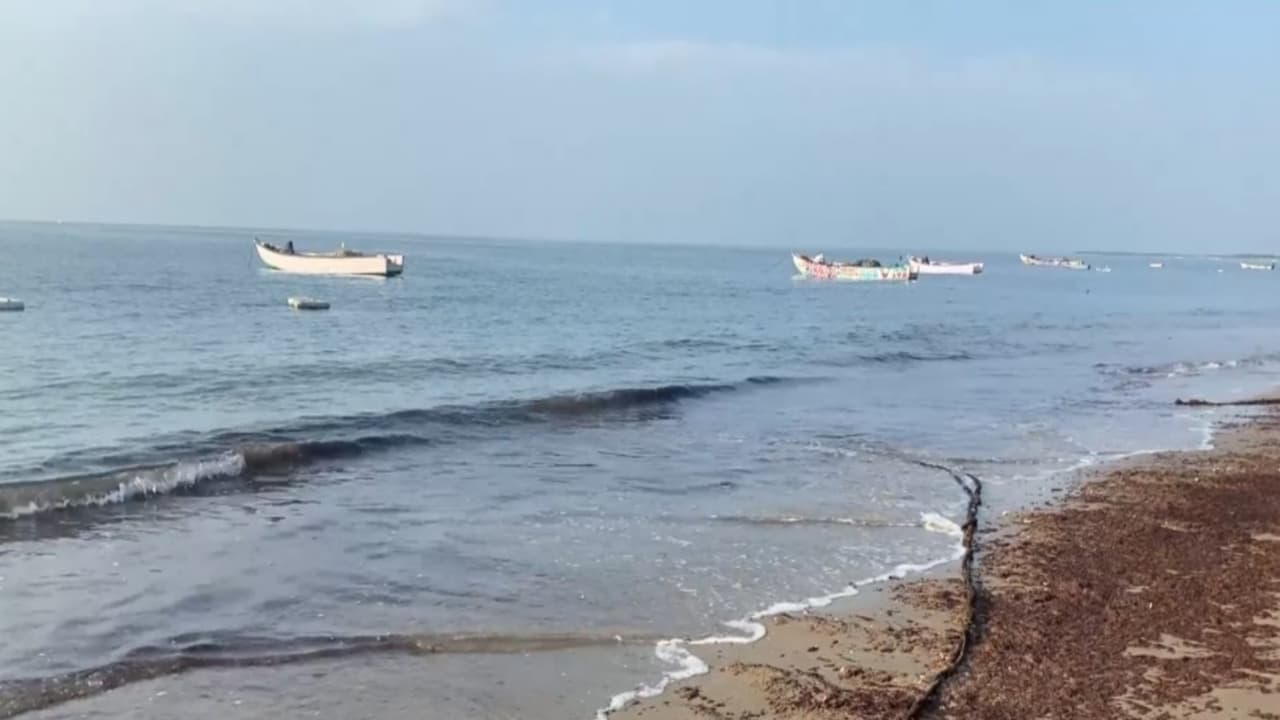
Large quantities of seaweed washed ashore along the coast of Thoothukudi on Sunday raised concerns among local fishing communities, who attribute the unusual phenomenon to climate change, rising sea temperatures, and shifting sea currents.
Sharing their traditional knowledge of seasonal sea behaviour, fishermen said the changing wave patterns and disturbances in the marine ecosystem indicate a noticeable alteration in the natural coastal environment.
"Large quantities of seaweed were washed ashore along the coastal areas of Thoothukudi. It is said that this situation has occurred due to climate change, rising sea temperatures, and changes in sea currents and wave patterns. In some places, changes have also been observed in the natural marine environment," a fisherman said "Such occurrences are common during Full Moon and New Moon periods in certain months of the year," he said.
Ancient Marine Fossils Discovered Inland
Meanwhile, in a recent development in the Thoothukudi district, marine fossils dating back thousands of years were discovered in Panaiyur, under Kulathur South Panchayat. The site, located about 25 kilometres from Thoothukudi, was first identified by an enthusiast in December 2025.
Following this discovery, a team of scientists from the Zoological Survey of India (ZSI) conducted geological and paleontological studies between January 5 and 10. During the study, a total of 104 fossil specimens were collected, primarily including marine organisms such as bivalves and gastropods.
Scientists have stated that these fossils belong to the Holocene epoch, dating back approximately 8,000 to 12,000 years. The findings suggest that the area was once submerged due to rising sea levels, which led to the formation of these fossil deposits. Notably, the fossil site is located about 5 to 7 kilometres inland from the present coastline, indicating significant changes in coastal geography over time. Experts have recommended that the government take steps to protect the site and conduct radiocarbon dating to determine the precise age of the fossils. This discovery is considered an important scientific finding that provides insight into the geological and marine history of the Thoothukudi region.
In an 'X' post on Monday, Union Environment Minister Bhupender Yadav noted that, following a request from the Thoothukudi administration, the Zoological Survey of India conducted a field survey of fossil sites exposed by heavy rainfall in 2023.
Geological Insights on Fossil Site
Antony Ravindran from the Department of Geology, VO Chidambaram College, Thoothukudi, observed that the Kulathur-Panaiyur village site contains distinct fossil forms and subsurface geological structures. He noted that the area is dominated by sedimentary formations, with layers of sandstone and lateritic red soils. He explained that much of the interior was earlier buried under sand, but heavy rainfall in 2023 exposed the underlying deposits. "At the site located near Kolathur Badayur village, we have seen differently formed fossils and different subsurface geological features. Sedimentary features occur in this place, so we generally observed that area. The interior area was totally buried due to sand. Due to heavy rain in 2023, the internally buried material came out, and we could see the differences accidentally. These features seen here include submarine canyons or water channels cutting through layers, where waves cut different sedimentary layers occurring in this particular area. Condensed sedimentary sandstones and lateritic red soils are present," he said. (ANI)
(Except for the headline, this story has not been edited by Asianet Newsable English staff and is published from a syndicated feed.)