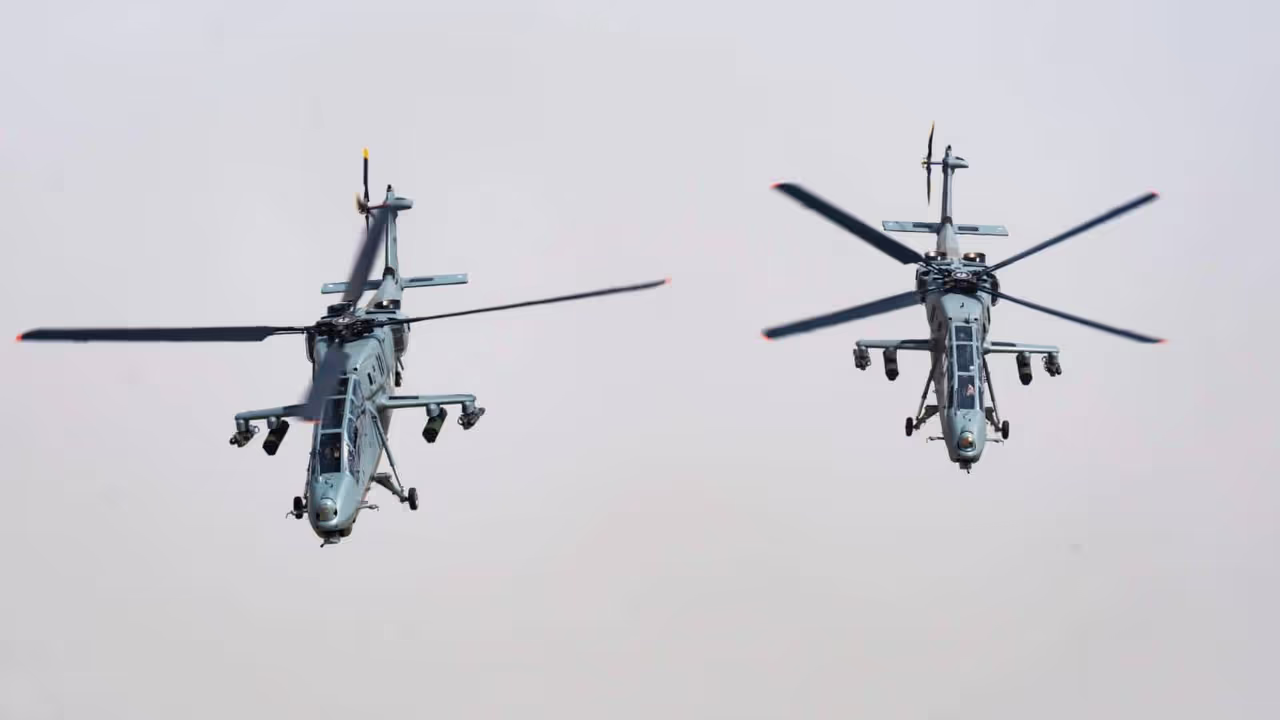
As noted in the book, The Indian Defence Budget, during the Kargil campaign, AAC conducted 2,500 missions and more than 2,700 hours of flight, successfully evacuating 900 casualties in the process.
New Delhi: A recent article published by a defence think-tank sounded alarm bells about wasteful duplication and optimisation in India’s defence establishment. While the discussion appears academic and well-researched in form, it mischaracterises Army aviation and invokes the concept of wasteful duplication to advocate consolidating India’s air assets under a single Air Service.
However, careful examination of history and doctrine will show that not only is the Indian Army’s quest for organic air power justified, but it is also necessary for military purposes.
Fallacies of Wasteful Consolidation over Necessary Optimisation
A fundamental assumption in the argument is that a consolidated air force yields better military results. The historical evidence proves this assumption wrong. During the Bangladesh Liberation War of 1971, army aviation proved crucial in providing necessary logistical support and air cover in areas where the Air Force’s tasking process could not respond.
Related Articles

Similarly, the Siachen operations since 1984 have shown that special skills in piloting helicopters and conducting ground-based operations at such high altitudes are required, which can only come from personnel trained and familiar with the Army’s operational tempo.
The same was true of the Kargil war of 1999, when the IAF provided excellent fixed-wing air cover for the army, but the latter’s helicopters belonging to the Army Aviation Corps (Cheetah and Chetak) proved essential in bringing logistics to heights as high as 5,250 meters.
As noted in the book, The Indian Defence Budget, during the Kargil campaign, AAC conducted 2,500 missions and more than 2,700 hours of flight, successfully evacuating 900 casualties in the process.
This was only possible due to the fact that the AAC helicopters were under the control of the Army Command and responded according to the requirements of the Army Command at a pace impossible otherwise.
Unsung Global Precedents of Organic Aircraft
One of the arguments used throughout the article is that even the US has a centralised Air Force and therefore the Indian Army’s demand for organic air assets is unnecessary. On the contrary, the US Army operates 4,300 rotary-wing aircraft that belong to the United States Army Aviation, making US Army Aviation the second largest air force in the world after the United States Air Force (USAF).
This arrangement is based on the reality that doctrine dictates the need for close air support, air assault and logistics in the land-war context, which requires an asset capable of responding in real time. Similarly, the UK Army has its own Apache helicopters in service with its 3rd and 4th regiments of Army Aviation Corps, again independent of the RAF.
The Land-based BrahMos Missile System: Another Example of Inter-Service Duplication?
Another case of inter-service duplication which is conveniently ignored in the above article is the induction of surface-to-surface BrahMos missiles into the IAF inventory.
In this respect, it should be recalled that the Indian Army inducted its first BrahMos regiment way back in 2007. Since then, the Army has set up multiple surface-to-surface BrahMos regiments along the border with both Pakistan and China. However, what should be pointed out in this respect is that the Indian Air Force, instead of just focusing on the BrahMos-A air-to-surface missile for the Su-30 MKI aircraft, went ahead and inducted two squadrons of the surface-to-surface BrahMos missile in 2007.
This happened because, at the time, it was considered a ‘stop-gap’ solution until the air-launched BrahMos became operational. The air-launched version of BrahMos entered service with the IAF on the Su-30 MKI aircraft in 2020.
This means that for two years, the IAF operated the BrahMos land-attack missile on the same platform that belongs to the Army. Under the same logic as that applied to Army aviation, this should be considered wasteful duplication. However, that argument never surfaces in this article.
Multi-Programme Fighter Acquisition: How Much Optimisation Can IAF Afford for the Nation?
The other aspect missing in this discussion is how much wastefulness the IAF can afford in its fighter programme acquisitions. For instance, in 2016, the Rafale deal of 36 aircraft for the IAF cost the nation ₹59,000 crore. The latest contract for purchasing 83 aircraft of Tejas Mk1A cost Rs 48,000 crore, followed by another contract for an additional 97 Tejas Mk1A aircraft in 2025, worth ₹62,370 crore.
Lastly, the Advanced Medium Combat Aircraft (AMCA) programme received cabinet clearances in March 2024, with ₹15,000 crore allocated for the Full-Scale Engineering Development (FSDE) programme.
Thus, in total, the IAF is now working with four programmes, including the Tejas Mk2, which is still under development, in addition to the FSDE and AMCA programmes. Each of these programmes will require its own procurement and support systems, training programmes, and maintenance. The above calculation makes clear how much wasteful duplication is going on. Moreover, it also shows how much fiscal wastefulness the country’s constrained budget cannot afford.
In conclusion, the fact is that the Indian Army does not require its organic aircraft for turf-protection purposes, but simply because of its operational needs. And as far as saving the exchequer money, maybe the quote “A dollar spent on duplicative capability comes at the expense of essential capacity or capability elsewhere” holds true for multifarious procurements by other services also.