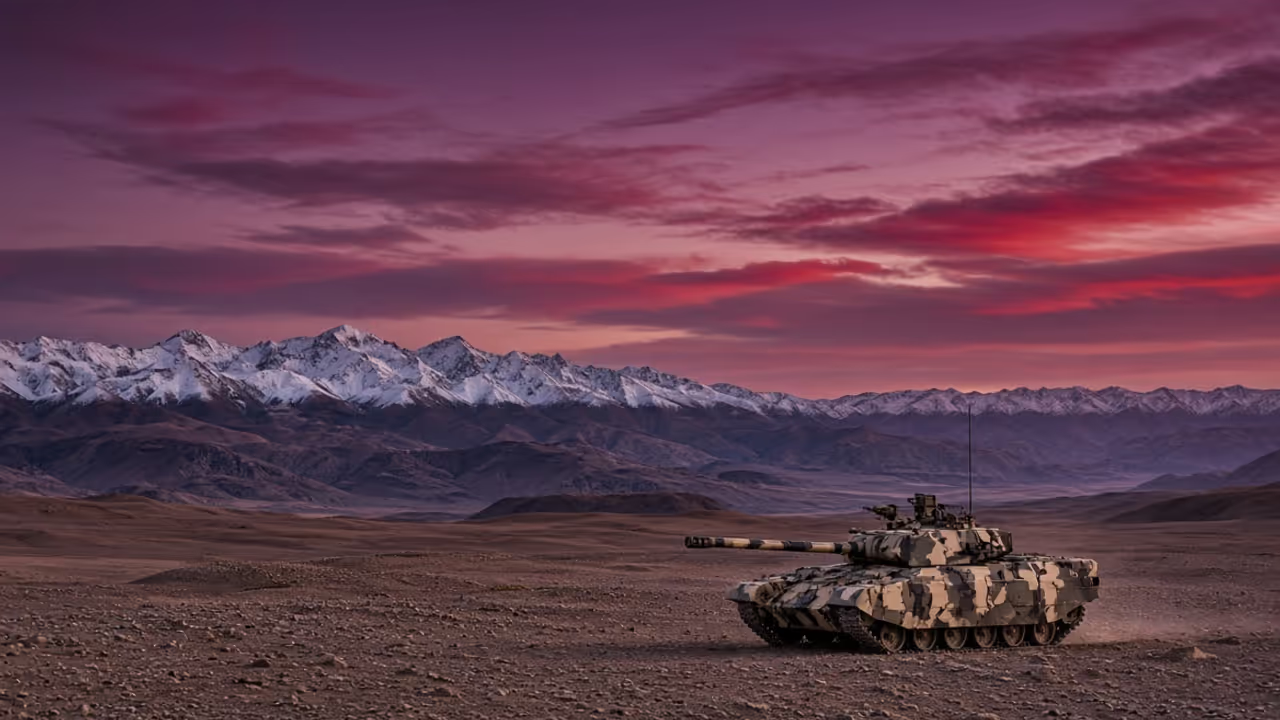
India’s Zorawar light tank, designed for high-altitude warfare, is moving towards production for deployment in Ladakh. The 25-tonne tank is designed to operate in challenging terrain and can be transported two at a time by an IAF C-17 aircraft.
At Nyoma in Ladakh, more than 4,200 metres above sea level, the air is so thin that soldiers and machines alike struggle for breath. An engine, much like a human lung, needs oxygen to do its work, and at such heights even the Army's mighty T-72 and T-90 tanks lose a part of their power. Across the Line of Actual Control, China has already deployed its Type-15 light tank, a machine made for precisely this terrain. India's answer is the Zorawar, and the country has now settled how this home-designed tank will reach the men who guard those frozen heights.
The Zorawar weighs about 25 tonnes, nearly half the weight of a T-72 or T-90. That lightness is its greatest strength. It allows the tank to climb where heavier armour gasps, and it allows a single Indian Air Force C-17 heavy transport aircraft to carry two Zorawars together.
The story of its making is one of quiet determination. The project was approved in March 2022. The design came from the Combat Vehicles Research and Development Establishment (CVRDE), a DRDO laboratory. Larsen & Toubro (L&T) served as the system integrator. Its job was to take engines, guns, armour plates and electronics from many factories and make them work as one tank. Several Micro, Small and Medium Enterprises (MSMEs) supplied important subsystems. On July 6, 2024, a little over two years after approval, the tank was formally unveiled at L&T's Hazira plant in Gujarat, a pace regarded as fast for a new armoured vehicle in India. A Defence Ministry reply in the Lok Sabha in July 2024 put the approved cost of design, development and one prototype at ₹234.5 crore. In September 2024, DRDO completed the first phase of firing trials in desert conditions, and the tank has since completed trials at Nyoma as well.
Related Articles

Here one distinction matters. The tank shown at Hazira and tested in the desert and the mountains is a prototype, a sample built to prove that the design works. The tanks the Army will actually buy are production tanks, built in numbers to a standard the Army has accepted. It was on that standard that a difficulty arose.
Defence Secretary Rajesh Kumar Singh, speaking on Sunday at a defence conclave in New Delhi, explained it candidly. A project starts with one set of needs, he said, and then more features and capabilities are asked for along the way, which can delay the tank's entry into the Army.
The solution he announced moves in two steps. The initial order of 59 tanks will begin with a first batch of about 18, the Zorawar Mk1, carrying a slightly lower level of protection. The remaining tanks of that order will be built to a higher standard. "We plan to first build the Zorawar Mark 1, which will have a certain level of capability," he said.
He described the arrangement as a middle path between the Defence Ministry and the Army. "We tried to find a solution acceptable to both sides," he said, adding that his present role gives him the opportunity to help settle such differences. The Army, in his words, has mostly agreed, and the ministry hopes to move ahead on these lines.
There is a human reason behind the early batch too. Teams who have given years to a machine need to see it being built. The Defence Secretary said the Mk1 order is meant to keep L&T motivated and engaged, and the company is expected to receive the order for about 18 tanks soon.
The better-protected version, the Zorawar Mk2, is where the Army's added demands come in. According to reports, its front is expected to carry STANAG Level 6 armour, with Level 5B on the sides. STANAG is a scale that grades how much punishment armour can withstand. The higher the level, the tougher the shield, so the front would be very strongly protected and the sides only a little less. In practical terms, the armour is expected to stop 25 mm and 30 mm APFSDS rounds fired from about 500 metres. An APFSDS round is a powerful armour-piercing shot designed to punch through a tank's skin.
Two more guardians are expected on board. An Active Protection System (APS) works like an alert goalkeeper, detecting incoming threats and stopping them before they strike. Built-in C-UAS jammers disrupt and disable enemy drones.
Safety, however, has a price in weight. Reports suggest these additions could add about 5 to 7 tonnes, taking the Zorawar to around 30 to 32 tonnes. DRDO had foreseen this. According to earlier reports, the tank was designed from the outset to handle up to 35 tonnes after future upgrades, with room for extra armour built into the original thinking.
A heavier body needs a stronger heart. The present prototypes run on a Cummins VTA903E-T760 diesel engine producing 760 horsepower, and the Mk1 tanks are expected to use the same engine. For the heavier version, reports say Cummins has offered its 1,000-horsepower Advanced Combat Engine along with transfer of technology, which would allow it to be made in India. DRDO has already developed an 800-horsepower engine for the programme and is reported to be working on a 1,000-horsepower engine of its own, possibly a more powerful version of the 800 hp design. Talks are also under way with Indian companies for a new engine. The final choice for the Mk2 has not yet been announced.
Indian industry already powers the Army's armour in other ways. This month, the Defence Ministry signed a ₹586 crore contract with Accurate Industrial Controls for Auxiliary Power Units (APUs) for T-72 and T-90 tanks. An APU is a small extra engine that supplies electricity to the tank's equipment when the main engine is switched off, saving fuel and sparing the main engine from wear.
The 59 tanks assigned to DRDO and L&T are best seen as a starter order. The Army needs around 354 light tanks in all, so this first lot is less than one-fifth of the requirement, and the contest to build the larger fleet is a separate one that is still running. In that programme, reportedly worth around ₹20,000 crore, Tata Advanced Systems is reported to have offered the lowest bid and must build and deliver two prototype tanks within 130 weeks. The selection took three years and was delayed further when another bidder raised objections, which were later found invalid. Mahindra Defence, the second-lowest bidder, will also build a prototype.
For the soldier standing watch in Ladakh's biting wind, these numbers mean one simple thing: a tank made in his own country, shaped for his own mountains, is finally on its way.
(Girish Linganna is an award-winning science communicator and a Defence, Aerospace & Geopolitical Analyst. He is the Managing Director of ADD Engineering Components India Pvt. Ltd., a subsidiary of ADD Engineering GmbH, Germany.)