Whether that machine arrives as the nimble mountain fighter it was meant to be, or as something heavier and slower, is a question the Indian Army is wrestling with right now.
Somewhere in Ladakh, a young tank crew will one day climb into a machine named after a nineteenth-century general who took armies across the Himalayas. Whether that machine arrives as the nimble mountain fighter it was meant to be, or as something heavier and slower, is a question the Indian Army is wrestling with right now.
Start with the paperwork, because that is where the newest trouble lies. In December 2022, the Defence Acquisition Council cleared an Acceptance of Necessity for 354 light tanks, part of a larger basket of proposals worth Rs 84,328 crore. The first 59 would come from the DRDO–Larsen & Toubro partnership that built the prototype; the rest would be thrown open to competition. That competition, worth roughly Rs 20,000 crore, has now produced a lowest bidder in Tata Advanced Systems, with Mahindra Defence Systems, the second-lowest, also permitted to build. Each has 130 weeks to deliver two prototypes.
Here is the worry. A tank is not a drawing; it is a body of hard-won lessons. The first firing trial reveals what bends. The first winter at altitude reveals what freezes. The first production run reveals which bolt nobody can source. L&T and DRDO are collecting those lessons today. If the bulk of the fleet then comes from a different company on a different development track, India may pay for the same education twice. Competition in manufacturing is healthy. Competition in fundamental design, after an indigenous platform has already been built and tested, is a costlier proposition.
Related Articles

Now rewind to why any of this exists. In 2020, when Chinese forces pushed into eastern Ladakh, India rushed its T-72 and T-90 tanks up into the mountains. These are fine weapons, but they weigh 40 to 50 tonnes, and the Himalayas are unforgiving to weight. Bridges have limits. Roads are few. Thin air starves engines. Across the line, the People's Liberation Army had brought the Type 15, a tank built for exactly that terrain. India had wanted a light tank since the mid-1980s and had quietly abandoned the idea by the mid-1990s. Galwan reopened the file overnight.
Russia offered a quick fix. In June 2021, this writer reported that Moscow had proposed the Sprut-SDM-1 following Defence Minister Rajnath Singh's 2020 visit. On paper it was startling: 18 tonnes, amphibious, airliftable, yet carrying the same 125 mm gun as the T-90 and firing the same family of ammunition. The Russians achieved this by a simple trade: enormous firepower, minimal armour.
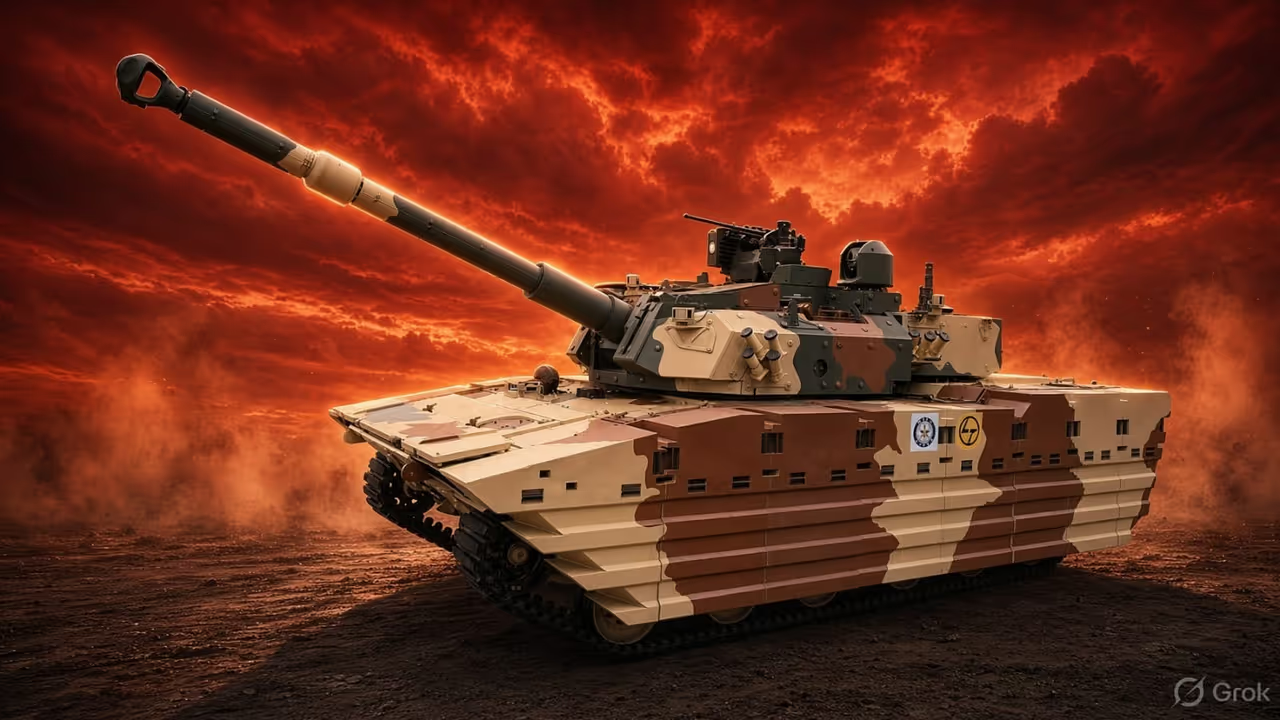
India chose to build instead. DRDO and L&T turned a concept into a rolling prototype in about two years, a speed that surprised even the army. The result, Zorawar, weighs 25 tonnes, mounts a 105 mm gun, swims, fits inside a transport aircraft, and carries a high power-to-weight ratio, meaning plenty of engine muscle for every tonne it hauls, the difference between a scooter and a motorcycle on a steep climb.
The army's 2021 Request for Information was anything but modest. Inside a 25-tonne limit it wanted protection on every face of the vehicle, including the roof and the floor. It asked for explosive reactive armour — bricks that blast outward to break an incoming warhead — and for both kinds of missile defence: soft-kill systems that confuse a missile's guidance, and hard-kill systems that shoot it down. It also wanted cover against weapons that dive from above, a sealed cabin against chemical, biological, radiological and nuclear threats, fire detection and suppression, all-round cameras, electronic warfare, and the ability to fight drones. That is a tall order for a machine that still has to climb, swim and fly in pieces inside a transport aircraft.
On armour, the army eventually settled on STANAG Level 3, a NATO yardstick for how much punishment a vehicle can absorb. The present Zorawar actually offers Level 4 over its protected frontal areas, enough to shrug off heavy machine-gun fire and shell splinters. It cannot stop a main battle tank's round or a modern anti-tank missile, but it was never meant to. A light tank survives by being hard to find, hard to hit, and quick to leave.
Yet the army now wants more armour, and that demand could push induction back by up to two years. Every extra plate is paid for in fuel, ammunition, or speed. Push Zorawar to 30 tonnes and it drifts towards the Type 15, which weighs 33 tonnes, 36 with added armour, carries a comparable gun, cannot swim, and has served China since 2018 in the hundreds. India would then own neither the Sprut's featherweight punch nor an MBT's shield, only an awkward middle.
No one should fault commanders for wanting their soldiers home. But the mountains taught a lesson in 2020: weight is a liability. Protecting the concept matters as much as protecting the tank, and that line deserves careful watching.