
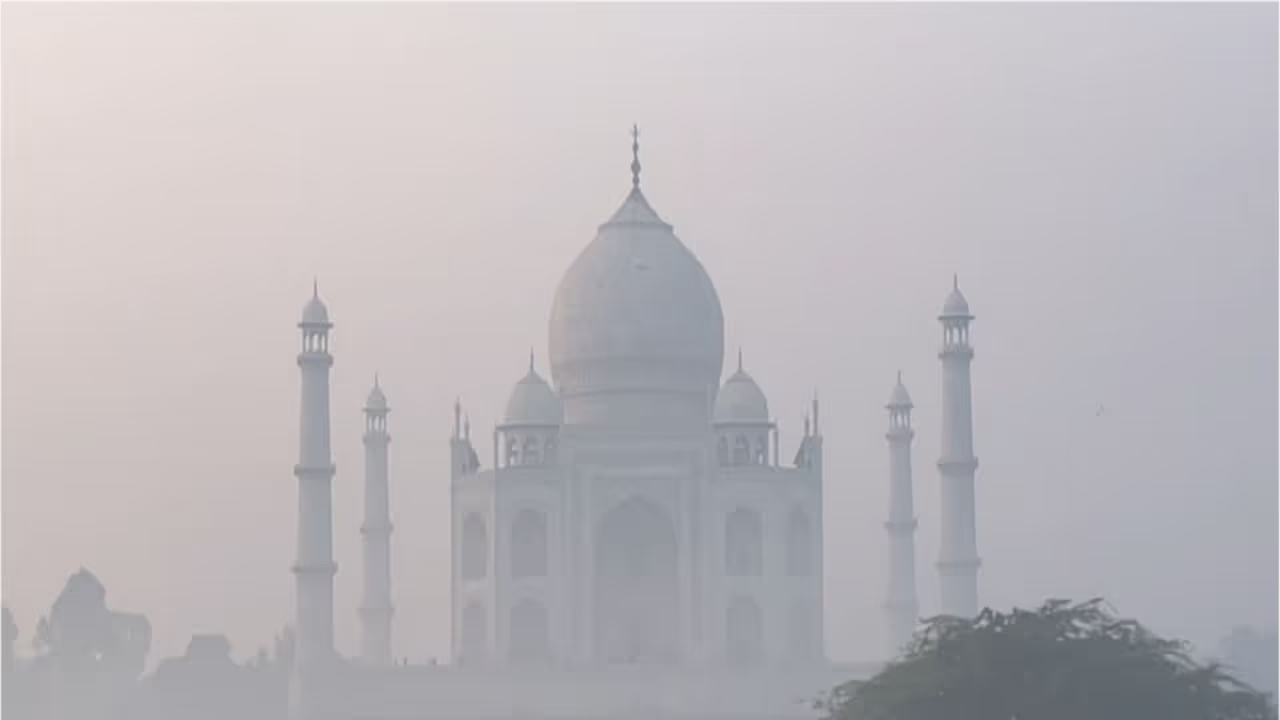
Despite Agra recording a moderate air quality index, persistent smog is dulling the panoramic view of the Taj Mahal, as seasonal weather conditions and urban dust continue to create a haze around the historic UNESCO World Heritage Site.
Smog Obscures Taj Mahal Views
Even as the Taj Mahal continues to captivate global tourists with its timeless architecture, ambient smog has begun dulling its famed panoramic view despite of Agra recording an overall Air Quality Index (AQI) of 189, categorised as ‘Moderate’ by the Central Pollution Control Board (CPCB) on Monday. Visitors to the UNESCO World Heritage Site observed a distinct haze around the monument, with its silhouette appearing less clear from distant vantage points along the Charbagh gardens and the Yamuna riverfront. Tourists said the monument continued to look beautiful up close, but the haze affected its visibility from a distance. “The Taj Mahal is undeniably beautiful, but the smog makes it noticeably less visible and sharp than you expect,” a visitor remarked.
Pollution Control Measures in Agra
Agra has undertaken several measures over the years to protect the 17th-century monument from pollution, including the creation of a special green zone around the site that restricts heavy vehicles and the use of polluting fuels. However, calm weather conditions and everyday urban dust continue to trap fine particles close to the ground, affecting visibility.
The Taj Trapezium Zone
Several initiatives have been introduced by the government and the Supreme Court to protect the air quality around the monument and preserve its ivory-white marble. Under the Taj Trapezium Zone (TTZ), a protected area covering 10,400 square kilometres was established around the monument following Supreme Court rulings on December 30, 1996. Coal- and coke-burning industries within the zone were required to shut down or switch to cleaner fuels such as natural gas (PNG) to reduce industrial emissions.
Preservation and Dust Management
A zero-emission perimeter has also been implemented within a 500-metre radius of the monument, where fuel-powered vehicles are banned. Visitors travel the final stretch using electric golf carts, battery-operated buses and traditional horse-drawn tongas. The Archaeological Survey of India (ASI) also undertakes periodic cleaning of the marble using Multani Mitti, or Fuller’s earth. The clay paste is applied to draw out accumulated dirt and pollutants from the marble surface before being washed off with distilled water. To control dust, municipal authorities deploy mechanical road sweepers and anti-smog water guns along major tourist routes on days when fine dust levels rise. Tree plantations along riverbanks and highways also serve as natural barriers against dust from surrounding urban areas.
Despite these measures, seasonal weather conditions continue to contribute to haze across the region. During cooler months, slow winds and falling temperatures trap everyday urban emissions and regional dust across the Indo-Gangetic plains, creating persistent haze. (ANI)
(Except for the headline, this story has not been edited by Asianetnews Editorial staff and is published from a syndicated feed.)










