
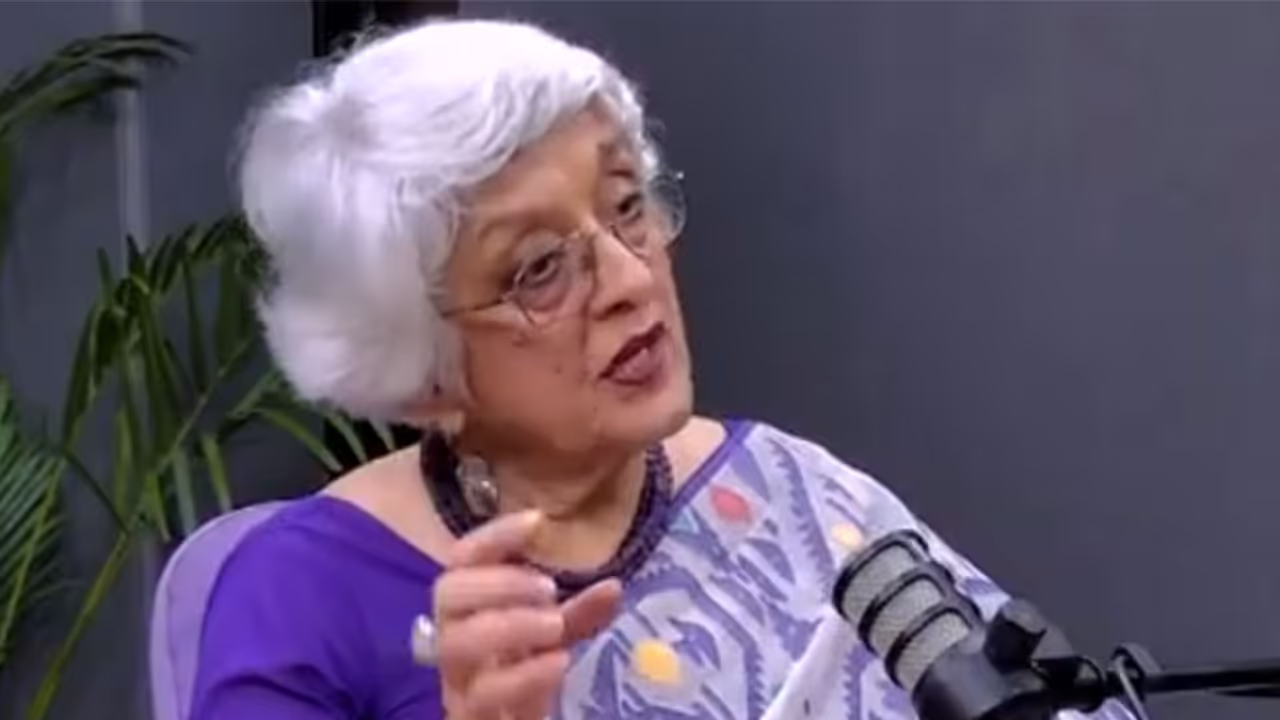
Former diplomat Veena Sikri says India is holding up SAARC on the "principled issue of terrorism," not just for Pakistan. She stressed the regional bloc cannot progress until terrorism is addressed in a clear and structured manner.
Terrorism the 'Principled Issue' for SAARC Stalemate
Former Indian diplomat Veena Sikri on Sunday said that India is not holding up the South Asian Association for Regional Cooperation (SAARC) for the sake of Pakistan, but on the "principled issue of terrorism," stressing that the regional grouping cannot move forward unless the issue is addressed in a clear and structured manner.
In an interview with ANI on the broader challenges facing regional cooperation in South Asia, Sikri said, "It is not just the terrorists. If the money is the weaponry, let's get all those lines clear as to who is doing what and then we'll be able to get the narrative clear on that and say that we are not holding up SAARC just for its sake about Pakistan. No, we are holding up SAARC on the principled issue of terrorism and we would like this issue to be solved. Give that importance."
Call for Broader Regional Engagement
She emphasised that resolving the issue of terrorism needed to be supplemented by broader regional engagement. "This needs to be supplemented by other efforts also. Such as today, there is a change in Bangladesh, in Nepal, etc. And the new generation is looking for mundane things. Technology cooperation, scholarships, markets, you know, people-to-people contact, issues of climate change, etc. Where India has huge, huge potential and our capabilities," she said.
Sikri further noted that India could expand cooperation in multiple domains while maintaining its core position. "Today, you know, we can mitigate these issues of SAARC and the Indus Water Treaty, et cetera, by first sticking to our positions, very, very important, as she said, but also offering something much more than they had earlier. And this will bring it together," she added.
'SAARC Hasn't Worked': A Call for Recalibration
Commenting on the future of the regional bloc, she was candid about its past performance. "So I think SAARC was one thing which was invented in the 1980s and it hasn't worked. It hasn't worked, it hasn't worked," Sikri said, while suggesting a recalibration of regional priorities.
She also pointed to India-Bangladesh relations under previous leaderships, stating, "Let me give you one example of how SAARC. Let's take just within SAARC, India and Bangladesh. Now, under the 15 years when Sheikh Hasina was Prime Minister, all she did was she said, I will respect India's security red lines."
Pragmatic Diplomacy Needed
Calling for a pragmatic approach to regional diplomacy, she said India should not be trapped in adversarial narratives. "Let's talk about SAARC. Let's be realistic and say that this India-Pakistan rivalry that is going on in SAARC, put that aside. Put your domestic fight with Pakistan aside. Give Pakistan the respect, which is that now the rest of the world sees Pakistan as an important power," she said.
At the same time, Sikri underlined that India's engagement with the world remains active and multidirectional. "All the players, President Trump, and the Prime Minister had a 40-minute discussion. The second time it was. He's spoken to Masood Peshishkian of Iran. He's spoken to Saudi Arabia, spoken to the UAE. So we have kept our doors open with everybody and they know that we are ready at any time," she said.
Reiterating Stance on Terrorism
Reiterating India's position on terrorism, she added, "Whatever has happened with Pakistan, it does not take away their use of terrorism as an instrument of a straight path. So, I think that there can be no talks with terrorism. If they're willing to abrogate their stand on terrorism, fine. I think that'll be a great progress."
She further said external mediation or pressure could help shift Pakistan's stance. "If America can get them, force them into that or somebody can, that's fine. Then we really can get it going," Sikri noted.
However, she also acknowledged the pattern of instability affecting regional dialogue. "But we know that every time you have a SAARC meeting, before or after, there'll be a terrorist deal," she said.
Established in 1985, SAARC comprises Afghanistan, Bangladesh, Bhutan, India, Maldives, Nepal, Pakistan and Sri Lanka. Its secretariat is based in Kathmandu, Nepal, and it aims to promote economic cooperation, regional integration and development across South Asia. (ANI)
(Except for the headline, this story has not been edited by Asianet Newsable English staff and is published from a syndicated feed.)