
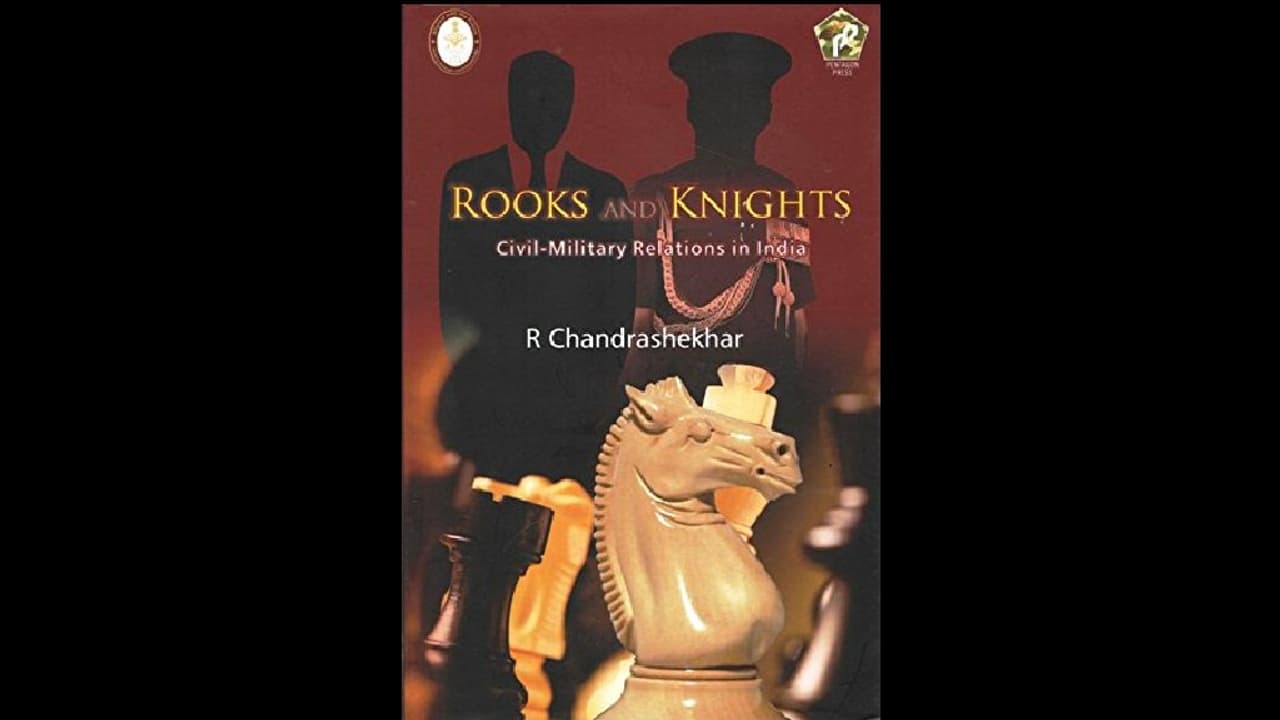
Rooks and Knights: Civil-Military Relations in India, Author R. Chandrashekhar provides a thoughtful and deeply researched study on relationship between democratic government, civil bureaucracy and armed forces in Indian context.
Reviewed by Manish Jaiswal, Research Assistant, Centre for Joint Warfare Studies (CENJOWS): In Rooks and Knights: Civil-Military Relations in India, Author R. Chandrashekhar provides a thoughtful and deeply researched study on relationship between democratic government, civil bureaucracy and armed forces in Indian context. Drawing from established theories on Civil-Military relationship such as Samuel Huntington’s model of ‘Objective Civilian Control’ and Rebecca Schiff’s ‘Concept of Concordance’, he offers an Indian perspective that is both unique and insightful. He argues that civil-military relations in Indian context cannot be fully understood using Western frameworks alone. Instead, the Indian experience is rooted in its own historical background, political culture, and strategic needs. The book explores how India has developed a model that lay emphasis on civilian control of the military, while preserving the military’s professional character within a democratic system.
The author begins by proving a historical perspective on how India’s civil-military relationship shaped during the times of Mauryans, Mughals, East-India Company and over the years following independence. He highlights the influence of Lord Ismay, a senior British officer and advisor to India's first Prime Minister, Jawaharlal Nehru. Lord Ismay’s proposals in 1947 laid the groundwork for civilian control by recommending formation of the Defence Committee of the Cabinet and integrating military planning with civilian decision-making. These early efforts were meant to ensure that the military remains under firm civilian oversight, a principle that is central to Indian democracy. The author also explores how key figures in the early years of India’s independence such as Prime Minister Nehru and successive defence ministers played significant roles in shaping the country’s military structure and governance.
The author also makes an attempt to explain the personal dynamics between political leaders and military officers. He shares detailed stories of how individualistic opinions influenced policy decisions and their subsequent consequences, especially during periods of strategic crisis. He shows that unlike in some other countries, India’s military has always remained subordinate to government, work within the democratic framework and respects civilian authority. India’s strong institutions, legal framework, and political culture have ensured that military stays apolitical.
The book also pays attention to various reform committees established over the years and there recommendation efforts over the years. The author evaluates the work of several key committees, including the ‘Kargil Review Committee’ in the year 1999 and the ‘Group of Ministers Report’ in the year 2000. These committees recommended a number of changes to improve coordination, strategic planning, and procurement process. One of the most notable outcomes was the eventual creation of the post of Chief of Defence Staff (CDS), which brought greater synergy among the three services and succeeded in providing a Single Point advice on military matters to the government. He views this as a positive step towards transition of the three services into a singular flexible ‘Joint’ entity with requisite strategic flexibility and tactical agility, but the role must be assigned with commensurate powers for it to be truly effective.
Towards the end of the book, he offers empirical suggestions for enhanced and productive civil-military relations. He recommends that military commanders should be given more responsibility in planning and force development. He also calls for better coordination and integration between the armed forces and the Ministry of Defence (MoD), including joint training and the use of common planning tools. Defence procurement procedures, he suggests, should be streamlined to reduce delays and provide requisite impetus to more domestic production. He envisages a modern Indian defence system that amalgamates civilian policymakers and military professionals and engenders team spirit mutually respecting the other’s assigned role and acquired expertise.
In conclusion, the book Rooks and Knights contributes significantly to the repertoire of India’s national security and governance issues. The author combines theoretical knowledge with practical insight to present a balanced and in-depth view of how India’s civilian and military institutions interact. His writing is clear, well-organized, and rich in historical details, making it a valuable book for both scholars and general readers. At a time when global strategic competition is on a rise and India’s military responsibilities are expanding, the insights in this book are more relevant than ever. By engendering trust, professionalism, and effective coordination, both civilians and the armed forces will make India stronger and secure. While this book was first published in 2017 and since then a numbers of reforms and measures have taken place, the book still remains relevant and contemporary for policymakers, defence analysts, students of political science, and anyone willing to gain an insight on how in a democratic country, the delicate balance of respective power and authority between political authority and military power is managed.
Rooks and Knights: Civil-Military Relations in India has been published by CENJOWS through Pentagon Press. It is considered a must read for all.
Disclaimer: The opinions expressed are solely those of the author and do not reflect the views or stance of the organization. The organization assumes no responsibility for the content shared.
