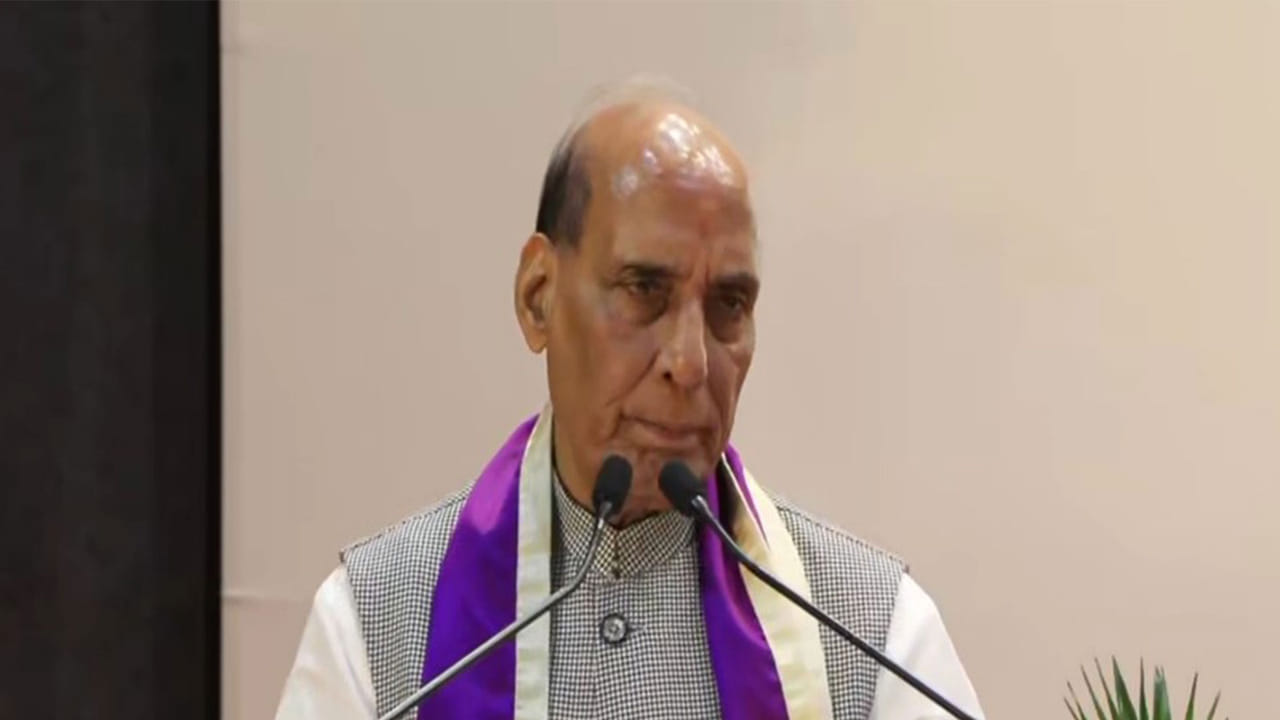
Defence Minister Rajnath Singh underscores that integrating military power with scientific advancements is crucial for securing India's sovereignty and achieving technological self-reliance in the evolving global landscape.
Pune (Maharashtra) [India], November 29 (ANI): Defence Minister Rajnath Singh on Sunday said coordination between India's military strength and scientific and technological capabilities was essential to making the country powerful, asserting that nations ahead in emerging technologies were also better placed to protect their security, sovereignty and independence. Addressing the convocation ceremony of the Defence Institute of Advanced Technology (DIAT), Singh said the institution was at the confluence of two important powers of the country — its external power, represented by the armed forces, and its internal power, represented by science and technology. He said the armed forces protected India's borders, sovereignty and territorial integrity, while scientific and technological capabilities strengthened the country from within and supported economic growth, industrial development and self-reliance.
"One power is our external power. Or, we can call it military power. And the second power is our internal power, which we can call scientific and technological power. The coordination between these two powers is what can truly make a nation powerful and empower it," Singh said. Highlighting the growing link between technology and national security, the Defence Minister said countries that were ahead in emerging technologies were also ahead in securing themselves. "In today's world, those who are ahead in emerging technology are also ahead in security," he said, adding that such countries were better able to protect their freedom, independence, sovereignty and development.
Explaining the role of the armed forces, Singh said the Army, Air Force and Navy were responsible for protecting the country's borders and ensuring that India remained strong against external challenges. "Our army, air force, and navy—this is the power that protects the country's borders. It also protects our sovereignty and integrity, and ensures that India will stand strong against any external challenge under any circumstances, and India will never bow its head," he said. He stressed that national security was the foremost requirement for any country, as development efforts could not succeed without a secure environment.
Turning to the country's scientific and technological strength, Singh said it helped drive the economy, provide new direction to industries, improve living standards and enable India to compete globally. He said defence capabilities could no longer be assessed only through the number of soldiers or the strength of weapons and equipment, as technological capabilities and research had become equally important. "How many modern weapons we have is important. But how much advanced technology has been used behind those weapons. How strong our research is. And I also believe that how ready we are for future challenges is equally important," he said.
Singh also underlined the wider significance of defence research, saying innovations developed for the armed forces could find applications in civilian sectors such as healthcare, agriculture, communication and transportation. "The defence technology being developed here is directly related to our national security. But the importance of this technology is not limited to the defence sector alone. It is also used in civilian applications," he said. He added that research conducted in laboratories could benefit different sections of society, including farmers, doctors and soldiers. "A small piece of research happening in our laboratories can become useful for a farmer in the country tomorrow. It can become a new facility for a doctor. And for a soldier, it can prove to be life-saving technology," Singh said.
Referring to the changing nature of technological development, the Defence Minister said innovations were no longer limited to improving existing systems but were increasingly transforming entire sectors. Citing Artificial Intelligence as an example, he said it was bringing changes in research, manufacturing, healthcare, communication and decision-making. He said disruptive technologies created new opportunities and capabilities but also brought challenges and risks. He emphasised that the challenge before the country was not only to develop new technologies but also to understand, adopt and use them quickly in the national interest.
Singh identified Artificial Intelligence, Machine Learning, Quantum Computing, Autonomous Systems, Advanced Materials, Cybersecurity, Space-Based Capabilities and Directed Energy Technology as areas bringing new opportunities and challenges for the defence sector. He said AI and Machine Learning had added a new dimension to information analysis, surveillance and decision-making on the battlefield, while autonomous systems were increasingly performing tasks that earlier required human intervention. "The role of technological superiority in future battlefields will become even more important," he said.
Calling upon DIAT to take a leadership role in technological disruptions, Singh said the institution should aim to produce research that addresses major national security challenges and meets the requirements of the armed forces. "I believe that the time has now come when DIAT should emerge not just as a participant but in the role of a leader in these technological disruptions," he said. Addressing students, researchers, faculty members and armed forces personnel present at the convocation, Singh urged them to consider the institution's future role in a rapidly changing technological landscape. He said DIAT's identity should not be determined merely by the number of students, research papers or courses, but by the impact of its research. "DIAT's identity should be defined by the fact that the research emerging from here solves a major security challenge for the country," he said. He further said the technology developed at the institution should fulfil important requirements of the armed forces and its researchers should make discoveries that demonstrate India's scientific capabilities to the world. Emphasising that an institution's stature was measured by its ideas and achievements rather than its infrastructure, Singh said the real success of a research institution depended on the impact of its work. "The real success of a research institution is not determined by the number of its publications, but by the real impact of its research," he said.