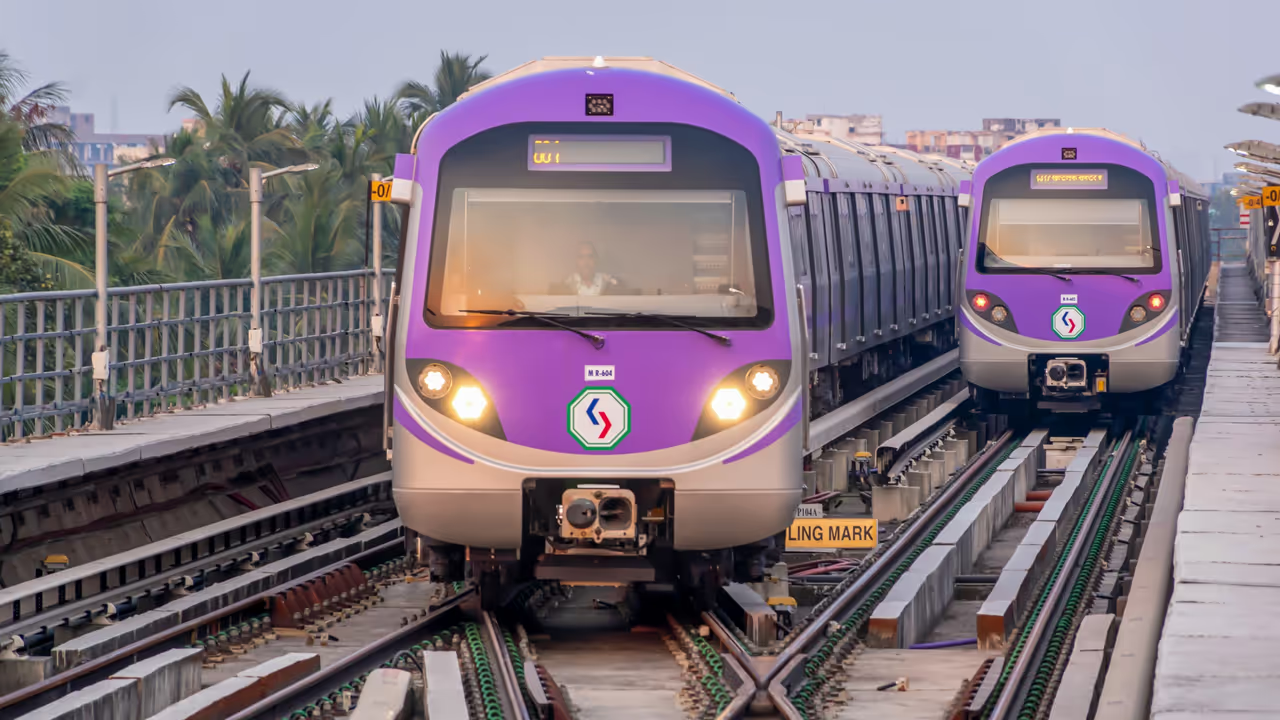
Good news for Kolkata commuters! The city's East-West Metro (Green Line) is one step closer to getting driverless trains. The Commissioner of Railway Safety has given the green signal after successful safety checks. This means a fully automated metro service could soon be a reality for us.
Kolkata Metro's East-West corridor, also known as the Green Line, is all set to introduce driverless train services. The path is now clear after the Commissioner of Railway Safety (CRS) gave the go-ahead following a series of successful trials and safety inspections. This has raised hopes for a fully automated metro service for Kolkata's passengers. While Metro Railway authorities haven't made a formal announcement yet, sources say the approval is in.
The driverless service is expected to start on the Howrah Maidan to Salt Lake Sector 5 route. Just last Sunday, a successful test run and safety check was completed on this entire stretch. According to metro sources, the whole route is built on the advanced 'Communication-Based Train Control' (CBTC) signalling technology.
For context, India's first fully driverless metro was inaugurated by Prime Minister Narendra Modi. This service was first launched on the Delhi Metro's Magenta Line (Janakpuri West to Botanical Garden), with plans to later introduce it on the Pink Line as well. In these trains, there is no separate loco pilot. The train's movements are managed by an Automatic Train Operation (ATO) system and an Operation Control Centre (OCC). Everything from controlling the speed, stopping at specific points in the station, opening and closing doors, and starting on time is handled by a computer-controlled system. If any unusual situation arises, the control room can intervene immediately.
Related Articles

So, how does a driverless metro even run?
1. Communication-Based Train Control (CBTC)
Think of this as the "brain" of the entire system. CBTC technology uses non-stop radio signals between the trackside equipment and the train to determine each metro's exact location and speed at all times. This ensures a safe distance is always maintained between trains, making the service much more precise.
2. Operations Control Centre (OCC)
The OCC is the central command hub for the entire metro network. From here, operators keep a constant watch on the whole system. The OCC sends the necessary commands to control train routes, speeds, and the gap between trains, ensuring every train reaches its destination on schedule.
3. Automatic Train Operation (ATO)
This is an automated computer system inside the train itself. The ATO receives information from the OCC and operates the train completely on its own. It handles tasks like smooth starts, controlling speed on curves and slopes, and stopping the train with extreme precision at the station platform.
But is it safe?
Driverless metros have multiple layers of safety. The train's position, speed, and the distance to the train ahead are monitored 24/7. If the safe distance is not maintained for any reason, the train automatically slows down or even stops if needed. Since the possibility of human error is reduced, this technology is considered even safer.
What happens in an emergency?
The trains are equipped with emergency communication systems, CCTV cameras, and facilities for passengers to speak directly with the Operation Control Centre. If there's a problem, passengers can contact the OCC, and technical staff can be sent to the spot quickly to handle the situation.
Advantages of a driverless metro
Faster speeds, less travel time
According to the Delhi Metro Rail Corporation (DMRC), driverless metros can run at a fixed and consistent speed. Their maximum speed is 95 km/h, and they will operate at around 85 km/h in regular service. They also consume comparatively less electricity.
More frequent trains
Thanks to the new signalling system, the distance between two metros can be reduced. This will also cut down the waiting time for passengers. Where you had to wait for about 2 minutes before, the next train could now arrive in just 90 to 100 seconds.
Fewer chances of error
This metro is operated completely automatically, which significantly reduces the chances of driver error. However, an attendant will still be present on the train for emergencies.
Even stronger safety
Starting, stopping, and opening/closing doors—everything is controlled automatically. If needed, the entire system can be operated remotely. The train is also capable of applying its own brakes if it detects any obstacle or object on the track up to 50 meters ahead.
Platform Screen Doors
Stations where driverless metros operate are fitted with Platform Screen Doors. These doors open only after the train has come to a complete stop at the platform, ensuring greater passenger safety.