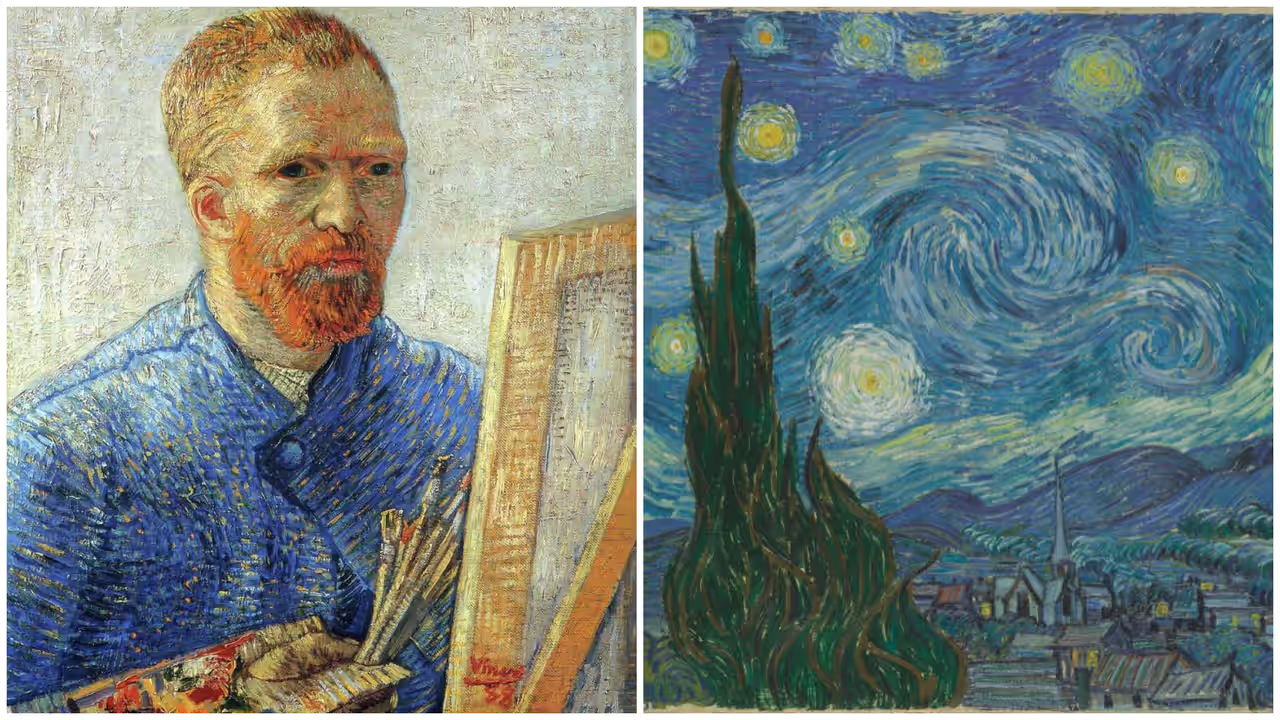
Painted on a summer night of 1889 by Vincent van Gogh, The Starry Night is one of the most recognised paintings, depicting the dreamy star-filled night sky that appeared before van Gogh from the window of his asylum in Saint-Rémy-de-Provence.
Vincent van Gogh - The master behind the immortal Starry Night, today stands as a global icon—his work revered, studied, and celebrated across continents. Yet, what remains heartbreakingly poetic is the truth that the artist himself never witnessed the fame that now engulfs his legacy. Throughout his tumultuous life, van Gogh battled crippling mental illnesses, suffocating poverty, and deep emotional turmoil.
Still, amid the storms that ravaged his existence, he birthed masterpieces that continue to electrify and mesmerise the world. From museums preserving his canvases to modern galleries reinterpreting his artistry through contemporary mediums, van Gogh has ascended to legendary stature.
The Starry Night
Starry Night remains one of van Gogh’s most celebrated creations—an artwork that has transcended time and geography. Its swirling celestial dance, a radiant moon, a solitary cypress piercing the sky, and stars with an almost supernatural glow—all come alive through van Gogh’s signature style marked by thick, impassioned brushstrokes. The painting seems to move, breathe, and shimmer with palpable energy.
Related Articles

A Symphony of Colours
The painting’s dramatic palette is one of its most arresting aspects—a breathtaking interplay of bold and subtle hues that instantly captivates any viewer. Blues, yellows, greens, and earthy browns converge to create a visual crescendo. The deep blues soothe, the dual-toned yellows swirl with kinetic motion, and the greens and browns ground the scene, embodying the essence of Earth.
How cow urine from ,India, found itself in van Gogh’s paintings
But nestled between van Gogh’s Dutch identity and his world-famous masterpiece lies a lesser-known, astonishing connection—one that leads straight to India.
No, the view isn’t Indian—it was painted from the window of his asylum. No, he never visited India, nor did he write of any Indian muse or confidant. So where does this connection come from?
The answer lies in a pigment—an extraordinary hue called Indian Yellow, the very pigment that illuminates the moon in Starry Night. This rare colour, renowned for its radiant, glowing warmth, bestowed the moon its golden luminosity. That dual-toned, shimmering moon owes its brilliance to a pigment sourced from India.
A study titled ‘An Investigation of Multispectral Imaging for the Mapping of Pigments in Paintings’ states: “Prussian blue was incorporated to account for the difference between modern and van Gogh’s blue paints. Four yellow pigments were selected based on spectral curve shape analysis, cadmium lemon yellow, zinc yellow, Indian yellow and earth yellow.”
The researchers further wrote: “The moon and stars were most likely created with Indian yellow and zinc yellow. Cadmium lemon yellow might be used to paint the yellow clouds surrounding the moon and the stars. The cypress tree might be painted with burnt sienna and Prussian blue.”
Historically, Indian Yellow is believed to have originated from Munger, Bihar, and was accessible only to a privileged few. Fascinatingly, the pigment was derived from the urine of cows fed primarily on mango leaves mixed with turmeric. The urine was collected, dried into solid nuggets, and finally ground into pigment powder.
Though this colour is no longer available, even in earlier centuries it was produced sparingly—its production halted after concerns arose about the health and ethical treatment of the cows, eventually leading to a ban.
(This article has been curated with the help of AI)