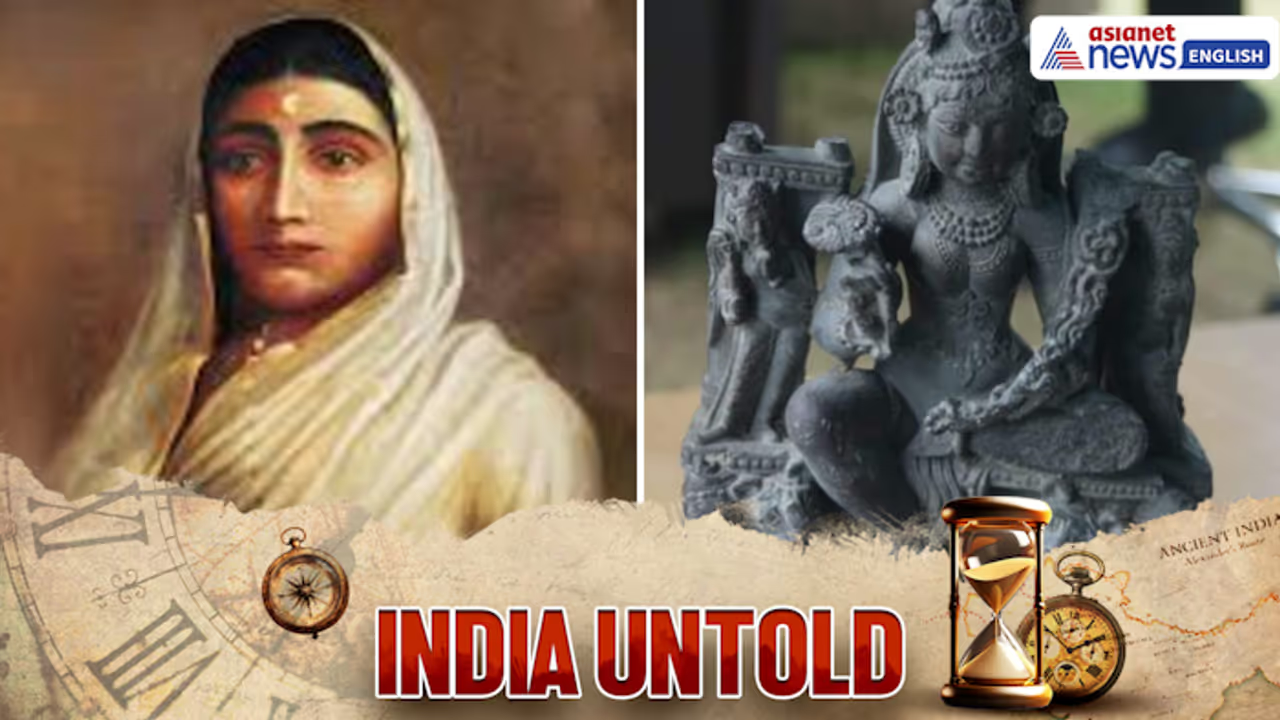
The tale of Patharkatti’s artistic genesis traces back to the revered Maharani Ahilyabai Holkar, who in the 18th century sought master craftsmen to build the Vishnupada Temple — a magnificent structure perched on the banks of the Phalgu River.
Tucked away in Bihar’s Gaya district, the quaint village of Patharkatti stands as a living museum of stone artistry — where black granite transforms into divine sculptures, household marvels, and ornate décor. For generations, its artisans have chiseled not just stone, but a legacy that bridges folklore, history, and devotion.
The tale of Patharkatti’s artistic genesis traces back to the revered Maharani Ahilyabai Holkar, who in the 18th century sought master craftsmen to build the Vishnupada Temple — a magnificent structure perched on the banks of the Phalgu River. Determined to construct a temple that could endure the ravages of time, the queen enlisted artisans from Rajasthan’s Gour community when local expertise fell short.
Once the temple’s grandeur was complete, the craftsmen planned to return home. But destiny had other plans — the Maharaja of Tekari, impressed by their skill, granted them land in Patharkatti, nearly 40 kilometres away from Gaya. Initially permitted to quarry stone for free, they later paid a nominal royalty of just Rs 1.50 per year.
Related Articles

What began as a royal commission soon evolved into a thriving artistic community. Ahilyabai, perhaps unknowingly, had sowed the seeds of an enduring craft that continues to sustain generations. Today, devotees and collectors from across India and abroad flock to this unassuming village to acquire handcrafted idols, utensils, and decor — all carved from the region’s signature black stone.
Yet, history hints that Patharkatti’s craftsmanship predates Ahilyabai’s era. Ashok Sinha, Director of the Upendra Maharathi Shilp Anusandhan Sansthan (UMSAS), a government body dedicated to preserving traditional arts, reveals,
“We have found several sculptures made from black stone across Bihar, especially in the Nalanda district, which are much older than the Vishnupada temple. Such stones are only found in Patharkatti village, and some settlements were living in the area before communities from Rajasthan came in.”
Sinha suggests that rather than founding the craft, Ahilyabai might have revived a dying tradition — a feat she repeated across India through her temple-building endeavors. Patharkatti’s craft, he notes, has been resurrected multiple times, the latest revival taking place in the 1960s under UMSAS.
For artisans like Rabindra Nath Gour, the eighth or ninth in his lineage, the connection to this legacy runs deep.
“It is quite amusing to see how this craft keeps coming back to offer the world such exotic items,” he says with pride. “Our ancestors from Jaipur were employed by the Maharani for the temple work in 1787. Since then, we have been living in Patharkatti and passing down the skills from one generation to another.”
Stone That Defies Time
Patharkatti’s black stone, known for its exceptional endurance, is nothing short of a geological marvel. Rabindra recalls rediscovering the value of century-old stoneware at an exhibition in Odisha, where even mundane household items were revered as museum pieces.
“During the exhibition, I saw that the items displayed were being guarded with tight security. I learnt that these century-old items had been kept as treasures... What struck all of us the most was the sturdiness of the raw materials. There is no crack or any kind of damage even after four centuries,” says Rabindra.
Sinha concurs, noting that Patharkatti’s stone items can last for centuries if properly preserved — a durability that makes them both sacred and profitable. “The beauty is that an artisan can procure raw materials at low rates and sell the finished item at profitable rates,” he adds.
The village’s stone artefacts fall into three broad categories — utilitarian, ritualistic, and decorative. From kharals used by local healers to prepare herbal medicines, to plates, bowls, and pestles that grace kitchens, and ornate idols of deities that adorn temples.
Artisans employ stones such as Pirkasauti, Parajit, Tamra, Hansraj, Motia, and Dhanmahua, each lending unique texture and finish. Remarkably, no artificial dye is required — the stone naturally turns deep black once rubbed with oil and wax. Depending on the design, crafting a single piece can take anywhere between a day to six months, relying solely on traditional tools like hammers and chisels.
A Heritage Tested by Time
For many artisans, stone carving begins as early as childhood. Rabindra recalls making his first diya at the age of five and selling his creations as a teenager for mere 10 paise. Today, some of his high-end works fetch up to Rs 10 lakh, though most artisans earn an average of Rs 15,000 a month, often struggling against market exploitation by middlemen.
UMSAS occasionally steps in to connect artisans with exhibitions and buyers, but the lack of consistent market support has pushed several younger villagers to abandon the trade.
“The craft in Patharkatti has gone through many turbulent times. Even now, we are suffering because of the pandemic. But the craftsmanship and skills of the artisans have helped us pull through and overcome difficult times. I really hope the training by UMSAS encourages more villagers to take up stone carving to ensure it stays eternal,” says Rabindra.
(This article has been curated with the help of AI)