
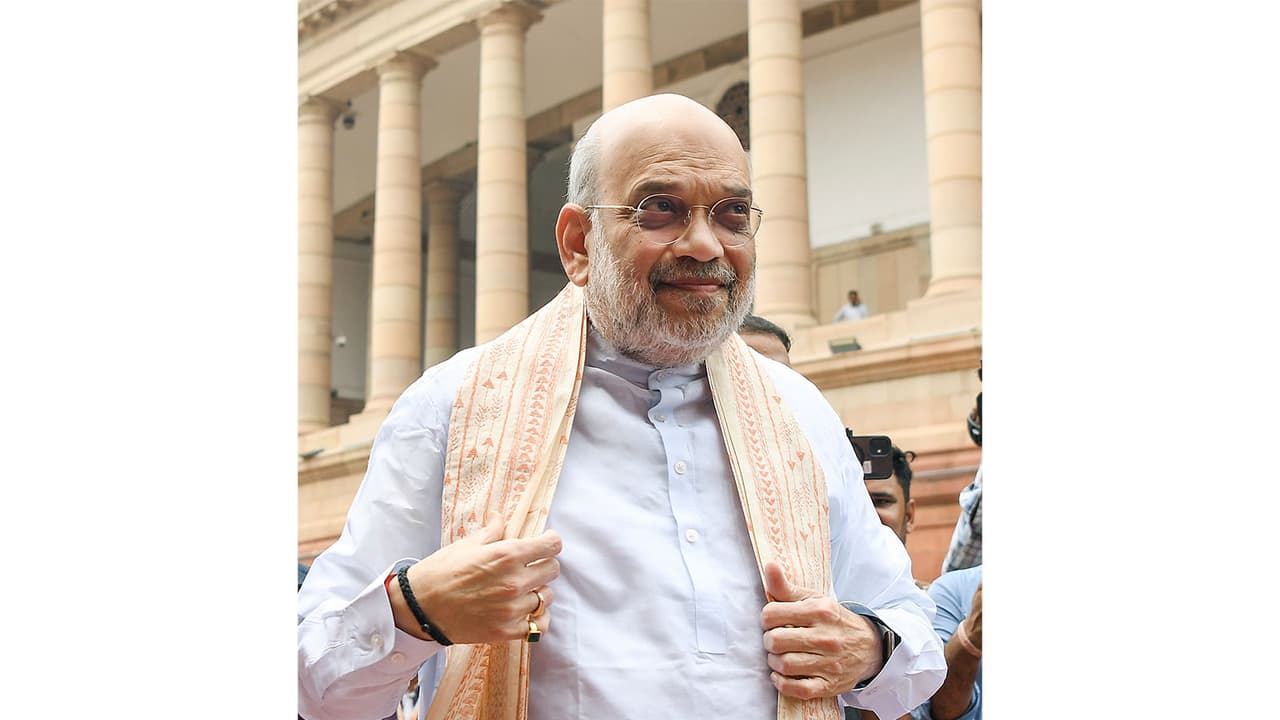
Union Home Minister Amit Shah vowed to intensify the fight against illegal infiltration, stating 'India is not a Dharamshala'. He asserted that the Modi government will make the country 'infiltrator-free in a very short time'.
Making India 'Infiltrator-Free'
In a stern message against illegal infiltration, Union Home Minister Amit Shah on Tuesday vowed to intensify the fight against the problem, saying "India is not a Dharamshala" and asserted that the Modi government will make the country "infiltrator-free in a very short time". Shah made the remarks while addressing the valedictory session of the Intelligence Bureau's 'National Security Strategy Conference' (NSSC) in New Delhi.
"By visiting all the land border states in the last eight months, we shared a document of a quadrangular border security approach with the states. Our aim is to make the country infiltrator-free in a very short time," in a statement, Amit Shah said, according to Ministry of Home Affairs release.
"This country is not a Dharamshala, and only the citizens of the country have the right to live in this country. Infiltrators are a threat to the country's security, economy and demographic change," he added. Shah said the forum of NSSC should look at the trends of the coming 15-20 years and decide which problems may arise and what should be the strategy to prevent them.
New Laws and Drug-Free India Vision
The Home Minister also announced that there will be 100 per cent implementation of three new laws in the next one year, so that criminal cases can be disposed of up to the Supreme Court within three years and noted that the conviction rate will increase by 25 per cent.
Shah later directed police forces of all states to implement the Narcotics Control Vision Document 2026-2029 on the ground to protect the new generation and work on the three D's of Detect, Disrupt and Destroy for a drug-free India.
Integrated Security for a Developed India
Noting that integrated data bank of Crime and Criminal Tracking Network & Systems (CCTNS), Interoperable Criminal Justice System (ICJS), National Intelligence Grid (NatGrid) and National Automated Fingerprint Identification System (NAFIS) has been created, the Home Minister said all young officers should develop actionable intelligence through data integration, analysis and identification of modus operandi through Artificial Intelligence, so that future challenges can be prevented.
"Modi ji has set the target of developed India in 2047, and the first condition of developed India is strong internal security. If we want to become first in every field, then internal security will have to be strengthened further," he said.
Tackling Internal Security Hotspots
"If earlier governments had visualised the problems of narcotics, Naxalism and the North East before they became acute, then the country would not have had to bear the brunt of them for decades," he said. He mentioned how the BJP-led Central government ended the challenge posed by the three hotspots of internal security, and stressed that "the entire credit for this goes to the police forces of every state, central agencies and Central Armed Police Forces (CAPFs)
He also said that the destruction of the entire cadre by striking and banning the Popular Front of India (PFI) in one night is an excellent example of Centre-State coordination. The PFI, a radical Islamic socio-political organisation, was banned by the MHA in September 2022 under the Unlawful Activities (Prevention) Act (UAPA) due to its alleged terror links.
Future Security Strategy and Policy
The Home Minister further called for taking 'PRAHAR' from document to everyday practice for total eradication of terrorism and dismantling of 360-degree terrorist networks. He also pointed out that the Modi government upgraded the Multi Agency Center (MAC) to create a platform to provide multi-dimensional results.
He further suggested that the security policy should be made only after considering global instability, energy-resource insecurity, supply chain disruption, increasing radicalisation and cyber-misinformation war. He advised identifying challenges early and destroying them before they become big problems, and said "By creating such an ecosystem, we will be able to create a secure, infiltrator-free and narcotics-free India."
About the National Security Strategy Conference
Ministers of State for Home Affairs, Union Home Secretary, Deputy NSAs, Heads of CAPFs/CPOs attended the conference in Delhi. DGsP of States and UTs, young police officers working at the cutting-edge level and domain experts from specialised fields joined the conference through virtual mode.
As per the MHA, the second day of the conference was focused on the "threat landscape from sub-aerial systems and formulating countermeasures, securing the blue economy, information warfare and its implications on national security and the need for a bio-security framework."
In pursuance to the directions of Prime Minister Narendra Modi, NSSC has been held every year in a hybrid format since 2021, with the objective of finding solutions to major National Security Challenges using the extensive experience of cutting-edge level officers working at the grassroots level in collaboration with domain experts. (ANI)
Over 850 participants from across the country took part in the conference held in hybrid format
(Except for the headline, this story has not been edited by Asianetnews Editorial staff and is published from a syndicated feed.)