
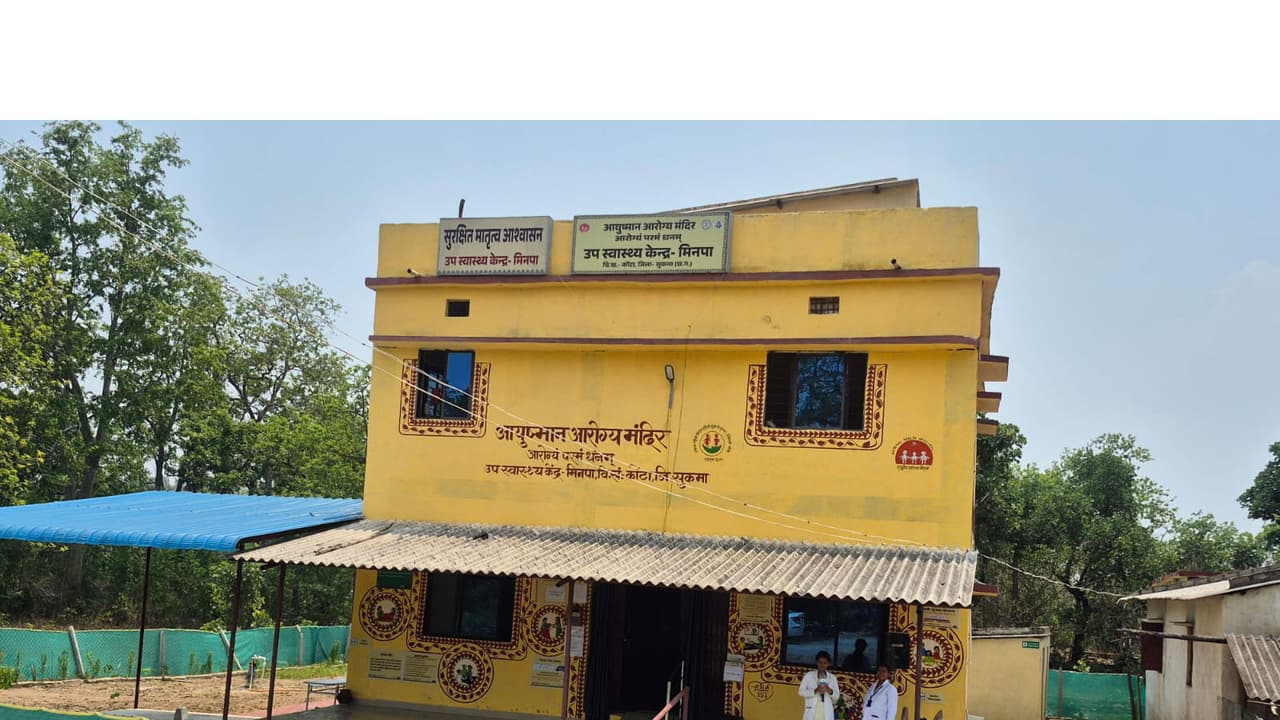
A two-bed clinic in Minpa, a former Maoist stronghold in Chhattisgarh's Sukma, has become a modern Sub-Health Centre with telemedicine. It's now a top district facility, improving healthcare access and aiming for NQAS certification.
What began as a makeshift two-bed healthcare facility in the remote village of Minpa in Chhattisgarh's Sukma district has now evolved into a Sub-Health Centre equipped with telemedicine services and is on track to receive National Quality Assurance Standards (NQAS) certification.
Located in an area that was once considered a Maoist stronghold and remained largely isolated due to security concerns, Minpa has witnessed significant changes in recent years, particularly after the establishment of security camps and improved connectivity. "Minpa Sub Health Centre is a top-performing facility in our entire district. According to the vision of Chief Minister Vishnu Deo Sai, an adequate number of healthcare workers have been deployed here. Minpa, which was once deeply impacted by the menace of naxalism, is now emerging as a major healthcare hub," Sukma Collector Amit Kumar said.
Telemedicine Bridges Healthcare Gap
The Collector said telemedicine services have recently been introduced at the centre, enabling patients to consult specialist doctors available at the district hospital and other healthcare facilities. "Through this facility, we connect patients directly with the District Hospital or other centres where specialist doctors are available. In line with the state government's vision, health check-ups of the local population are being conducted systematically," he said.
Overcoming a Troubled Past
Minpa came into national focus in March 2020 when 17 personnel of the District Reserve Guard (DRG) were killed and several others injured in a deadly Maoist attack in the area. At the time, the village lacked basic infrastructure, including healthcare facilities, roads, reliable electricity and communication networks.
Healthcare services were first introduced in 2021 through a temporary two-bed facility operating from a hut. Over the years, the centre has expanded into a modern healthcare establishment with trained staff, ambulance services and digital health facilities.
Specialist Consultations Made Easy
Chief Medical and Health Officer (CMHO) Sukma, Dr R K Singh, said telemedicine has helped bring specialist healthcare to remote communities. "MD medicine, gynaecologists, ophthalmologists and paediatricians provide immediate consultations to patients through the telemedicine facility whenever required. Digital prescriptions are also provided instantly. This allows patients to receive specialised treatment without travelling long distances, offering immense relief particularly to pregnant women and children," he said.
Broader Health Initiatives in Bastar
Mukesh Kumar Bakshi, Medical Officer at Primary Health Centre Chintagufa and District Nodal Officer, said Chief Minister Vishnu Deo Sai launched the Mukhyamantri Swasthya Bastar Abhiyan during his visit to Sukma in April this year. "The objective of this campaign is to ensure health facilities reach the last person in Bastar," Bakshi said.
He said healthcare teams are regularly visiting villages to conduct health screenings and monitor vulnerable groups. "Screening for non-communicable diseases such as diabetes and hypertension is actively underway. Infectious diseases are being identified early, while pregnant women, children and elderly citizens are being monitored regularly. To accommodate villagers working in fields and forests, health teams visit remote areas during the day, evening and even late at night," he said.
Tangible Impact on Community Health
According to Anjali Baghel, Community Health Officer posted at Minpa, one of the most visible changes has been the increase in institutional deliveries. "Earlier, most women delivered at home with the assistance of traditional birth attendants. In the absence of transport, pregnant women often had to be carried on makeshift cots. Continuous awareness campaigns have changed mindsets, and villagers are now actively visiting health centres to access these services," she said.
Local resident Buddhu Yadav, whose wife was recently admitted to the hospital for delivery, recalled the difficulties families once faced while seeking medical care. "When healthcare facilities did not exist here, complications often became serious while travelling long distances for treatment. The situation has changed significantly. Now, an ambulance reaches our doorstep with a single call. Safe institutional delivery, food, medicines and proper care are being provided free of cost. We also receive the birth certificate from the facility, and benefits under government welfare schemes are directly credited to our bank accounts," Yadav said.
He also expressed gratitude to the state government for expanding healthcare services in the region. (ANI)
(Except for the headline, this story has not been edited by Asianet Newsable English staff and is published from a syndicated feed.)