SC criticised the affluent class for refusing to change lifestyles that worsen Delhi-NCR air pollution, saying the poor suffer the most. It raised concern over children's exposure during outdoor sports and warned states for failing to enforce rules.
The Supreme Court of India has made strong observations on the worsening air pollution crisis in Delhi-NCR, saying that the burden of dirty air falls most heavily on the poor, while the causes are often linked to the lifestyle choices of the affluent class. The top court said that richer sections of society are unwilling to change their habits, even as millions of people breathe hazardous air every day.
The top court also raised serious concern over children’s health, especially outdoor sports activities in schools, and stressed that orders must be enforced strictly because states are failing to act on their own.
One of the strongest observations made by the Supreme Court was on social inequality linked to air pollution.
Related Articles

The court said that pollution is largely caused by the practices of the affluent class, such as excessive vehicle use, construction activity, and high consumption patterns. However, the worst impact is faced by poor people, who do not have access to air purifiers, sealed homes, or healthcare.
CJI Surya Kant said that while richer people can protect themselves indoors, poor labourers and daily wage workers are forced to breathe polluted air all day.
Aparajita Singh agreed with this view and told the court that poor labourers are the worst sufferers of the pollution crisis.
Lifestyle change in cities not easy, court notes
The Chief Justice also observed that people living in urban metropolitan cities have their own lifestyles, and changing these habits is difficult.
However, he underlined that this cannot be an excuse to ignore the health crisis. He said the court understands the problem fully and will ensure that only workable and enforceable orders are issued.
“There are some directions which cannot be enforced,” the CJI said, but added that others must be implemented strictly.
Hearing on Delhi pollution fixed for December 17
The Supreme Court said on Monday that it will hear a petition related to the deteriorating air quality in Delhi-NCR on December 17. The case was mentioned before a bench led by Chief Justice of India (CJI) Surya Kant, along with Justice Joymalya Bagchi and Justice Vipul M Pancholi.
The issue was raised by Senior Advocate Aparajita Singh, who is assisting the court as amicus curiae, or friend of the court. She highlighted continued violations of court directions and warned that the air pollution crisis remains uncontrolled despite existing rules.
States act only when courts give clear orders, amicus tells SC
During the hearing, Aparajita Singh told the bench that state governments do not take effective steps to control pollution unless courts give very clear and strict directions.
She said that pollution control protocols already exist, but they are not being followed on the ground. According to her, enforcement agencies and state governments continue to ignore rules, leading to the same pollution crisis every year.
She also pointed out that despite earlier Supreme Court directions, sports activities are still being organised in many places, exposing children to dangerous air during December and January.
Concern over children exposed to toxic air during sports
The court expressed deep concern over schools continuing outdoor sports activities even when air quality remains at hazardous levels.
Aparajita Singh reminded the bench that the Supreme Court had earlier directed that sports and outdoor activities be stopped or restricted during peak pollution months, but schools have found ways to continue such events.
She informed the court that a separate application related to children’s health has been filed, stressing that young lungs are being damaged due to prolonged exposure to polluted air.
CAQM cited orders, but ground situation unchanged
The amicus also criticised the Commission for Air Quality Management (CAQM), saying that it keeps citing Supreme Court orders but there is no visible improvement on the ground.
She said that despite repeated warnings and directions, pollution levels remain high, and enforcement remains weak.
The bench acknowledged this concern and said it was fully aware of the situation.
Supreme Court: Only pass orders that can be enforced
Responding to these submissions, CJI Surya Kant said the court would pass only those orders that are effective and can be complied with.
“We have to pass orders that can be complied with,” the Chief Justice said, adding that the matter would be taken up in detail by a three-judge bench on Wednesday, December 17.
He noted that some directions need to be forcibly imposed, but also admitted that enforcing lifestyle changes in large cities is not easy.
Supreme Court questions focus on stubble burning alone
In earlier hearings, the Supreme Court had also questioned the tendency to blame stubble burning alone for Delhi’s pollution.
The bench of CJI Surya Kant and Justice Joymalya Bagchi said it is easy to blame farmers who burn stubble, especially since they are not properly represented before the court.
“We do not want to comment on stubble burning as it is easy to pass the burden on those who are hardly represented before us,” the bench had said.
Multiple sources of pollution identified
The Additional Solicitor General Aishwarya Bhati informed the court that the CAQM has prepared action plans to deal with pollution in Delhi and surrounding areas.
She said that several factors contribute to the air quality crisis, including:
- Stubble burning
- Vehicular pollution
- Construction dust
- Road dust
- Biomass burning
The court noted that pollution is a complex and repetitive problem, and focusing on only one source does not solve the crisis.
AAP attacks Delhi CM over air pollution handling
Aam Aadmi Party (AAP) Delhi unit president Saurabh Bharadwaj strongly criticised Chief Minister Rekha Gupta over the worsening air pollution in the national capital. He alleged that the Chief Minister lacks basic understanding of the Air Quality Index (AQI) and its measurement. Bharadwaj said she cannot even properly pronounce AQI and questioned what Delhi residents can expect from her leadership over the next four years, adding that pollution control should be left to experts.
Vipassana not running away, says Kejriwal after Delhi CM jibe
Aam Aadmi Party chief Arvind Kejriwal on Sunday responded sharply to Delhi Chief Minister Rekha Gupta’s remarks, saying that practising Vipassana meditation should not be mocked or described as 'running away'. He said political rivalry does not justify ridiculing a spiritual practice taught by Lord Buddha and advised the CM to try it herself. His comments came amid a political war of words over Delhi’s worsening air pollution. The exchange followed criticism from both Kejriwal and AAP leader Saurabh Bharadwaj, who accused the Delhi government of poor handling of the pollution crisis as AQI touched the ‘severe’ level of 497.
Delhi AQI remains severe, residents suffer health problems
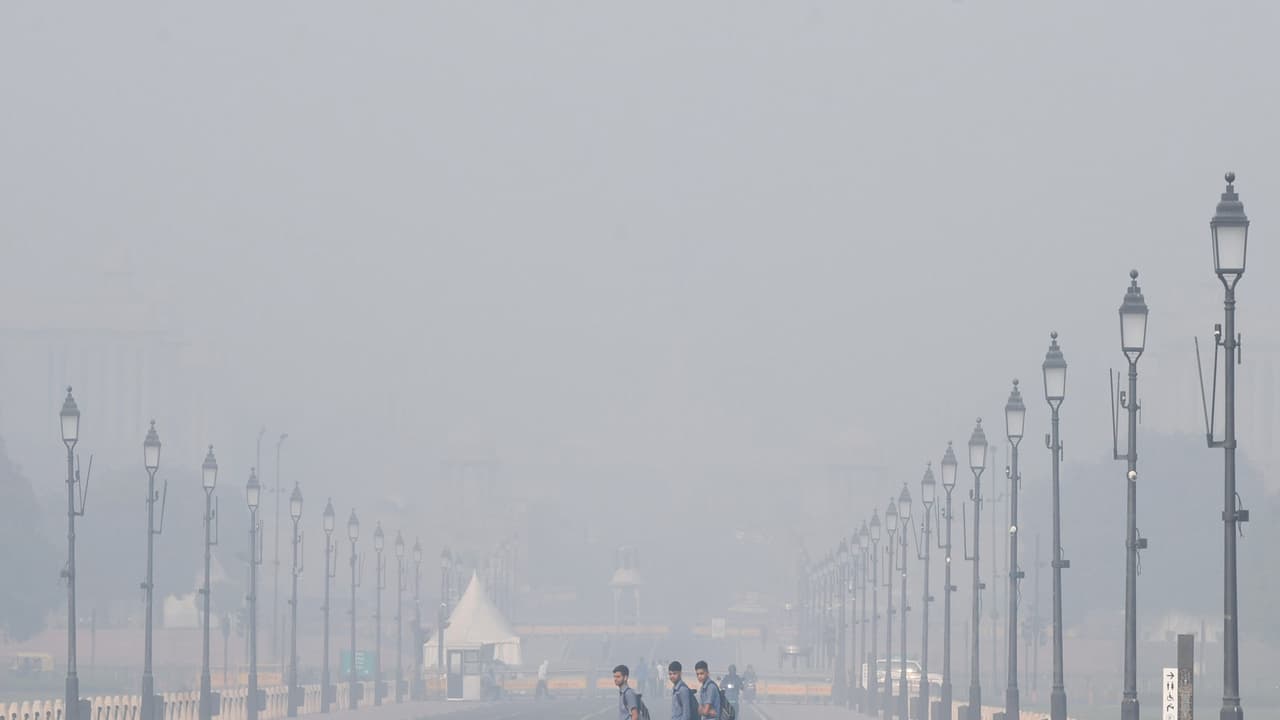
Delhi’s air quality remained in the 'severe' category on Sunday, with the AQI touching 497, according to the Central Pollution Control Board (CPCB). Residents across the city reported breathing difficulties, eye irritation and other health issues due to dense smog, even inside closed rooms. Many expressed concern for children, elderly people and those with existing health conditions, who are more vulnerable to the harmful effects of polluted air.
Schools shift to hybrid classes as GRAP Stage IV imposed
In response to the worsening situation, the Commission for Air Quality Management (CAQM) invoked Stage IV of the Graded Response Action Plan (GRAP) as AQI levels neared the ‘Severe Plus’ mark. Following this, the Delhi Government’s Directorate of Education directed all schools to conduct classes up to Class IX and XI in hybrid mode, allowing both physical and online learning. The restrictions also include a ban on certain trucks, construction activities and advisories for people to stay indoors to reduce health risks.
Court to consider children's health application
The Supreme Court also confirmed that it will examine the application related to children's health when the matter comes up on December 17.
The judges stressed that children are among the most vulnerable groups, and exposing them to outdoor activities during severe pollution is unacceptable.
The Supreme Court’s sharp remarks underline growing frustration over the failure of authorities to control Delhi-NCR’s air pollution. By directly calling out the affluent class and highlighting the suffering of the poor, the court has brought social responsibility into the centre of the debate.
With the case listed for December 17, all eyes are now on whether stricter and enforceable directions will finally bring real relief to millions breathing toxic air.
(With ANI inputs)