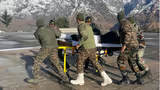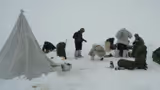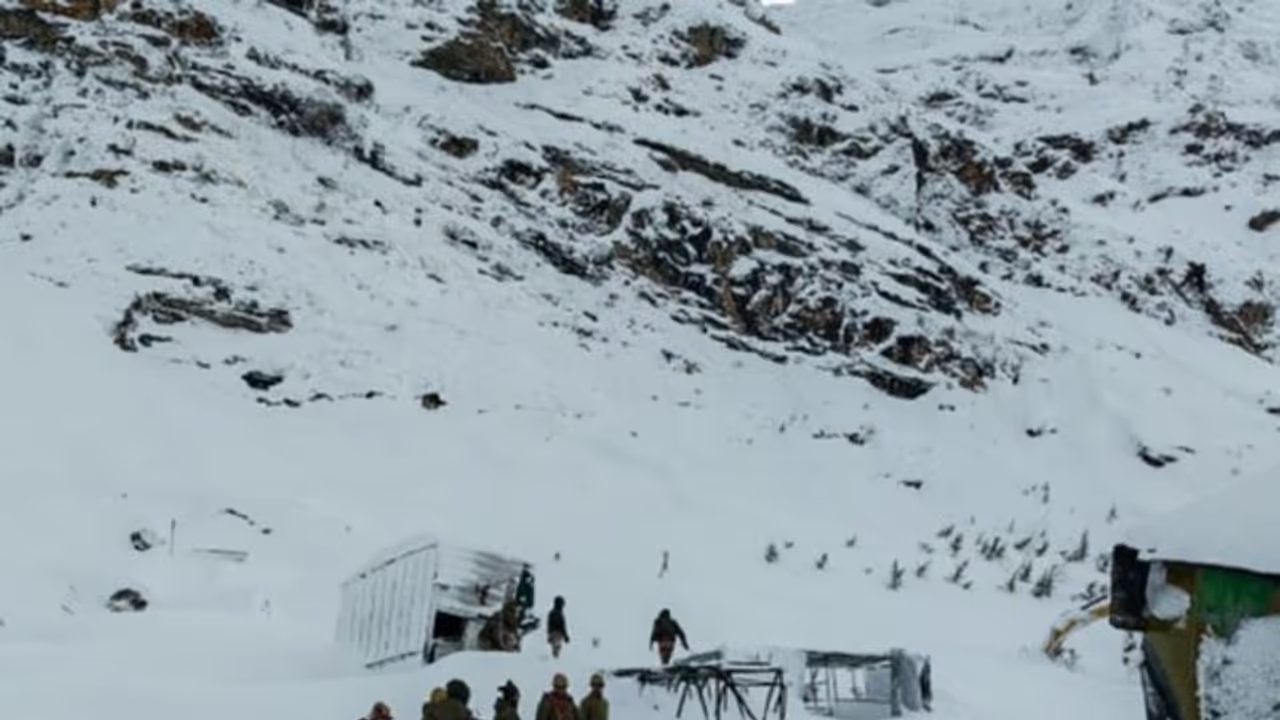
Three army personnel died when a massive avalanche hit Siachen Glacier in Ladakh. Rescue operations are in progress amid harsh weather and difficult terrain, as teams search for more victims and secure the area.
Three army personnel were killed after a major avalanche struck the Siachen Glacier in Ladakh on Tuesday. Rescue operations are currently underway to search for other possible victims and ensure the safety of remaining troops stationed in the area. The harsh weather conditions and difficult terrain have posed significant challenges for the rescue teams as they work against time to reach the affected zone.
The Indian Army’s Fire and Fury Corps paid solemn tribute to Sepoy Mohit Kumar, Agniveer Niraj Kumar Choudhary, and Agniveer Dabhi Rakesh Devabhai, who made the supreme sacrifice in the line of duty at Siachen Glacier on September 9, 2025. The official X account of the Fire and Fury Corps expressed deep condolences to the bereaved families and saluted the bravery and dedication of the fallen soldiers. Siachen, known as the world’s highest battlefield, remains a critical and challenging post, requiring immense resilience from troops.
Siachen: The strategic high ground
Siachen Glacier holds immense strategic importance as it lies at the nuclear tri-junction of India, Pakistan, and China. The region dominates the Shaksgam Valley, routes from Gilgit Baltistan to Leh, and the ancient Karakoram Pass. The high-altitude terrain remains a bone of contention between India and Pakistan since the 1949 Karachi Agreement, where the area remained undivided due to harsh geography and climate. India’s presence at Siachen is a critical defensive measure to prevent any potential adversarial move in this strategically vital zone.
Operation Meghdoot: Bold military strategy
Launched on April 13, 1984, Operation Meghdoot was India’s pre-emptive military response to Pakistan’s “cartographic aggression” in the Siachen region, north of NJ9842. Intelligence reports of imminent Pakistani action led India to secure the strategic Sia La and Bilafond La passes. The operation marked the first-ever assault launched at such an extreme altitude. Under the leadership of Lt. Gen. Manohar Lal Chibber, Lt. Gen. P.N. Hoon, and Maj. Gen. Shiv Sharma, the Indian Army successfully deployed troops by airlifting them to glacial peaks, gaining control over the entire Siachen Glacier.
Related Articles

Operational challenges and costs
Maintaining a brigade of about 5,000 troops in Siachen costs approximately ₹6 crore daily, underscoring the immense logistical effort required. The Indian Air Force has played a crucial role since 1978, first landing a Chetak helicopter on the glacier. Tactical airlifters like An-12s, An-32s, and IL-76s transported personnel and materials, while Mi-17, Mi-8, Chetak, and Cheetah helicopters ferried them to remote high-altitude airfields. These operations defy the limits of aviation technology, demonstrating exceptional coordination between the Indian Army and Air Force to maintain India’s strategic advantage in this hostile terrain.
In February, this year, a massive avalanche struck a Border Roads Organisation (BRO) construction camp near Mana village in Uttarakhand's Chamoli district. The avalanche buried 54 workers under snow and debris. Rescue operations, led by the Indian Army, Indo-Tibetan Border Police (ITBP), National Disaster Response Force (NDRF), and local authorities, were launched promptly. Despite facing severe weather conditions, including sub-zero temperatures, the teams managed to rescue 46 workers. Tragically, eight workers lost their lives. The last missing worker's body was recovered on March 2, 2025, marking the end of the three-day rescue operation.
In March 2024, a significant avalanche in Himachal Pradesh's Lahaul-Spiti district obstructed the flow of the Chenab River near Jasrat village. The avalanche led to the closure of over 650 roads across the state due to heavy snowfall and rain. While no casualties were reported, the incident disrupted normal life and prompted authorities to issue advisories for residents and travelers in the affected regions.
In April 2021, two Indian Army soldiers, Sepoy Prabhjit Singh and Sepoy Amardeep Singh of 21 Punjab, were killed in an avalanche in Sub Sector Haneef, Southern Siachen Glacier. The avalanche struck their patrol at around 1 pm, and despite rescue efforts, both soldiers succumbed to their injuries. Other soldiers and porters in the area were rescued and are stable. The incident highlights the perilous conditions faced by troops in the region.
On November 18, 2019, an avalanche in the northern sector of Siachen Glacier buried a group of eight soldiers and two civilian porters. The avalanche struck around 3 pm, and despite rescue efforts, four soldiers and two porters died due to extreme hypothermia. The remaining personnel were rescued and evacuated to a military hospital. The incident underscores the harsh and unpredictable conditions in the region.
(With agency inputs)