
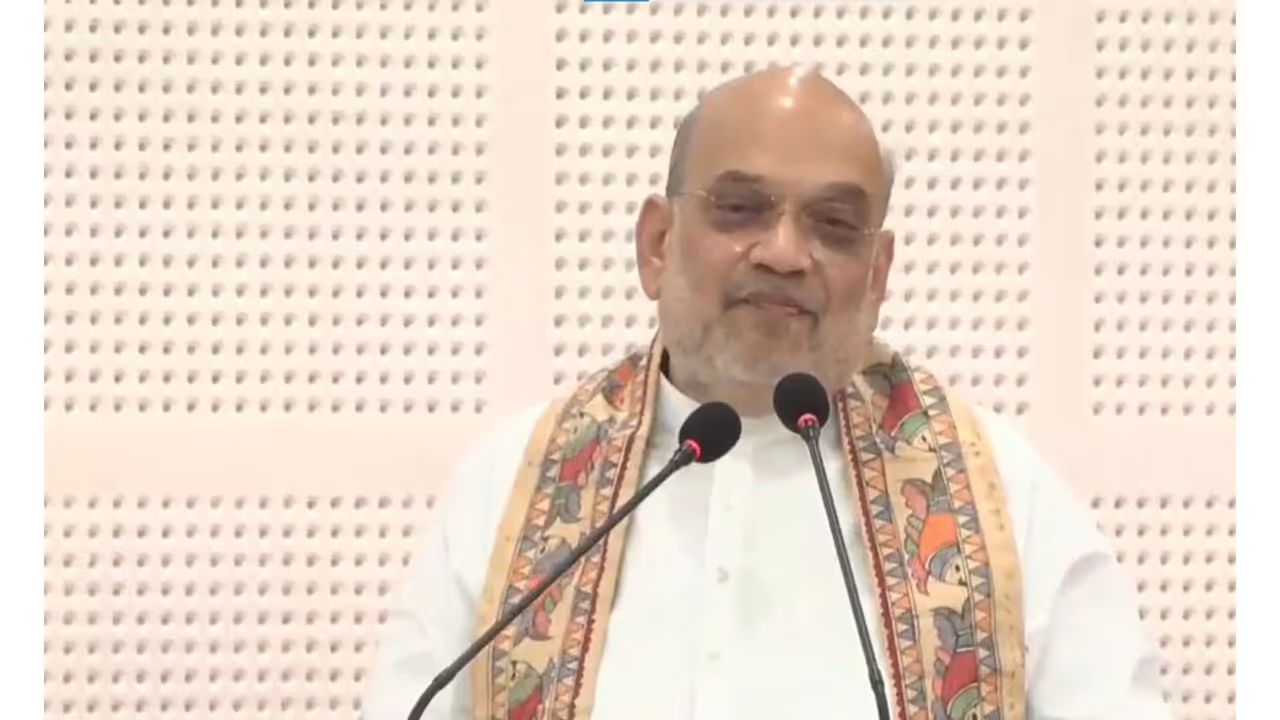
Union Home Minister Amit Shah inaugurated the state-of-the-art 'Jayaprakash Narayan Library' in New Delhi, a multimedia and digital facility dedicated to the legacy of the legendary freedom fighter Loknayak Jayaprakash Narayan.
Asserting that a nation's true progress is mapped not just by its financial indices but by its intellectual depth, Union Home Minister Amit Shah on Saturday inaugurated the state-of-the-art 'Jayaprakash Narayan Library' in the national capital.
Addressing the gathering, Shah described the launch as a landmark milestone for Delhi's socio-educational landscape, dedicating the new multimedia and digital facility to the legacy of the legendary freedom fighter, thinker, and social reformer, Loknayak Jayaprakash Narayan.
"Today is an important day for Delhi. Here, in the name of the great freedom fighter, thinker, and the great leader of the country who accomplished numerous monumental tasks, Loknayak Jayaprakash Narayan Ji, the library has been inaugurated," Shah said.
'A Nation's Progress Mapped by its Libraries'
Developed by the New Delhi Municipal Council (NDMC), the multi-story structure bridges traditional learning with digital resources, providing users access to over five lakh e-books and digital catalogues alongside physical volumes.
Underlining the foundational link between reading spaces and nation-building, the Home Minister shared an expansive view on measuring a country's actual growth. "A great thinker has said that the future of a country cannot be assessed by how prosperous its agriculture is, how crowded its markets are, or how many industries have been established in the country, but rather by how crowded its libraries are and how many young people there are," he remarked.
The building has a rich collection of more than 32,000 books across its two floors. Special arrangements have also been made for researchers and students engaged in research. Additionally, a modern reading area has been created so that students, researchers, and readers can study and acquire knowledge in a peaceful environment.
The Gandhinagar Library Model
To illustrate how administrative interventions can revive reading habits, Shah highlighted a highly successful hub-and-spoke "experiment" implemented in his own parliamentary constituency of Gandhinagar, Gujarat, to democratize literature for rural youth.
"We conducted a small experiment in the Gandhinagar Lok Sabha constituency. We opened libraries in every village, each containing 3,000 to 4,000 books. These libraries were linked to a large library with millions of books. We also operated four mobile vans. Now, if a village child writes down the name of a book in their local library, that book is made available to them in their village every Friday. Along with this, we also connected every library to a school," the Home Minister informed.
Knowledge, the Ultimate Catalyst
He emphasised that such local networks are vital because structural knowledge serves as the ultimate catalyst for strategic national execution.
"All activities that build the nation and bring glory to it stem from knowledge taking practical form as wisdom and prudence. And knowledge is obtained from the library," Shah added, making an impassioned appeal to the younger generation.
"I want to say with full confidence to the youth of the country that whatever thoughts come to your mind in the age and stage you are in today, enrich them with the stored knowledge in books."
Officials expect the newly opened facility to serve as a vibrant, accessible hub for young researchers, students, and thinkers in central Delhi, reinforcing an ecosystem of continuous learning that honours Jayaprakash Narayan's enduring ideological focus on social empowerment.
(Except for the headline, this story has not been edited by Asianet Newsable English staff and is published from a syndicated feed.)
