
With the 8th Pay Commission expected in 2026, the Bharat Pensioners Samaj has put forward its demands, including a minimum pension of Rs 45,000 and more frequent revisions of Dearness Relief.
The 8th Pay Commission is likely to bring major adjustments for serving central government employees as well as pensioners. Tho no announcement has been made by the Center on the final fitment factor and the amended pension formula, there is much talk about a raise in pension. Employee and pensioner associations have already made their ideas, with some saying the minimum pension should be increased sharply to assist retirees deal with the growing cost of living.
How is pension revised under the Pay Commission?
The pensions of retired central government employees are changed using the authorised fitment factor as and when a new Central Pay Commission is adopted. The updated amount is calculated on the basis of the current basic pension and the multiplication factor proposed by the commission.
The government has not revealed the fitment factor for the 8th Pay Commission yet. But other projections indicate that it might drop into a zone that would trigger a significant rise in pension payments.
Related Articles

How High Can Pension Rise?
While official estimates have still to be determined, many fitment factor scenarios predict a significant increase in the basic monthly income of retirees.
For instance, if the 7th Pay Commission’s similar fitment ratio of 2.57 is adopted, pension modifications might be huge. But other employee groups are lobbying for a considerably greater fitment factor, which might lead to even bigger rises. These are ideas and should not be considered government decisions.
Pensioners Demand Increase Of Minimum Pension
Several pensioners’ groups have been demanding a steep hike in basic pension from the 8th Pay Commission. Among the proposals made is one that moots raising the minimum pension to ₹45,000 to better factor in inflation and the increased costs of running a household. The proposals are likely to be examined by the panel before it makes its final recommendations.
Decision not yet taken
The Center has not yet revealed the final pension modification formula, fitment factor and date of implementation amid the mounting anticipation. The 8th Pay Commission would incorporate comments from employee unions, pensioners’ groups and several government ministries before making its recommendations.
All the estimated pension numbers till the report is officially approved by the government are based on varied assumptions of fitment factor and not on verified disbursements.
What Pensioners May Expect
“Pensioners should wait for the official recommendations before calculating their new benefits for the moment. If the commission suggests a greater fitment factor than the last pay panel, then the basic pension of retired central government employees may see a big jump once the new pay structure is put in place.
The 8th Pay Commission Pension Hike: How Much Could It Increase?
The fitment factor suggested by the 8th Pay Commission and agreed by the government will be the primary determinant of pension increases. However, employe representatives have asked for a 3.83 fitting factor. The staff side of the National Council-Joint Consultative Machinery (NC-JCM) has advocated utilising this factor to raise the minimum basic wage from Rs 18,000 to around Rs 69,000. The same paper states that the 3.833 factor should also be used to increase the pension of existing retirees.
In simple terms, multiplying a pensioner's present basic income by 3.83 yields the expected updated basic pension:
To estimate the updated basic pension, multiply the existing basic pension by 3.83.
A senior on a basic pension of Rs 20,000 can get Rs 76,600 (Rs 20,000 x 3.83). Similarly, the computation would look as follows:
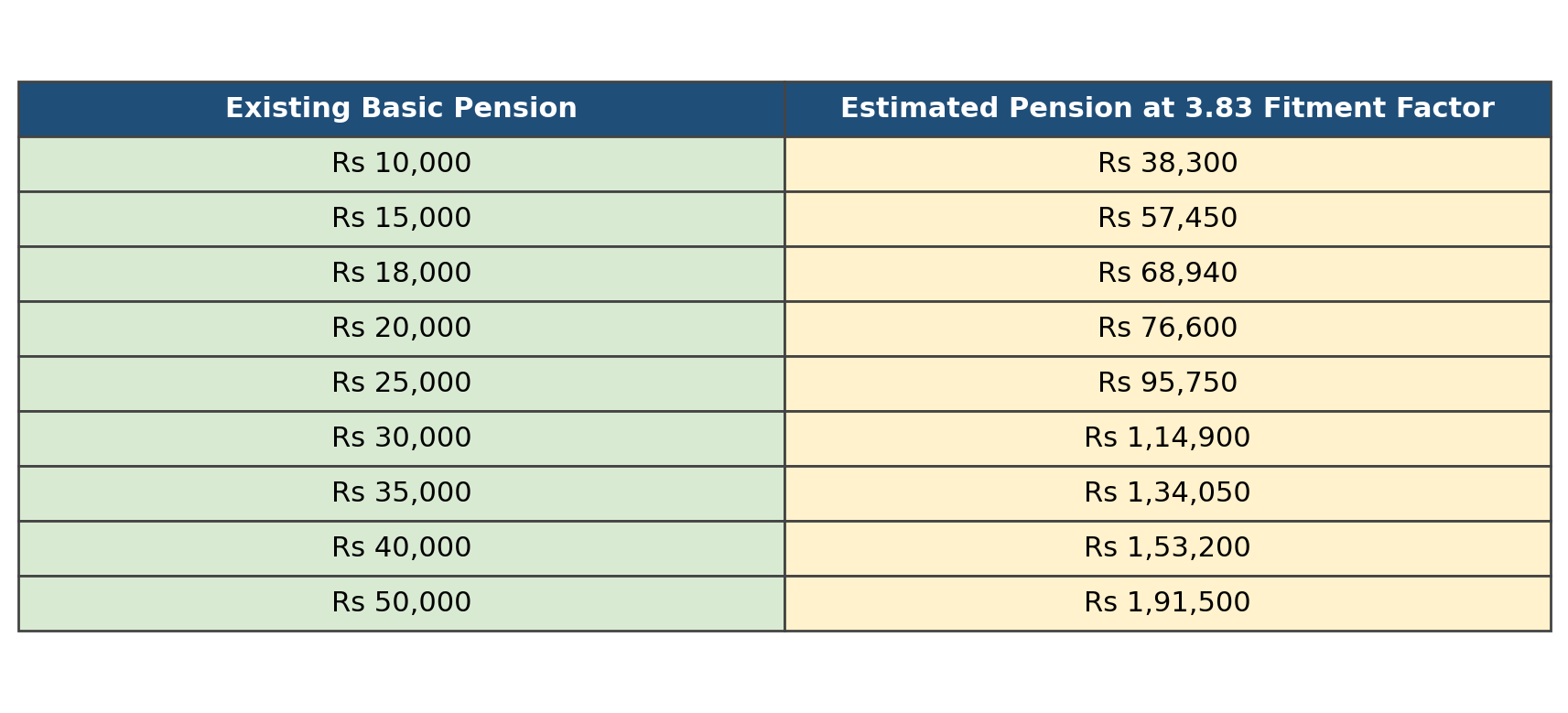
These numbers are only calculated using the 3.83 fitment factor demand. These are not the pension amounts approved by the government.
What is the Fitment Factor?
The fitment factor is a multiplier used in calculating the updated basic pay or pension. For instance, if the current basic pension is Rs 20,000 and the final fitment ratio is 3.83, the computation is Rs 76,600 (Rs 20,000 × 3.83). Thus, the base pension would potentially increase from Rs 20,000 to Rs 76,600.
However, the 3.83 number is an employe demand rather than an 8th Pay Commission suggestion. The Commission is still working up its proposals.
Under the 7th Pay Commission, the government recommended a fitment factor of 2.57 for all pay levels. Following this, the minimum wage was raised from Rs 7,000 to Rs 18, 000.
What about Dearness Relief?
Dearness Relief (DR) is provided to Central Government retirees to compensate for inflation. When a new pay commission revises the pension scheme, the handling of current DR will be an important consideration. Pensioners should not just add the current DR to the predicted pension based on 3.83.
The ultimate amount will be determined by how the government restructures basic pension and dearness relief following the implementation of the 8th Pay Commission recommendations.
What Is the Minimum Pension under the Eighth Pay Commission?
The 8th Pay Commission is now working on establishing an officially authorised minimum pension. The Rs 69,000 number that is extensively discussed refers to the desired minimum basic salary for employes using the 3.83 fitment rate. It should not be automatically considered the minimal pension.
Some pensioner associations have made separate calls for a greater minimum pension. According to reports, the Bharat Pensioners Samaj has suggested a minimum pension of Rs 45,000. This is also a demand, not an official government statistic.
When Will Pensioners Find Out Their Actual Revised Pension?
The actual pension rise will be known only once the 8th Pay Commission presents its recommendations and the government makes a final decision. The Commission was established on November 3, 2025, and has 18 months to submit recommendations. As a result, the deadline is May 3, 2027.
The government will next review the suggestions and decide whether to adopt, alter, or reject some of the plans.