Women’s T20 World Cup 2026: What Led to Team India's Group-Stage Exit? Explained
Team India's Women's T20 World Cup 2026 journey ended with a group-stage exit after a loss to Australia. A campaign that began with title hopes ultimately unraveled due to repeated setbacks in key matches.
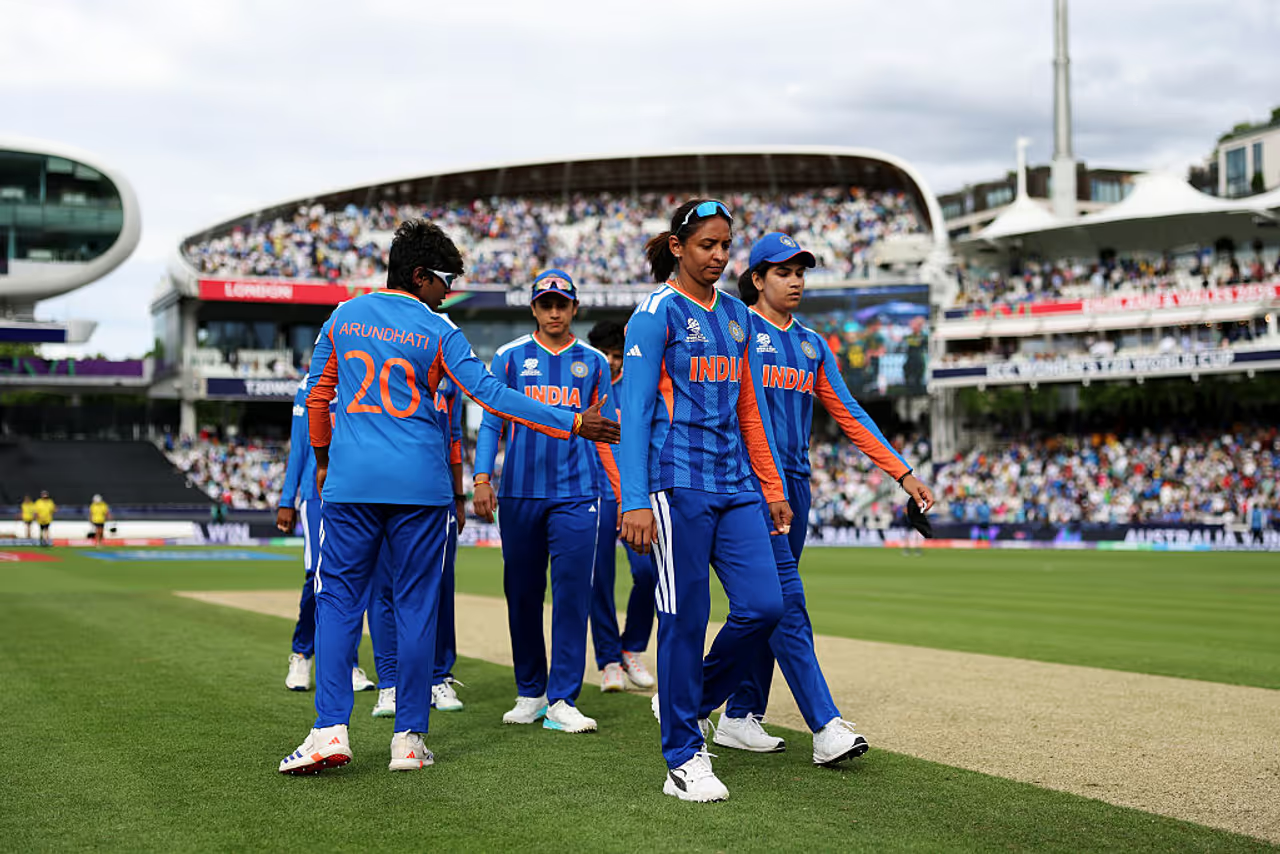
India's Dream of a Maiden Women's T20 World Cup Title Ends in the Group Stage
Team India’s hopes of qualifying for the Women’s T20 World Cup 2026 semifinal were dashed after a six-wicket defeat to Australia in their final group-stage match at Lord’s in London on Sunday, June 28.
The Women in Blue’s qualification to the semifinal was hanging in the balance after South Africa’s win over Bangladesh earlier in the day left India needing an improbable margin of victory over the six-time champions to sneak through on net run rate, but a six-wicket defeat after Australia chased down the 171-run target confirmed their elimination from the tournament.
Team India’s group stage exit ended their aspirations of emulating their Women’s ODI World Cup success in November last year, falling well short of expectations after entering the tournament as one of the favourites.
On that note, let’s take a look at the key reasons behind the Women in Blue’s group stage exit from the tournament.


Inability to Defend Targets against Top Sides
The Women in Blue might’ve registered victories against Pakistan, debutants Netherlands, and Bangladesh. Still, they were exposed in crunch encounters against top teams like South Africa and England, who were in the same group as Team India. Against both sides, the Harmanpreet Kaur-led team failed to defend competitive totals.
In the match against the Proteas, Team India couldn’t defend their 158-run total, as two crucial dropped catches of Marizanne Kapp shifted the momentum entirely, allowing the veteran all-rounder to take the team past the finishing line with five balls to spare in the final over. Similarly, the Women in Blue couldn’t defend their 170-run total in a crucial group stage clash due to fielding lapses.
Team India’s inability to successfully defend these challenging totals exposed deeper flaws in their tournament strategy, ending their hopes of reaching the semifinals.
Also Read: Women's T20 World Cup 2026: Smriti Mandhana Soaks in Matthew Hayden's Batting Masterclass (WATCH)
Unsettled Batting Lineup and Middle-Order Inefficiencies
Throughout the tournament, Team India has been over-reliant on the top-order, especially openers Smriti Mandhana and Shafali Verma, which meant that any early breakthroughs by the opposition exposed the fragile middle order, stalling the run rate and preventing the team from posting an imposing total.
Except against the Netherlands and Bangladesh, posting a total of 209/5 and chasing down a 139-run target with 19 balls to spare, respectively, the Women in Blue’s middle order didn’t capitalise on the aggressive starts by the openers. Since the middle-order batters, especially skipper Harmanpreet Kaur, Richa Ghosh, and Jemimah Rodrigues, failed to find the boundary consistently, the team’s scoring rate drastically plummeted during the middle overs against quality bowling attacks.
Additionally, the unsettled batting order, particularly Jemimah’s frequent shuffling between the number three and four positions, and Yastika Bhatia’s No.3 spot despite a lack of firepower, exposed a rigid tactical approach that failed to adapt to modern T20 tempo and requirements, ultimately stranding the team with sub-par totals.
Costly Fielding Lapses and Dropped Catches
One of the key reasons behind Team India’s early exit from the tournament was the fielding lapses and dropped catches. The Women in Blue dropped a total of 11 catches throughout the tournament, with catching efficiency standing at 71%, placing them among the lowest in the competition.
In the match against South Africa, Radha Yadav dropped crucial catches of Marizanne Kapp, followed by four matches in the first five overs against Bangladesh, Indian players put down four more chances inside the powerplay. However, against Australia, Team India didn’t drop a single match, yet suffered a defeat.
Across 25 T20I matches, including four group stage games, Team India has dropped 46 matches over the course of the last calendar year, illustrating a systemic flaw in their fielding standards that continually releases pressure on top-tier opposition batters.
One-Dimensional Bowling Attack
Another key reason behind the Women in Blue’s group stage exit was an over-dependence on spin bowlers and a distinct lack of genuine express pace, leaving the attack toothless on true, batting-friendly surfaces. In the group stage, the Women in Blue have picked a total of 34 wickets, out of which 29 wickets were taken by spinners.
Shree Charani picked 12 scalps, while Deepti Sharma and Shafali Varma took 7 and 5 wickets, respectively. Radha Yadav picked up three wickets. This means India’s spin attack contributed an overwhelming majority of the wickets, highlighting both their heavy reliance on slow bowlers and the lack of penetration from the pace battery.
The lack of support by pace attack on true batting tracks against major opponents, against South Africa and Australia, meant that the bowling lacked penetration to take early wickets or restrict run-flows in the middle and death overs, ultimately exposing the team's one-dimensional composition.
Also Read: IND vs BAN, Women’s T20 World Cup 2026: India’s Catching Woes Hand Bangladesh Early Reprieves
Over-Reliance on Individual Batting Brilliance
Last not but not the least, Team India’s individual batting brilliance masked deeper inconsistencies, as the middle-order often failed to fire when the stalwarts fell early, leaving the team without collective batting efforts to fall back on in high-pressure run chases or while posting totals on the board.
In the match against Australia, Harmanpreet Kaur smashed 56 off 27 balls, supported well by Smriti Mandhana (38), Shafali Verma (34), and Jemimah Rodrigues (34), but the inability of the lower-middle order to provide a strong finish, combined with leaking runs at the death, saw the team fall short in a must-win encounter.
Out of India’s total runs of 846 in the group stage, Smriti Mandhana (205), Shafali Varma (179), and skipper Harmanpreet (141) collectively scored 525 runs, meaning they contributed 62.1% of the team's total runs, highlighting India's heavy reliance on a handful of senior batters rather than consistent collective contributions.
Stay on top of all the latest Sports News, including Cricket News, Football News, WWE News, and updates from Other Sports around the world. Get live scores, match highlights, player stats, and expert analysis of every major tournament. Download the Asianet News Official App from the Android Play Store and iPhone App Store to never miss a sporting moment and stay connected to the action anytime, anywhere.