Annual Solar Eclipse 2026: Visibility, Timings And Global Impact; Read On
Annual Solar Eclipse: A rare annular solar eclipse will occur on 17 February 2026, creating a dramatic “ring of fire” over Antarctica. While only a few observers can see it fully, celestial event has sparked worldwide scientific and cultural interest
A Rare Celestial Ring Visible Mostly Over Antarctica
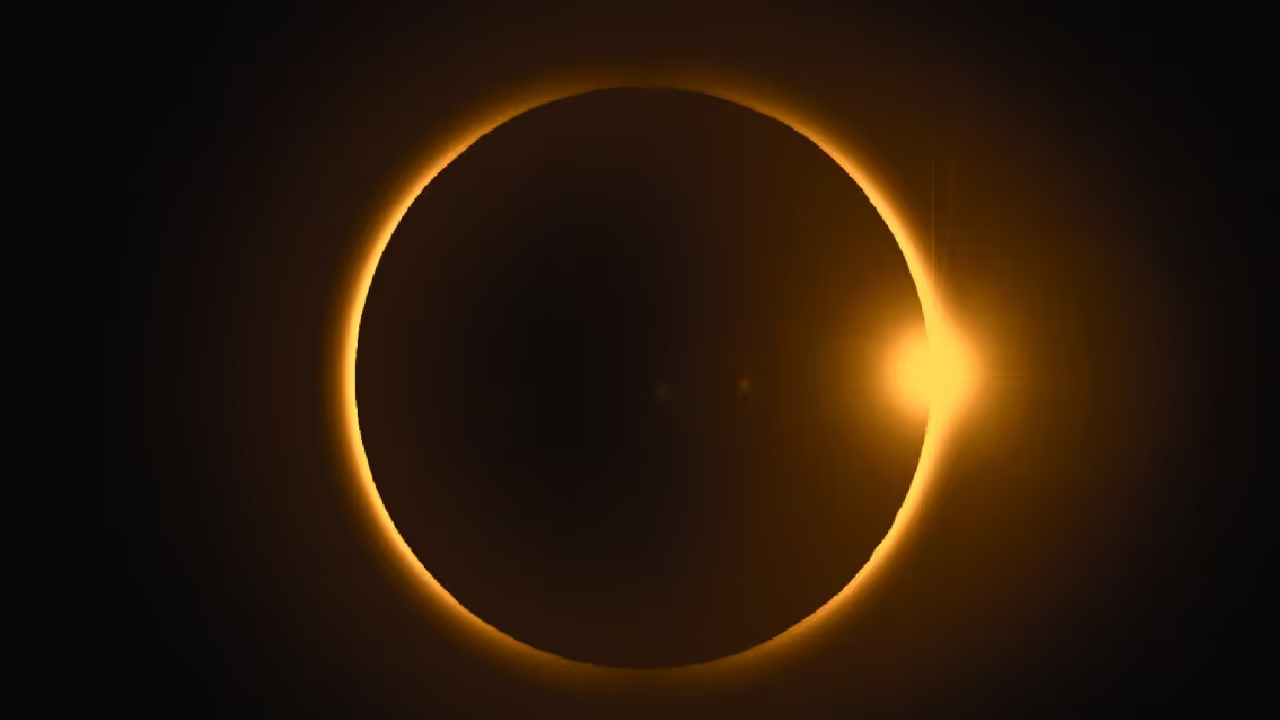
The annular solar eclipse on 17 February 2026 will create a bright ring-shaped sunlight effect when the Moon passes directly in front of the Sun but fails to block it completely. This happens because the Moon will be slightly farther from Earth, making it appear smaller than the Sun. As a result, a glowing ring of sunlight will remain visible around the Moon, commonly known as the “ring of fire.”
The eclipse will begin at 07:01 UTC and will reach its peak over the icy interior of Antarctica. During the maximum annular phase, nearly 96 percent of the Sun will be covered, and the striking ring effect may last up to 2 minutes and 20 seconds. Despite the dramatic visuals, scientists strongly advise using certified eclipse glasses, as the Sun’s rays remain dangerous to the eyes even during annularity.


Extremely Limited Viewing Zones Across The World
Unlike many solar eclipses that attract millions of spectators, this event will be visible in its full annular form only to a small number of people stationed in Antarctica. The eclipse path is relatively narrow, stretching approximately 759 kilometres across remote polar regions. Most of this path passes over uninhabited Antarctic terrain.
Two research facilities fall directly within the eclipse track. Concordia Station, located on the Dome C plateau and jointly operated by European partners, will offer one of the best viewing points. During summer months, about 80 personnel stay there. The Mirny Station, a Russian coastal research base in Queen Mary Land, will also witness the full annular view, hosting between 50 and 200 residents.
Outside Antarctica, only partial eclipse phases will be visible. Regions in southern Argentina and Chile may observe the eclipse during sunrise, while parts of southern Africa could catch limited partial views. North America, Europe, and most of Asia will miss the event entirely.
Astronomical And Cultural Significance Beyond The Eclipse
This annular eclipse is closely linked to the New Moon phase, which plays an important role in various global calendars and cultural traditions. The February New Moon marks the beginning of the Chinese Year of the Fire Horse, a zodiac sign associated with energy and transformation. Additionally, the appearance of the crescent moon on 18 February is expected to signal the beginning of Ramadan in many regions.
Astronomers also note that solar and lunar eclipses often occur in pairs. About two weeks after this event, a total lunar eclipse will take place, which will be visible across North America and other parts of the world. Looking ahead, several more annular eclipses are scheduled, including one on 6 February 2027 that will pass across South America and parts of West Africa. Additional ring of fire eclipses are expected on 26 January 2028, visible from Ecuador and Spain, and again on 1 June 2030, when the eclipse path will cross North Africa and sections of Asia.
The 2026 annular solar eclipse may be visible to only a select group of observers, but its scientific importance and global cultural connections make it one of the most fascinating astronomical events of the decade.
Explore the latest Lifestyle News covering fashion, wellness, travel, Food and Recipes, and more. Stay updated with trending Health News, fitness tips, and expert insights to inspire your daily living. Discover personalized lifestyle trends that keep you stylish and informed. Download the Asianet News Official App from the Android Play Store and iPhone App Store for everything that adds value to your everyday life.