
- Home
- International
- From New York To Honolulu: Chilling List Shows US Cities That Could Be Targeted First In World War 3
From New York To Honolulu: Chilling List Shows US Cities That Could Be Targeted First In World War 3
Growing tensions in the Middle East have raised fears that a wider global conflict could erupt if major powers become involved. Military analysts say several US cities could be key targets in a nuclear war because of their strategic importance.
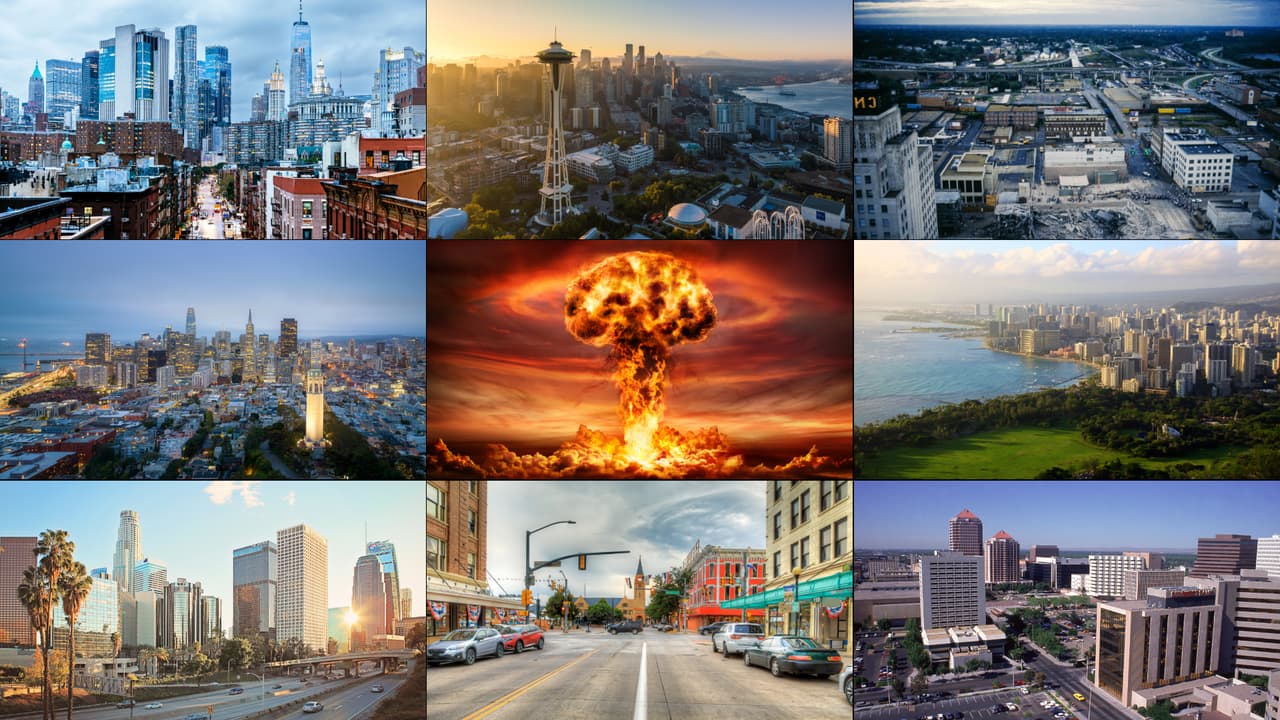
Rising global tensions raise fears of a wider conflict
As tensions rise in the Middle East, many security experts are warning about the risk of a much larger global conflict. Recent military strikes by the United States and Israel on targets in Iran have increased fears that the situation could spiral into something far more dangerous.
Several European nations have also started moving military equipment to support their allies. At the same time, governments are trying to avoid becoming directly involved in fighting.
Military analysts say the biggest worry is that the conflict could draw in powerful nations such as Russia or China. Both countries are close partners of Iran and possess some of the world’s largest nuclear arsenals.
If a wider war were to break out between major powers, experts warn that the risk of nuclear weapons being used would increase sharply. In such a situation, the United States itself could become a major target.


The cities experts say could be hit in a nuclear war
Over the years, defence experts, as quoted by Daily Mail report, have studied which locations inside the US would likely be attacked first if a nuclear conflict began. These areas are not chosen randomly. Instead, they are selected because they hold important military, economic or political value.
A list that has circulated in defence discussions, and was even mentioned on Russian state television in 2019, highlights several US cities and regions that could become early targets in a nuclear strike scenario.
The locations include famous major cities, but also several smaller places that host key military facilities.
Why certain cities become strategic targets
In any nuclear war scenario, attackers usually focus on locations that could weaken a country’s ability to respond. This means military bases, missile command centres and nuclear weapon storage sites are considered top targets.
Cities that host these facilities could face serious danger because they sit close to strategic defence infrastructure.
Another factor is economic importance. Large financial centres, ports and technology hubs could be targeted because damaging them would disrupt the country’s economy.
Population density also plays a role. Highly populated cities would suffer heavy casualties in an attack, which would create chaos and pressure on government systems.
Finally, geography matters. Some cities have limited evacuation routes due to mountains, water or limited road networks. In an emergency, this could make it very difficult for people to escape quickly.
Honolulu, Hawaii
Honolulu may be famous for its beaches and tourist attractions, but it also holds major strategic importance.
The city is home to Pearl Harbor and Joint Base Pearl Harbor-Hickam, two of the most important US military facilities in the Pacific region.
These bases support naval operations and air force missions across the Pacific Ocean. Because of this role, Honolulu could become a significant target in a nuclear conflict involving major powers.
The city has about 350,000 residents. Its remote location in the middle of the Pacific Ocean, about 2,500 miles from California, could make evacuation extremely difficult if an attack occurred.
Shreveport, Louisiana
Shreveport is not widely known outside the United States, but it sits near one of the most powerful nuclear airbases in the country.
Barksdale Air Force Base is located less than six miles from the city. The base operates B-52 bombers, which are capable of carrying nuclear weapons and striking targets across the world.
Because of this role in the US nuclear strike system, the area could be seen as a priority target during a nuclear conflict.
Shreveport has a population of about 172,000 residents, meaning a strike near the base could have severe consequences for civilians.
Ogden and Clearfield, Utah
The cities of Ogden and Clearfield lie along Utah’s Wasatch Front and together have more than 121,000 residents.
They sit near Hill Air Force Base, which supports the Air Force Nuclear Weapons Center.
This installation plays a major role in maintaining and managing the United States’ nuclear arsenal.
Although the region is known for its scenic mountains and quiet suburban life, its close link to nuclear defence systems makes it strategically important.
Experts have estimated that a nuclear explosion in the region could cause more than 87,000 deaths.
Evacuation could also be challenging because the surrounding mountains limit the number of major highways leaving the area.
Cheyenne, Wyoming
Cheyenne is a relatively small city with around 66,000 residents, but its military role gives it significant importance.
The city hosts Francis E. Warren Air Force Base, which oversees a large number of US intercontinental ballistic missiles.
These missiles form a critical part of the United States’ nuclear deterrent system.
Because of this role, Cheyenne could be considered a high-priority target in a nuclear conflict.
The region’s rural road network and limited transport routes could make it difficult for large numbers of people to evacuate quickly.
Great Falls, Montana
Great Falls is located near Malmstrom Air Force Base, which controls hundreds of nuclear missile silos across the northern United States.
This base is a central part of the country’s land-based nuclear defence system.
Although Great Falls has a population of only about 60,000 residents, its proximity to the missile command centre increases its strategic importance.
Evacuation during an emergency could be complicated by Montana’s long distances between towns and limited road networks. Harsh winter weather could also create serious challenges.
Colorado Springs, Colorado
Colorado Springs, Colorado
Colorado Springs is home to several important military installations.
One of the most significant is the North American Aerospace Defense Command (NORAD), which monitors and protects airspace over the United States and Canada.
Peterson Space Force Base is also located in the area and plays a role in space-based military operations.
The city has nearly 492,000 residents and acts as both a major population centre and a military hub.
However, the surrounding Rocky Mountains limit the number of evacuation routes, which could lead to heavy traffic and congestion during an emergency.
Omaha, Nebraska
Omaha plays a major role in the command structure of the US military.
Just outside the city is Offutt Air Force Base, which serves as the headquarters of the United States Strategic Command.
This command centre oversees the nation’s nuclear weapons and global military operations.
With about 486,000 residents, Omaha sits close to one of the most important command centres in the US defence system.
Severe winter weather and limited shelter infrastructure could make evacuation difficult during a crisis.
Albuquerque, New Mexico
Albuquerque is another city with deep connections to the US nuclear weapons programme.
Kirtland Air Force Base, located in the city, stores one of the largest concentrations of nuclear weapons in the country.
The city has a population of more than 557,000 residents and plays a major role in nuclear research, logistics and military operations.
Because of its large size and desert surroundings, evacuating large numbers of people quickly could prove challenging.
Houston, Texas
Houston is one of the largest cities in the United States, with a population of about 2.3 million people.
It is widely known as the country’s energy capital because it hosts major oil refineries, chemical plants and shipping ports.
The city’s industrial infrastructure plays a crucial role in the global energy market.
Because of its economic importance, Houston could become a major target in a large-scale conflict.
Seattle, Washington
Seattle is a major technology hub and an important port city on the US west coast.
The region lies near Naval Base Kitsap, which is one of the largest nuclear submarine bases operated by the US Navy.
These submarines form a critical part of America’s nuclear deterrence system.
Seattle’s geography could make evacuation difficult. The city is surrounded by mountains and water, leaving only a limited number of land routes for people to escape during a crisis.
Los Angeles, California
Los Angeles is the second-largest city in the United States, with more than 3.7 million residents.
It is home to major ports, aerospace companies, defence contractors and global media industries.
Because of its massive population and economic influence, Los Angeles could be a major strategic target.
The region’s already crowded freeway network could make evacuation extremely slow and difficult.
San Francisco, California
San Francisco sits at the centre of one of the world’s most powerful technology and financial regions.
The city has about 842,000 residents and plays a key role in global innovation and finance.
However, its geography could create serious problems during an emergency.
The city is surrounded by water on three sides and connected to the mainland by only a few bridges, which could quickly become overwhelmed if people tried to flee.
Chicago, Illinois
Chicago is the third-largest city in the United States, with nearly 2.7 million residents.
Its wider metropolitan area is home to around 9.6 million people.
The city serves as a major transport hub connecting railways, highways and airports across the country.
Because of its infrastructure, population density and economic importance, Chicago could become a strategic target during a nuclear conflict.
Washington, DC
Washington, DC is the political centre of the United States.
The city houses the White House, the US Congress and the Pentagon.
Because these institutions control the country’s leadership and military command, the capital would almost certainly be among the first targets in a major conflict.
Washington has roughly 684,000 residents, but millions more work in the surrounding metropolitan area.
New York City
New York City is the most populous city in the United States, with around 7.9 million residents.
It is the centre of global finance and hosts institutions such as Wall Street and the United Nations.
A nuclear strike on New York would cause enormous human loss and severe economic disruption across the world.
Because of its global importance and symbolism, experts believe New York would likely be one of the most significant targets in any large-scale nuclear conflict.
The wider risk of escalation
Experts stress that the scenarios discussed above are theoretical and based on strategic analysis rather than predictions.
However, they highlight the serious consequences that could occur if tensions between major global powers were to escalate into open conflict.
For now, international leaders continue to stress the importance of diplomacy and dialogue to avoid a crisis that could have devastating global consequences.