- Home
- India
- Over 100 Killed In UP As Violent Thundersquall Sweeps Five Districts: What Made It So Deadly?
Over 100 Killed In UP As Violent Thundersquall Sweeps Five Districts: What Made It So Deadly?
A violent thundersquall swept across Uttar Pradesh, killing at least 104 people in Bhadohi, Fatehpur, Budaun, Chandauli, and Sonbhadra. Strong winds, lightning, and heavy rain caused widespread damage. The storm was triggered by Western Disturbances.
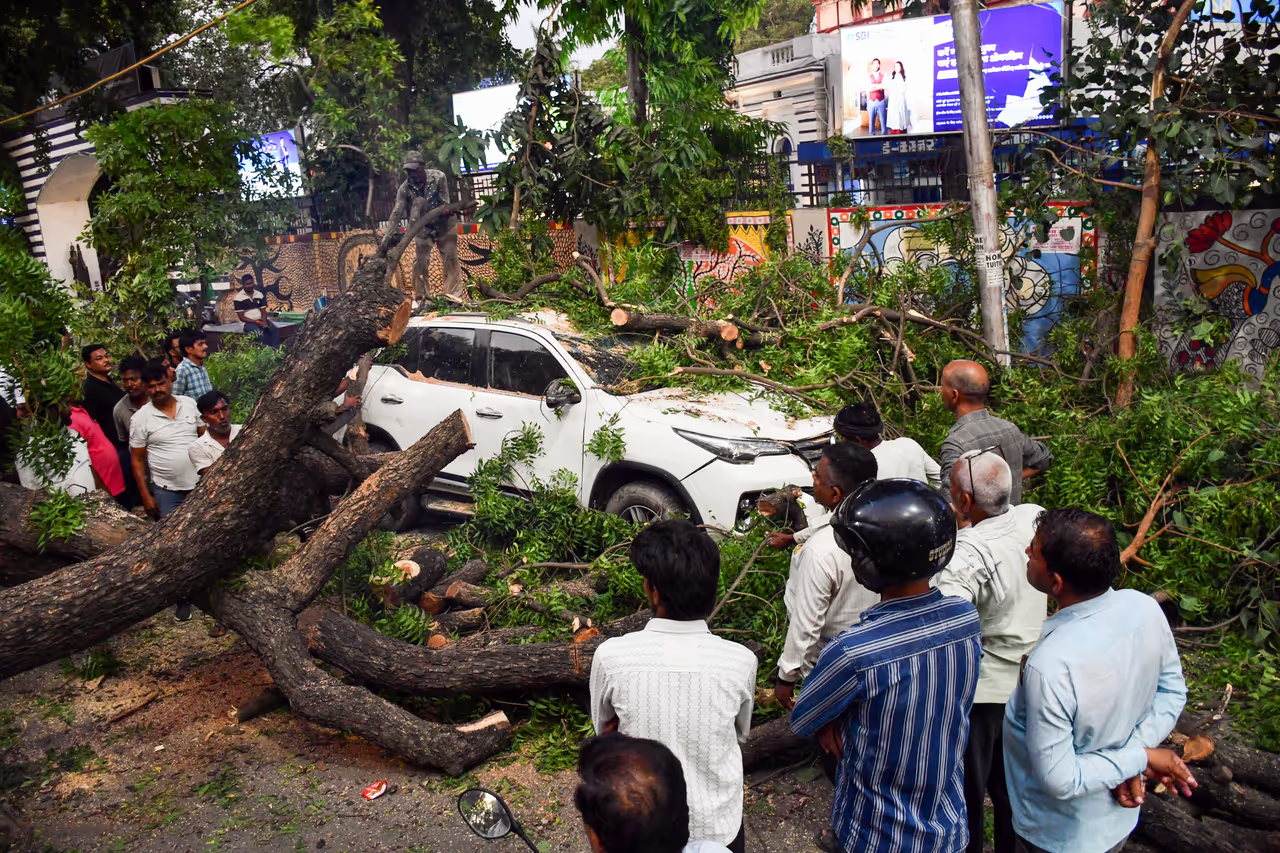
Over 100 Killed Due To Thundersquall Across UP
A violent thundersquall swept across parts of Uttar Pradesh on Wednesday, causing widespread destruction and heavy loss of life. According to officials, at least 104 people have died due to relentless rain, lightning, and strong thunderstorms over the past 36 to 48 hours.
The storm hit five districts badly: Bhadohi, Fatehpur, Budaun, Chandauli, and Sonbhadra. Many homes were damaged, trees were uprooted, and several areas lost mobile network service. The tragedy has left families in shock across the state.


What Is A Thundersquall?
A thundersquall is not a normal rain shower. It is a fast-moving and violent storm. It forms when very hot air near the ground rises quickly and meets cooler air above. This process is called convection, which simply means hot air going up.
In May, temperatures in north India often cross 40 degrees Celsius. The land becomes extremely hot. This hot air rises rapidly and pulls in moist air from other directions. When these air masses meet, they form tall storm clouds called cumulonimbus clouds. These clouds can bring lightning, hail, heavy rain, and very strong winds.
When such clouds collapse, cold air rushes down to the ground. This downward rush is called a downdraft. It spreads out quickly and can turn into powerful winds. In dust-prone areas, it can create dangerous dust storms, locally known as “andhi.”
Why Did The Storm Become So Severe?
Meteorologists say the storm was triggered by atmospheric systems over the region. The India Meteorological Department (IMD) had flagged a Western Disturbance over North Pakistan and Jammu. Another cyclonic circulation was present over south Haryana and northwest Uttar Pradesh.
A Western Disturbance is a low-pressure system that starts near the Mediterranean Sea and moves east through Iran, Afghanistan, and Pakistan before reaching India. It is driven by westerly winds.
These systems carry moisture from the Mediterranean, Caspian Sea, and Black Sea. When they meet the already hot air over north India in April and May, they can trigger severe thunderstorms.
In the 24 hours before Wednesday’s event, IMD had already recorded thunderstorms with wind speeds between 50 and 100 km/h in parts of Uttar Pradesh. The atmosphere was already unstable.
Why May Is Dangerous In Uttar Pradesh
March to May is called the pre-monsoon season. During this time, the land heats up strongly, but the monsoon has not yet arrived to cool and stabilise the air.
Because of this, the temperature difference between the hot ground and cooler upper air becomes very high. This creates strong instability. Any trigger, such as a Western Disturbance or cyclonic circulation, can start a severe storm.
Research published in scientific journals explains that dust storms form when moist winds from one direction collide with dry winds from desert regions. This collision creates strong convection and powerful downdrafts.
The position of the upper-level jet stream, a fast-moving wind high in the sky, also guides these storms and affects their strength.
Studies confirm that pre-monsoon thunderstorms in Uttar Pradesh and nearby Himalayan regions are linked to this heat-driven instability.
Role Of Climate Change
Experts say that climate change is increasing the intensity of such storms. Higher temperatures mean more energy in the atmosphere. This leads to stronger convection, faster storm formation, and more powerful downdrafts.
Western Disturbances are now seen throughout the year, not just in winter. When they overlap with high summer heat, they can produce extreme weather.
For densely populated areas like the Indo-Gangetic Plain, where many homes are made of mud and light materials, this combination can be deadly.
Lightning And Its Impact
Lightning is a natural part of these storms. Inside tall cumulonimbus clouds, ice particles and water droplets collide. This creates electrical charges. The top of the cloud becomes positively charged, and the bottom becomes negatively charged.
When the charge difference becomes very large, it is released as lightning. This can strike the ground or travel between clouds.
Lightning has caused many deaths during this event.
Bhadohi And Other Districts Suffer Heavy Damage
Bhadohi was the worst affected district. Trees were uprooted within seconds. Mud walls collapsed while families were taking shelter. Entire areas lost mobile network signals.
Reports from 19 districts, including Barabanki, Bahraich, Kanpur Dehat, Basti, Sambhal, Hardoi, and Unnao, mention deaths, livestock loss, and crop damage.
So far, 130 livestock animals (large and small) have died, and 98 houses have been damaged.
#उत्तर_प्रदेश
आंधी-तूफान का #कहर, 54 लोगों की #मौत, सैकड़ों लोग #घायल, इलाज जारी#UttarPradesh#UPWeather#Storm#RainAlert#UPNews#HeavyRainAlert#WeatherUpdate#Thunderstorm#NaturalDisaster#samachareisamay@NewsFlash@UPGovtpic.twitter.com/hbHNDkHV7B— Goldy Srivastav (@GoldySrivastav) May 14, 2026
In several cases in Bhadohi, Budaun, and Fatehpur, people died while standing under trees or inside mud houses during the storm. Both are very dangerous places during thunderstorms.
Injuries In Bareilly Incident
In Bareilly, Uttar Pradesh, a young man named Nanha Miyan was standing near a tin shed during strong winds. When the storm became stronger, the tin roof was lifted. He was carried into the air with it.
The tin sheet fell to the ground, but he was thrown down later. He suffered serious injuries. Both his hands and legs are broken. He is now admitted to hospital.
31 people have been killed as powerful storm, rains caused havoc in various districts of Uttar Pradesh. pic.twitter.com/Q94PJxxKBV
— Citizen Kau (@citizen_kau) May 13, 2026
Up #Bareliy के कस्बा बिशारतगंज ब आसपास के क्षेत्रों में तेज आंधी और बारिश से भारी तबाही तेज हवाओं के कारण जगह-जगह पेड़ टूटकर गिरे जिससे सामान्य जनजीवन हुआ प्रभावित। #Bareliy@myogiadityanath@dmbareillypic.twitter.com/gvHjmm7tc2
— sayma Khan journalist (@SaymaKh32639264) May 13, 2026
This incident shows how dangerous strong winds can be during such storms.
Government Response And Relief Measures
The Uttar Pradesh Relief Commissioner, Harikesh Bhaskar, confirmed that at least 104 people have died due to rain, lightning, and thunderstorms.
The state government has started financial relief. Monitoring is ongoing. A 24-hour Integrated Control and Command Centre is active. Officials have been told to conduct field inspections.
Chief Minister Yogi Adityanath has expressed condolences to the families of the victims.
On Tuesday, Union Minister Dr Jitendra Singh launched two advanced weather forecasting systems under the Ministry of Earth Sciences. These systems aim to provide hyper-local and AI-based weather alerts.
IMD had already issued warnings for May 13 and 14 about thunderstorms with strong winds and lightning.
However, experts say warnings must be matched with public awareness and safe behaviour.
Safety Advice During Such Storms
Officials remind people to stay indoors during storms. It is unsafe to stand under trees, near walls, or in open fields. Many deaths in this event happened because people sought shelter under trees or in weak structures.
When the sky turns dark and winds increase, the safest place is inside a strong building.
(With inputs from agencies)
Stay updated with the Breaking News Today and Latest News from across India and around the world. Get real-time updates, in-depth analysis, and comprehensive coverage of India News, World News, Indian Defence News, Kerala News, and Karnataka News. From politics to current affairs, follow every major story as it unfolds. Get real-time updates from IMDon major cities weather forecasts, including Rain alerts, Cyclonewarnings, and temperature trends. Download the Asianet News Official App from the Android Play Store and iPhone App Store for accurate and timely news updates anytime, anywhere.