Remembering Dharmendra: The He-Man Who Ruled Hearts for Six Decades
Legendary Bollywood actor Dharmendra, star of 300 films and one of Indian cinema’s most loved icons, has passed away at 89 in Mumbai, ending a six-decade career that shaped generations of film lovers.
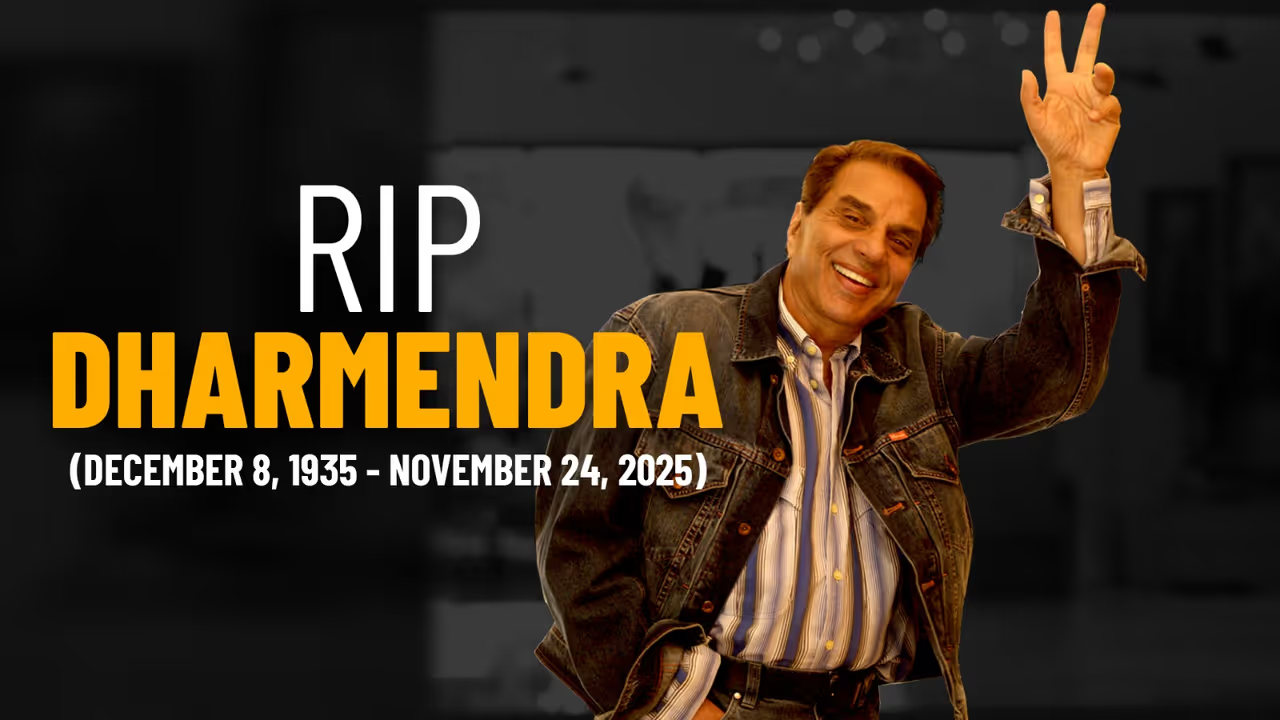
The He-Man With a Poet’s Heart Who Lit Up 65 Years of Hindi Cinema
When Dharmendra smiled, hearts melted; when he flexed those famous “dishoom” biceps, villains trembled. For over six decades, he stood at the intersection of tenderness and swagger — the rare Hindi film hero who could romance, joke, fight, and still look like the boy next door who made it big. On Monday, the curtain came down on an era. Dharmendra passed away in Mumbai, just days before he would have turned 90.
His funeral at Pawan Hans crematorium in Vile Parle drew industry heavyweights and emotional admirers. Amitabh Bachchan, Hema Malini, Esha Deol, Salman Khan, Aamir Khan, Abhishek Bachchan — generations of colleagues and fans came to pay final respects.
What India said today was not goodbye. It was gratitude.
Prime Minister Narendra Modi captured a nation’s sentiment in his tribute:
“The passing of Dharmendra Ji marks the end of an era in Indian cinema. He was an iconic film personality, a phenomenal actor who brought charm and depth to every role he played... Dharmendra Ji was equally admired for his simplicity, humility and warmth.”
After 300 films, blockbuster after blockbuster, hearts won both on and off screen, and an influence that spanned three generations of Indian cinema, Dharmendra leaves behind not just a filmography — but a feeling.


A Village Boy with Film Posters in His Eyes
Dharmendra’s life began far from the arclights — in Nasrali, a small village in Ludhiana, on December 8, 1935. He was born Dharam Singh Deol to a respected schoolteacher, a man who believed education could lift lives. He dreamt that his son might someday become a professor.
But another teacher — cinema — was calling.
A teenage Dharmendra would walk to the local railway station and climb the bridge, folding his hands to pray as the Frontier Mail roared past below. He asked for one thing — that the train would someday take him to Bombay, the mythical land where actors became gods.
Like many great movie stories, this too needed a twist of fate. In 1958, Filmfare magazine announced a nationwide talent hunt. Dharmendra, armed with dreams, photographs and no backup plan, applied — and won. He boarded the train he once prayed before and arrived in Bombay with a suitcase, some confidence, and more hunger than money.
Before his first shoot began, the young struggler worked in a drilling firm for ₹200 a month. The dream had begun, but it demanded rent.
Struggle, Breakthrough, and the Arrival of a New Kind of Hero
His debut came with “Dil Bhi Tera, Hum Bhi Tere” (1960) — not a failure, but not quite the explosion that later roles would be. Audiences noticed the handsome newcomer. Directors noticed the quiet intensity he carried in his eyes.
Slowly, films began to come — “Ayee Milan Ki Bela”, “Kaajal”, “Haqeeqat” — each building a reputation brick by brick. Then came the turning point:
“Phool Aur Patthar” (1966) opposite Meena Kumari.
Dharmendra emerged not as another handsome face, but a screen presence. Audiences saw a man who could be rugged and romantic in the same breath — the country’s first true He-Man, with a marshmallow soul.
But destiny had one more gift — filmmaker Hrishikesh Mukherjee.
Mukherjee saw what many hadn’t yet fully realised — the vulnerability beneath the striking looks. Beginning with “Anupama”, the director cast Dharmendra in a series of films where silence spoke louder than action. “Satyakam”, “Guddi”, “Chaitali” and “Chupke Chupke” displayed a tender, literate, thoughtful performer.
In an interview years later, with characteristic modesty, Dharmendra reflected:
“I have always broken my image every time I went on screen. I don't know what it means to be a Greek god but people used to call me one.”
In truth, he was far more complex — the rare actor who could headline a patriotic drama in the morning and a romantic comedy in the evening.
A Star at His Peak — And a Superstar Beside Him
As the 1970s rolled in, Hindi cinema was changing. A tall, deep-voiced new actor named Amitabh Bachchan was capturing the nation’s imagination.
For many stars, such seismic change would have meant sidelining. Dharmendra refused to be overshadowed.
Instead, he partnered with Bachchan in two of the most beloved films in Indian history — “Chupke Chupke” and “Sholay”.
The friendship between Jai (Dharmendra) and Veeru (Bachchan) in Sholay became the gold standard of on-screen male bonding — the kind that felt real, unmanufactured, and human. Their banter, bravery and vulnerability etched itself into folklore. So often, fans have said: if you mention Indian cinema in one sentence, “Jai-Veeru” eventually enters the conversation.
His superstardom continued through the 70s and 80s as he headlined romances, thrillers, action films and entertainers with heroines across generations — Sharmila Tagore, Hema Malini, Dimple Kapadia, Sridevi and many more.
Unshakeable. Adaptable. And always, always watchable.
Reinvention at an Age Where Most Fade
Most actors have two acts — Dharmendra had four.
In 2007, at 72, he surprised everyone with a gritty performance in Sriram Raghavan’s “Johnny Gaddar”, and then a deeply emotional character in Anurag Basu’s “Life in a… Metro”.
He proved that he could transition from hero to character actor without losing either dignity or screen command.
And then came perhaps the most remarkable full-circle moment — 2023.
In “Rocky Aur Rani Ki Prem Kahani”, at 88, he played a man still capable of loving, longing, and sweeping audiences off their feet. His romantic scenes with Shabana Azmi — especially set to “Abhi Na Jao Chhod Kar” — went viral.
The walk was slower. The hair was white. But the eyes still sparkled. The smile still felt like home.
The audience didn’t see an “old actor”. They saw Dharmendra — timeless.
The Poet, The Farmer and “Aapka Dharam”
The industry gave him stardom. Punjab gave him roots he never abandoned.
He retained the simplicity of a man who knew the value of soil and season. At his farmhouse in Lonavala, he grew vegetables, tended land, and often clicked photographs of fresh produce to share online. Millions followed him on X and Instagram, where he posted poetry, couplets, Gujarati shayari, and philosophical reflections.
The handle he chose: “aapkadharam”. Not “mega star”, not “legend”. A man who belonged to the people.
A Love Story That Lived in Newspapers
When Dharmendra married Prakash Kaur, the couple had four children — Sunny, Bobby, Ajeeta and Vijeta. Years later, his electrifying pairing with Hema Malini led to a love story that India watched unfold in real time.
Their chemistry shimmered in films like “Seeta Aur Geeta”, “Dream Girl”, “The Burning Train” and “Sholay”. After a widely discussed religious conversion controversy — which Dharmendra always denied — the couple married and had daughters Esha and Ahana.
Their love became part of Bollywood mythology — passionate, intensely lived, and human.
Vijayta Films — A Launchpad for Generations
In 1981, Dharmendra founded Vijayta Films — not as a vanity banner, but as a legacy.
- Sunny Deol debuted with “Betaab” (1983)
- Bobby Deol began with “Barsaat” (1995)
- Abhay Deol got his break in “Socha Na Tha” (2005)
- Grandson Karan Deol debuted in “Pal Pal Dil Ke Paas” (2019)
Three generations walked through a door he opened.
The Deol men finally appeared together on screen in “Apne” (2007) and later in the cheerful “Yamla Pagla Deewana”, titled after one of Dharmendra’s own evergreen songs from “Pratigya”.
He could be stern as a father — resisting daughter Esha’s entry into films — but also soft enough to eventually act with her in “Tell Me O Kkhuda” (2011).
At heart, Dharmendra was always a family man. Just a famous one.
Politics, Awards and a Life Beyond Film
Though he remained one of India’s most recognisable stars, Dharmendra was not a constant fixture on award stages. His greatest honour arrived as producer of “Ghayal” (1990), which won the National Award for Best Popular Film Providing Wholesome Entertainment.
He received the Padma Bhushan and even served as an MP from Bikaner after winning the Lok Sabha seat in 2004 on a BJP ticket — though politics never became his primary identity.
A Misinformation Storm Before the Final Goodbye
In a painful twist, earlier this month, false reports of his death went viral — forcing the family to request privacy and dignity for the ailing legend. When the end finally came, the family chose silence, letting the world grieve in its own way, while they mourned in private.
Tributes poured in.
Karan Johar wrote:
“It is an end of an ERA….. a massive mega star… incredibly handsome… a bonafide Legend of Indian Cinema… but mostly he was the best human being…”
Kajol shared a message that resonated with many:
“The OG of the Good Man is gone and the world is poorer for it.. somehow it seems like we are only losing the good people in it. Kind to the core and loved always.”
Few who met him ever complained that the man differed from the image. He was, by most accounts, exactly what audiences hoped he was — straightforward, emotional, at times impulsive, but always kind.
The Final Performance Still Awaits
Fittingly, even death does not stop Dharmendra from appearing again. His final film — the Sriram Raghavan war drama “Ikkis” — releases on December 25.
A last bow. A final spark from a star who never stopped shining.
The Legacy That Cannot Be Replaced
Cinema creates stars. But only a handful become feelings.
For 65 years, Dharmendra was the hero your mother adored, your father respected, your sister blushed for, and your grandfather cheered. He was the action hero before the era of gym-built physiques, the romantic hero before the age of lip-synced formula, and the comic hero without ever being a comedian.
He was one man who could do it all — convincingly.
And he did it with grace.
Dharmendra may have left the stage, but heroes like him don’t fade. They become part of the country’s subconscious — dialogue lines quoted on tea stalls, songs hummed on long bus rides, posters treasured on living-room walls, and memories passed down from grandparents to grandchildren. In that sense, Dharmendra has not exited. He has only moved — to the brightest seat in the cosmic cinema hall.
Where legends sit. Forever.
Catch all the latest Entertainment News from movies, OTT Release updates, television highlights, and celebrity gossip to exclusive interviews and detailed Movie Reviews. Stay updated with trending stories, viral moments, and Bigg Boss highlights, along with the latest Box Office Collection reports. Download the Asianet News Official App from the Android Play Store and iPhone App Store for nonstop entertainment buzz anytime, anywhere.