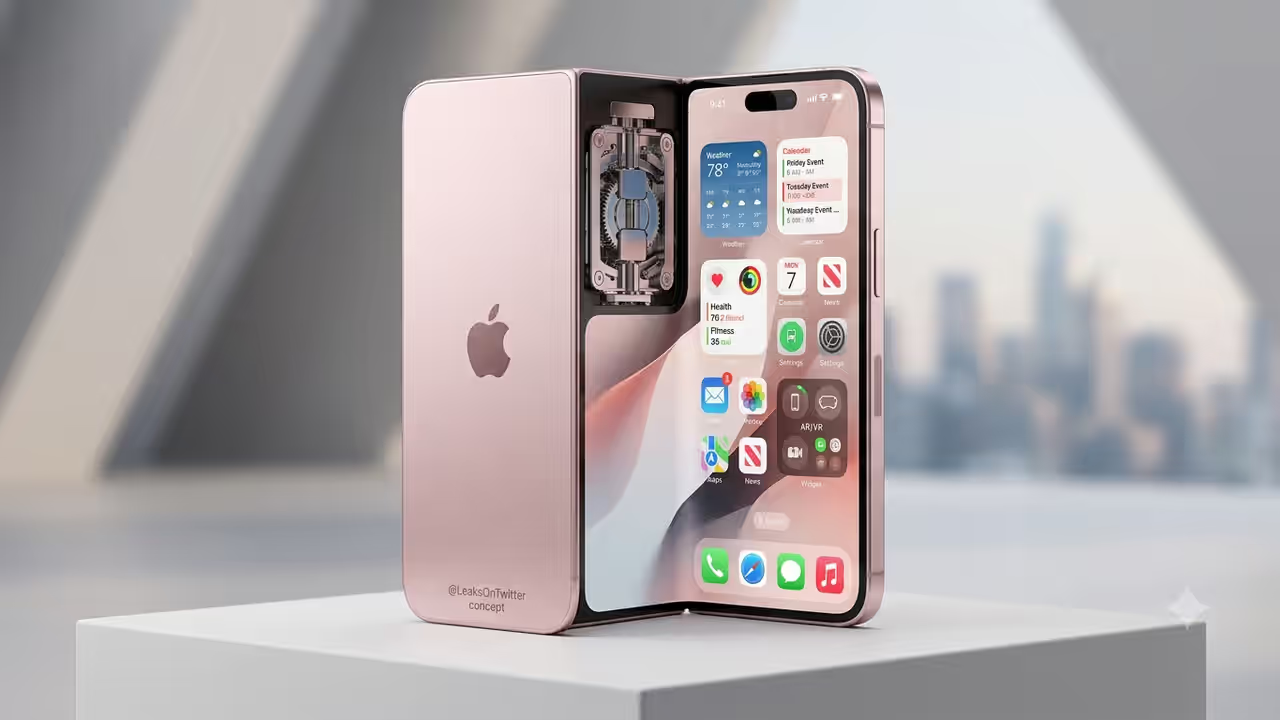
Apple is reportedly set to launch its first foldable iPhone, the culmination of a decade-long project intensified by CEO Tim Cook. The company focused on creating a nearly creaseless screen with a custom hinge to justify its premium price, which could start as high as $2,199.
Around 2020, Apple CEO Tim Cook came back from a trip through Asia with a new obsession. According to sources familiar with the situation quoted by Bloomberg, he had witnessed an increasing number of people using folding phones from Samsung and Huawei and returned home persuaded Apple needed to produce one as well. He was unaware at the time that Apple's own engineers had been discreetly researching folding screens and hinges for years before to the 2019 release of Samsung's first Galaxy Fold.
This week, Apple is anticipated to introduce its first foldable iPhone, the largest design change in the device's almost 20-year existence, marking the culmination of that ten-year endeavour.
According to Bloomberg, Apple's hardware teams focused on four main issues early in the development process: concealing the crease that has been present on almost all foldable screens to date; ensuring that the hinge would hold up over years of folding; designing a flexible cover glass that wouldn't break or scratch; and positioning camera components behind the display itself to avoid wasting screen space on notches or cutouts.
Related Articles

Reports further suggests Apple's design team considered the crease to be non-negotiable out of the four. For a $1,000 Android gadget that was competing on features, a visible fold line could be acceptable, but Apple was getting ready to charge more than twice that amount for a product that it wanted consumers to view as premium first and foldable second. The entire pitch is undermined by a seam that runs down the middle of a $2,000 phone. Any other shortcoming of a first-generation foldable might be described as a trade-off. A conspicuous gap indicates an unresolved issue.
In response, Apple created a titanium and aluminium hinge and a bespoke cover glass in collaboration with Corning. The combination results in a crease that is far less noticeable than any foldable presently on the market, according to Bloomberg's reporting. Apple plans to use this contrast as a key component of its marketing strategy.
How Tim Cook Started The Project?
The concept was not initially intended to be a phone. Something more akin to an iPad mini that expanded into a bigger tablet was envisioned in early internal ideas. According to Bloomberg's reporting, Cook's push during his trip to Asia turned the work toward a foldable iPhone instead. This was a noteworthy intervention for a CEO more recognised for supply-chain and financial discipline than for determining product direction.
Dan Riccio is said to have invented the concept before Cook and current CEO John Ternus became its most ardent internal supporters. According to Bloomberg, Ternus later utilised his position to see the gadget through to completion.
iPhone Fold Expected Price
Apple originally targeted $1,999 for the device, mirroring the just-under-a-threshold pricing it used for the $999 iPhone X in 2017. According to Bloomberg, recent internal discussions have pushed that number as high as $2,199, with the ongoing memory chip shortage driving costs past Apple’s original targets. Larger storage configurations could approach $3,000. That compares with a $799 starting price for the standard iPhone, and $1,099 for the iPhone 17 Pro.