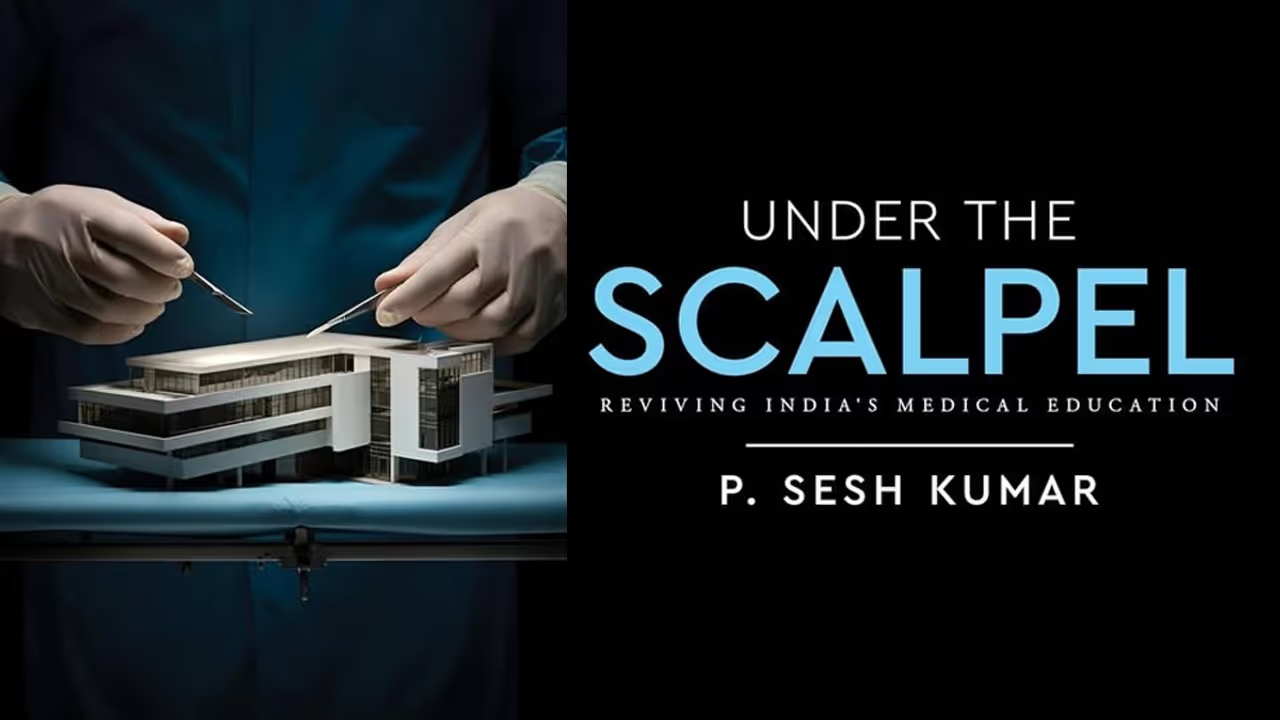
P. Sesh Kumar’s book exposes deep flaws in India’s medical education system, blaming NEET pressure, limited PG seats, regulatory dilution and mental health crises among students.
New Delhi: P. Sesh Kumar’s book Under the Scalpel: Reviving India’s Medical Education reveals a system expanding at breakneck speed yet cracking under pressure, inequity and regulatory chaos. Kumar notes that India today boasts one of the world’s fastest-expanding medical education systems. The establishment of new colleges and the addition of MBBS seats in recent years have been a major focus of the government.
However, Kumar — who served as Secretary to the Supreme Court–mandated Oversight Committee on the Medical Council of India (2016–17) — argues that beneath the impressive numbers lies a system in deep distress.
NEET’s, Hidden Cost: Childhood Lost, Minds Broken
At the heart of the crisis is NEET. Kumar credits the exam with curbing corruption and imposing a national benchmark. Yet, he argues, its transformation into a single, high-stakes gatekeeper has exacted a brutal psychological cost on medical aspirants.
Related Articles

“Children as young as 13 are drawn into a grind of 14-hour coaching days, stripped of childhood and crushed by expectation. Kota, India’s coaching capital, has become a grim symbol — 26 student suicides in 2023 alone, most of them NEET or JEE aspirants,” Kumar writes.
He flags rising anxiety, depression, panic attacks and sleep disorders among medical aspirants, describing these challenges as “structural by-products of the system.”
“For students from poorer families, the pressure is existential. Coaching fees, hostel rents and loans turn one exam into a make-or-break moment. One bad day, and years of sacrifice collapse,” Kumar stresses.
Post-MBBS Bottleneck: Too Many Graduates, Too Few PG Seats
Kumar argues that “NEET has become a gladiatorial contest where the weakest — not the dishonest — are the casualties.”
“The cruelty intensifies after MBBS. India produces over one lakh medical graduates annually, but postgraduate seats number around 74,000, and only half are in government colleges. Private PG seats, often priced up to ₹1 crore, are effectively out of reach for middle- and lower-income doctors,” he writes.
NEET-PG, according to Kumar, is a “national bloodbath” — one rank list, sky-high cut-offs and careers derailed by a single incorrect multiple-choice answer.
“Despite claims of expansion, the system remains structurally unfair. Many new seats are concentrated in poorly equipped private colleges or remote areas lacking academic credibility,” he adds.
Kumar also highlights the imbalance in super-specialty training. “In 2024, just 2,447 DM/MCh seats existed nationwide — roughly one for every 40 MD doctors — while nearly 80% of specialist posts at district hospitals lie vacant,” he writes.
NMC Reforms or Dangerous Dilution?
The National Medical Commission (NMC), set up in 2020 to replace the disgraced Medical Council of India, was meant to restore trust. “It has liberalised faculty and infrastructure norms — allowing visiting faculty, digital attendance, fewer beds and phased construction. While this has helped expand colleges in resource-poor districts, a dangerous slide into dilution is now visible,” Kumar laments.
He warns that “desk-based inspections, lower experience thresholds and reduced clinical exposure risk reviving the very ghosts that haunted the MCI era.”
Kumar cites “CBI raids in 2025” to argue that “inspection scams, ghost faculty and bribery persist across several states.”
He also raises concerns about Indian medical students pursuing education abroad. “From Russia to Eastern Europe, many leave the country out of compulsion. They get trapped by over-admitting foreign universities and rigid Indian rules that bar mid-course transfers. Expulsions by foreign medical schools further lead to financial ruin and shattered dreams,” Kumar writes.