
India reiterated its stance on the Shaksgam Valley, calling it an integral part of its territory. The MEA rejected China's CPEC infrastructure buildup in the region, terming the 1963 China-Pakistan boundary agreement 'illegal and invalid'.
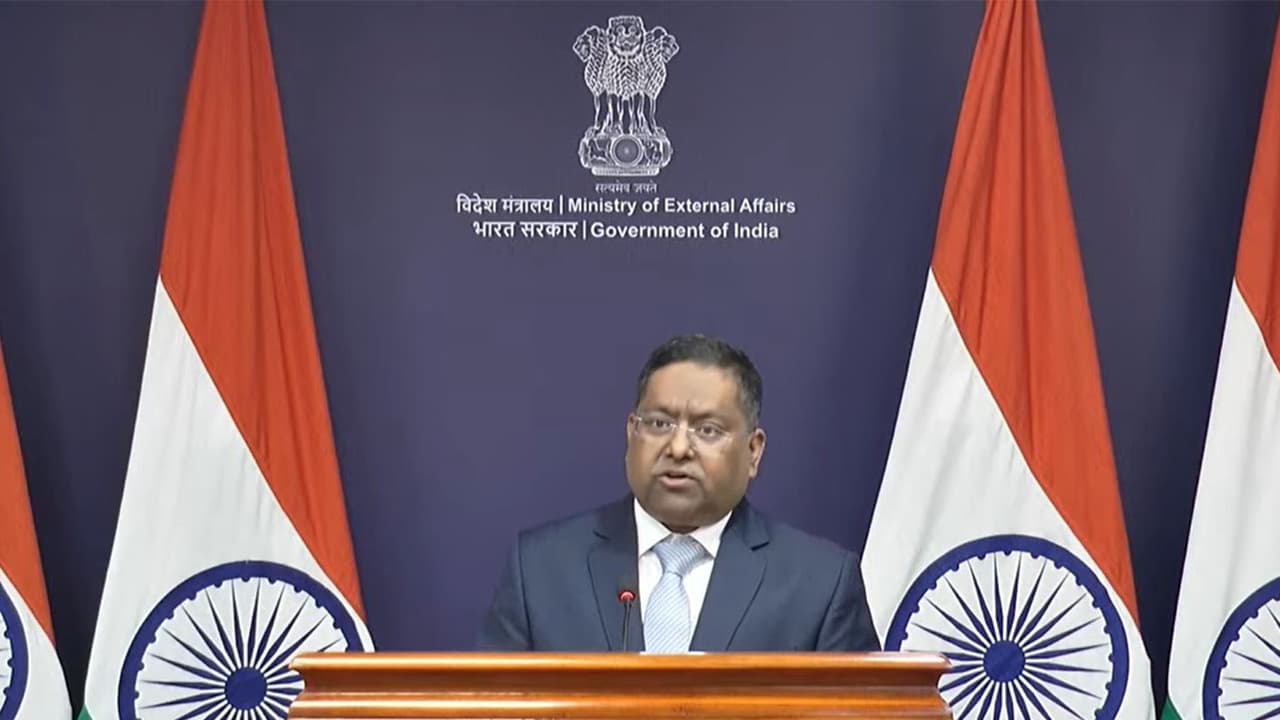
India on Friday reiterated that it has already made its position clear on the Shaksgam Valley issue. Addressing the weekly press briefing in the national capital, Ministry of External Affairs spokesperson Randhir Jaiswal said, "On the Shaksgam issue, we have already clarified what our position is, so I will refer you to our comments that we made in the last press briefing."
India's remarks came days after it had rejected China's infrastructure buildup through the China-Pakistan Economic Corridor (CPEC) in the Shaksgam Valley, terming it "illegal and invalid", while noting that the region is an "integral and inalienable part" of India.
India's Official Stance
During the weekly press briefing on January 9, Jaiswal said India has never recognised the "so-called" China-Pakistan boundary agreement of 1963 or the "so-called" CPEC. "Shaksgam Valley is an Indian territory. We have never recognised the so-called China-Pakistan boundary agreement of 1963. We have consistently maintained that the agreement is illegal and invalid. We do not recognise the so-called China-Pakistan Economic Corridor either, which passes through Indian territory, which is under forcible and illegal occupation of Pakistan," Jaiswal said.
He further reaffirmed that the Union Territories of Jammu and Kashmir and Ladakh are an integral and inalienable part of India, noting that New Delhi has "consistently protested" to the Chinese side on the matter and has further reserved the right to safeguard its interests. "The entire UTs of J&K and Ladakh are an integral and inalienable part of India. This has been clearly conveyed to the Chinese and Pakistani authorities several times. We have consistently protested against the Chinese side's attempts to alter the ground reality in the Shaksgam Valley. We further reserve the right to take necessary measures to safeguard our interests," the MEA spokesperson added.
Strategic Importance of Shaksgam Valley
The Shaksgam Valley lies close to the Siachen Glacier, borders China's Xinjiang in the north, and Pakistan-occupied Kashmir in the south and west, making it highly sensitive for India's security. Shaksgam Valley, also known as the Trans Karakoram Tract, lies in the Hunza-Gilgit region under Pakistan's occupation, north of the Siachen Glacier. Covering over 5,000 sq km, its harsh terrain limits habitation. Although claimed by India, Pakistan controlled the area until 1963, while China earlier asserted influence by building a highway through Aksai Chin linking Tibet and Xinjiang.
Shaksgam Valley holds critical importance for India due to its proximity to the Siachen Glacier, the world's highest battlefield, and its access to the Karakoram Pass. From Siachen, India can closely monitor Pakistan's military movements, while the Karakoram Pass allows observation of Chinese manoeuvres. As a result, developments in the Shaksgam Valley have direct implications for India's security along both the Line of Actual Control (LAC) with China and the Line of Control (LoC) with Pakistan.
China Rejects Objections
Meanwhile, Chinese Foreign Ministry spokesperson Mao Ning on Monday rejected India's objections, claiming its construction activities are legitimate. "The territory you mentioned belongs to China. It's fully justified for China to conduct infrastructure construction on its own territory," Mao said when asked about border issues and the China-Pakistan Economic Corridor (CPEC). However, this stance exposes a contradiction: while China calls Kashmir a bilateral issue between India and Pakistan, it continues strategic development in areas of Kashmir under Pakistan's illegal occupation.
She further said that China and Pakistan had signed a boundary agreement in the 1960s and demarcated borders between the two countries, calling the settlement an exercise of the rights of two sovereign states.
China's 'Salami Slicing' Strategy
Geostrategists have warned that China's "salami slicing" strategy in Shaksgam is nearing a tipping point. China's "salami slicing" strategy is a tactic of achieving territorial expansion or greater influence through a series of small, incremental actions. These actions, individually minor, cumulatively create significant shifts in control, often in disputed areas.
By mid-2024, China reportedly completed a road across the 4,805-metre Aghil Pass into Lower Shaksgam Valley, bringing Chinese construction teams--and potentially military patrols--within 50 km of India-controlled Siachen at Indira Col. Shaksgam Valley, part of the Hunza-Gilgit region, came under China's control in 1963 following a so-called boundary agreement with Pakistan, although India objected. India maintains that Pakistan illegally ceded 5,180 sq km of the Shaksgam Valley to China under a 1963 agreement, which New Delhi has never recognised. The territory was part of Jammu and Kashmir under Pakistan's illegal occupation. The Ministry of External Affairs asserted thatthe Shaksgam Valley is Indian territory and stated that India reserves the right to take "necessary measures" to safeguard its interests.
In 1963, Pakistan formally ceded the Yarkand River region and Shaksgam Valley to China, despite lacking legal authority to transfer Indian territory. (ANI)
(Except for the headline, this story has not been edited by Asianet Newsable English staff and is published from a syndicated feed.)