
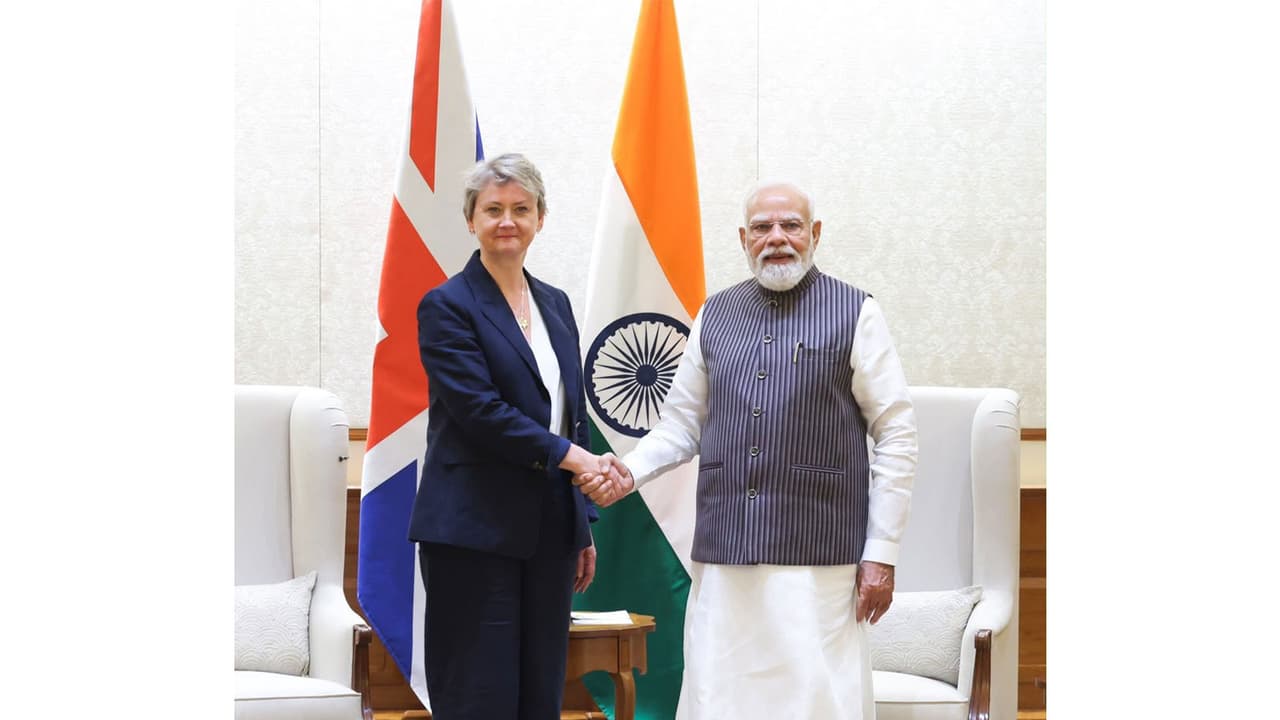
PM Modi met UK Foreign Secretary Yvette Cooper, hailing the deepening India-UK partnership. They discussed Vision 2035, trade, and security. The two nations also launched a joint Critical Minerals Global Supply Chain Observatory in New Delhi.
Modi Hails Deepening India-UK Partnership
Prime Minister Narendra Modi on Thursday met UK Foreign Secretary Yvette Cooper and said the deepening of the India-UK partnership in recent times has unlocked unprecedented growth opportunities for the two countries. In a post on X, he said India-UK Vision 2035 will continue to guide the bilateral partnership. "Pleased to meet UK Foreign Secretary Yvette Cooper. Appreciated the deepening of the India-UK partnership in recent times that has unlocked unprecedented growth opportunities for both our countries. India-UK Vision 2035 will continue to guide our partnership and strengthen our joint efforts for global good," he said.
India and the UK held the first ministerial review of the "India-UK Vision 2035" during the maiden official visit of UK Foreign Secretary. External Affairs Minister S Jaishankar welcomed Cooper, characterising the bilateral relationship as a "forward-looking highway of shared economic ambitions and high technology". The two leaders met to address pressing global concerns, including trade, energy, food, and economic security, against the backdrop of a global "churn in supply chains". The discussion reaffirmed the importance of the Comprehensive Economic and Trade Agreement (CETA) and the defence industrial roadmap in building resilient, mutually beneficial supply chains.
India-UK Launch Critical Minerals Observatory
India and the United Kingdom on Thursday launched the India-UK Critical Minerals Global Supply Chain Observatory (GSCO) in New Delhi, marking a significant step in bilateral cooperation aimed at strengthening critical mineral supply chains and improving resource security for key industries. The observatory was formally launched by Union Minister for Coal and Mines G. Kishan Reddy and UK Foreign Secretary Cooper.
The initiative seeks to support monitoring and analysis of global critical mineral supply chains, helping policymakers, industry and researchers identify supply risks, disruptions and emerging market trends.
Addressing the gathering, Reddy said critical minerals are essential for modern economies and play a key role in clean energy technologies, advanced manufacturing, electric mobility and strategic sectors. He noted that the Observatory would "strengthen India's capabilities in critical mineral supply chain intelligence, support evidence-based policymaking, and advance the objectives of the National Critical Mineral Mission (NCMM).
The minister further said that the initiative reflects India's commitment to building resilient and diversified critical mineral value chains while enhancing international cooperation with trusted partners, according to a release.
Speaking on the occasion, Cooper highlighted the importance of India-UK collaboration in developing resilient, diversified and sustainable critical mineral supply chains. "Greater access to critical minerals and improved information-sharing are in the mutual interest of both nations and can contribute significantly to economic growth and supply chain security," she said.
Cooper added that the partnership has the potential to serve as a foundation for broader cooperation across the critical minerals sector and related strategic industries.
The Observatory is a joint initiative of TEXMiN, the Indian Institute of Technology (ISM) Dhanbad and the University of Cambridge. It aims to create a data-driven platform for monitoring and analysing global critical mineral supply chains. An interactive demonstration of the platform was jointly presented by TEXMiN and the University of Cambridge.
The platform will enable monitoring of global critical mineral supply chains, identification of supply risks and disruptions, generation of market intelligence, and informed decision-making. The initiative was announced during the India-UK Prime Ministers' bilateral engagement in October 2025 and was formalised through a Research Collaboration Agreement signed in March 2026. It is expected to strengthen India-UK cooperation in critical minerals and support resilient, secure and sustainable global supply chains. (ANI)
(Except for the headline, this story has not been edited by Asianet Newsable English staff and is published from a syndicated feed.)