
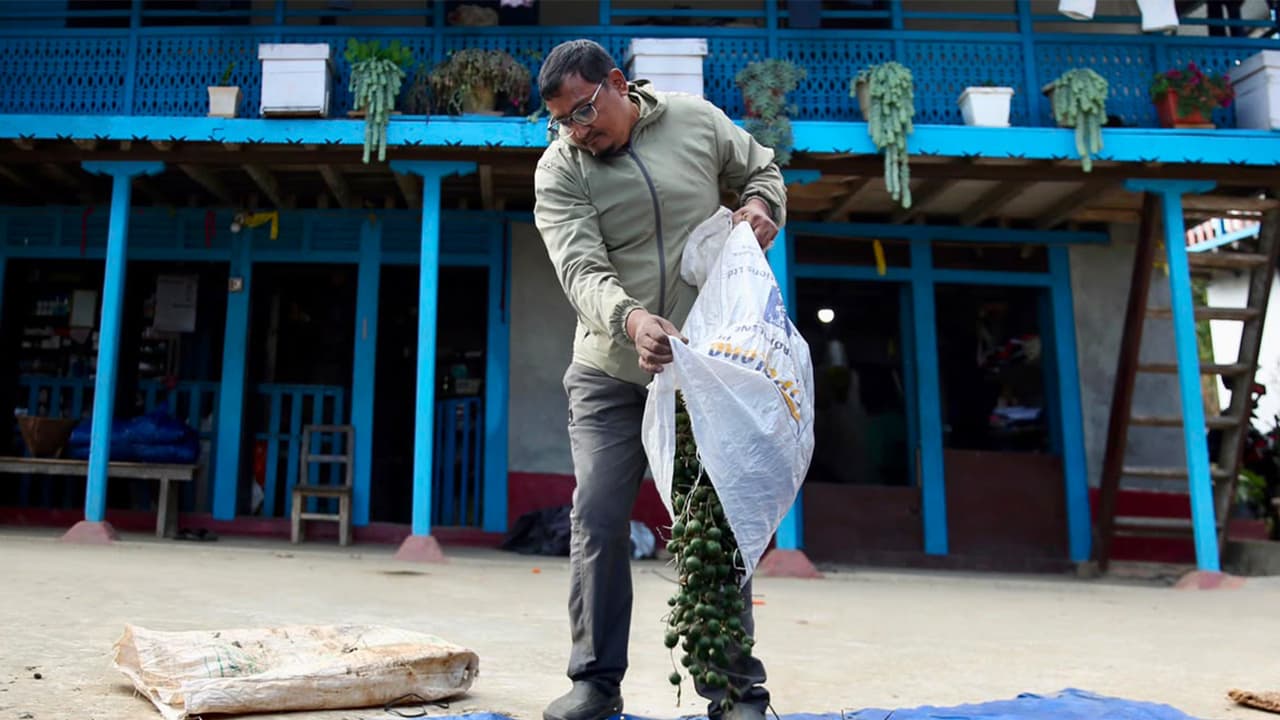
Rudraksha farming in Eastern Nepal sees an economic boom driven by Chinese demand for ornamental seeds. However, to meet aesthetic preferences, farmers resort to unregulated chemicals, risking the long-term health and sterility of the ancient trees.
Bhojpur [Nepal], June 12 (ANI): For three decades, Ashok Karki's family has tended to the towering Elaeocarpus ganitrus or Rudraksha trees that define the landscape of the Makalu Himalayan region. Once a product sold primarily to Hindu pilgrims in India, the Rudraksha has become a high-stakes commodity, driving a massive economic shift in Eastern Nepal.
However, this newfound prosperity comes with a troubling cost: the heavy use of unregulated chemicals to meet the aesthetic demands of the Chinese market. For generations, Rudraksha seeds were valued for their spiritual significance, particularly among Hindus who consider them symbols of Lord Shiva. In recent years, however, a surge in demand from Chinese buyers, who prioritise the seeds as ornamental jewellery rather than religious artefacts, has transformed the local economy.
A High-Stakes Commodity
Before Chinese interest peaked, the common five-faced seeds sold for approximately NRS 30 per kg. Today, prices can soar to NRS 2,000 per seed, with rare, multi-faced varieties fetching millions. Sadananda Municipality, home to over 100,000 Rudraksha trees, now generates an estimated NRS 1 billion annually from exports, positioning itself as the "Rudraksha Capital of Nepal."
To satisfy Chinese buyers, who prefer specific shapes and sizes, farmers have increasingly turned to chemical interventions. Traders report that they inject buds with Plant Growth Regulators (PGRs) up to four times during the early stages of development. "The natural seeds are not that attractive," explains Karki. "To catch the attention of Chinese traders, we have to use these medicines. It has become a compulsion."
Karki has been earning a substantial income from the orchards since childhood. A single tree can yield more than 4,000 seeds per year. While single-facet (ekmukhi) Rudraksha seeds are extremely rare and believed to have miraculous healing powers, five-faced (panchamukhi) seeds are the most common and in high demand.
The Chemical Compulsion
Initially dependent on Indian tourists and pilgrims, farmers and traders have now tapped into the Chinese market. However, meeting Chinese demand has required significant changes to farming practices. The practice presents several critical issues. Because the government of Nepal has not sanctioned the use of these specific growth regulators for Rudraksha, farmers are often forced to source them through illegal channels, leaving them vulnerable to police confiscation and predatory pricing by black-market suppliers.
Farmers warn that excessive use of these chemicals is causing trees to wither and, in the long term, could permanently alter the genetic and structural integrity of the seeds. "Those which are let grow naturally look as if they have spikes; hormonal medicines are given to the buds from their early stage, which ranges up to four times depending on the process that is involved. After being injected, the Rudraksha seeds' structure changes and they look strong as well as attractive and they are all exported to China," Ashok Karki, Rudraksha trader/farmer said.
"In the early days, the seeds used to be sold in their own natural form, as there were no such medicines and medications. Now, it has been a compulsion to use the medicine or otherwise sell it at a low price, which would basically give no profit to farmers. On top of that, the medicines are also expensive and sometimes have to be sold for a lower price," Karki said. "The natural seeds of the Rudraksha are not that attractive. If we use the medicine, then it will come to the attention of the Chinese traders, and it is now in demand in the market; we have to use it. The Government of Nepal has also not given permission to use the medicine or import it. The seed traders/farmers have to buy it through illegal ways, which at times have been confiscated by the Police. The medicine also can't be purchased as other pesticides or insecticides; it is only accessible to those who have connections, which are sold in the market at the price determined by their whims," Karki said.
Official Perspective vs. Farmer's Reality
While Mayor Surendra Kumar Udash acknowledged the use of PGRs, he framed them as a standard agricultural practice, comparing them to the treatments used on imported fruits. He insists that the primary issue is dosage and awareness rather than the chemicals themselves. "Currently, the farming of Rudraksha is high here; it is the major source of income for the farmers and locals here, as they plant it instead of crops. In an estimate, there are over one hundred thousand trees of Rudraksha and it is also acclaimed as the capital of Rudraksha in Nepal," said Surendra Kumar Udash, Mayor, Sadananda Municipality.
Mayor Udash clarified that farmers are using Plant Growth Regulators (PGR), common in agriculture, to improve the yield and appearance of the seeds. "The farmers have been using the fertiliser on their trees. I have seen the farmers using it in their trees, which is PGR (Plant Growth Regulator), which has been used in other fruits as well. The apples brought from China and other countries have been using the PGR in the fruits, which is being used in other forms of crops as well. Here, the farmers have the conception that a high dose of PGR would yield good and quality seeds and make it more attractive. That resulted in the withering of the trees, but now they're more aware of its dosage and if it is used correctly, then it won't harm other plants as well," Udash said.
Karki cautioned that continuous application over four to five years eventually makes the trees sterile, causing them to stop bearing fruit altogether. "The medicines used in the trees, if continued for a few years, would further disrupt the seeds' structure and reduce the quality, which ultimately would result in the situation where the medicine also would not work. If the continued use of medicine for four to five years is maintained, the tree won't bear the Rudraksha seeds as it used to before. The structure of the seeds would change," Karki added.
Diverging Demands: Religious vs. Ornamental
Rudraksha trees, which can grow from sea level to 2,000 metres, are large evergreens that take 7 years to bear fruit, with seeds varying in the number of faces or ridges. The cultivation of these trees is challenging due to slow sprouting and long maturation time.
Mayor Udash noted the economic impact. "In rough figures, this municipality has been earning about one hundred crores from the export of Rudraksha. Currently, it is being sold with two aims: one is based on the religious belief - the Hindus take it as the symbol of Lord Shiva; driven by this, it is exported to India. The Indian pilgrims take it from here in abundance. Another reason for its sale is based on the ornamental value, which the Chinese have also been purchasing Rudraksha to wear as an ornament. They only take the attractive and good-looking seeds sans the faces of the seeds," Udash stated.
While Hindus value Rudraksha for religious reasons, Chinese buyers are primarily attracted to the aesthetic and ornamental qualities of the seeds. Farmers use various techniques, including clamps to shape fruits and sorting large seeds preferred by Chinese buyers, to meet demand.
Over the past decade, Chinese merchants have travelled to Nepal to buy seeds directly from farmers and local markets, significantly increasing Rudraksha's value. The trade has grown into an international event, with Chinese buyers paying premium prices for multi-faced seeds, while Indian buyers continue to purchase seeds for religious purposes. (ANI)
(Except for the headline, this story has not been edited by Asianet Newsable English staff and is published from a syndicated feed.)