
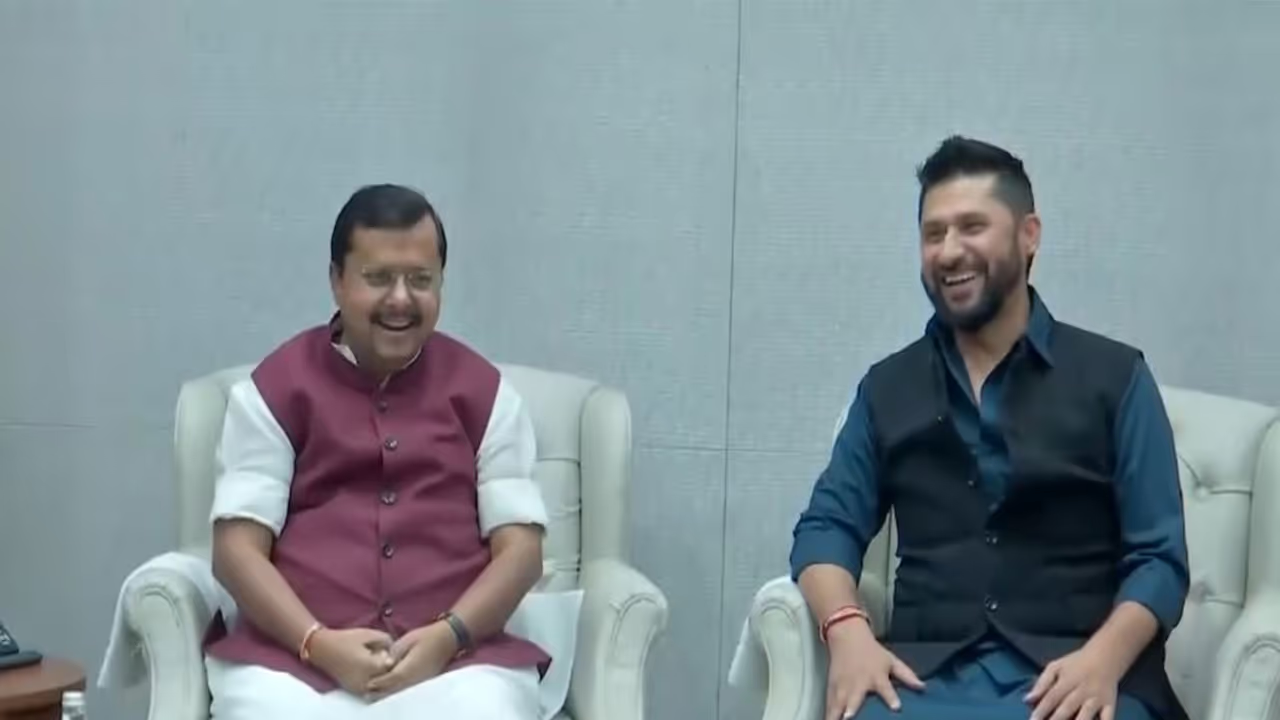
A Nepali expert says RSP President Rabi Lamichhane's India visit is a key diplomatic outreach to revitalise ties. This follows Nepal's "ballot-box revolution," offering a chance to fix foreign policy and move past old ideological issues.
Nepal's ruling Rastriya Swatantra Party (RSP) President Rabi Lamichhane's ongoing five-day visit to India represents a significant diplomatic outreach, a Nepali expert has said.
'Ballot-Box Revolution' Creates Opportunity
In an interview with ANI, foreign policy expert Chandra D Bhatta said the visit aligns directly with expert recommendations for revitalising Nepal-India ties following the country's recent "ballot-box revolution" and generational political shift. Bhatta described Nepal's recent electoral outcome as the result of a revolution that has peacefully cleaned the accumulated "political dirt" of the past 35-plus years. He argued that this change is highly significant not only for Nepal's domestic politics but also for its foreign policy, particularly towards India.
"The 'ballot-box revolution' has fundamentally altered Nepal's political landscape," Bhatta stated. "Now it's time to fix the foreign policy as well as relations between our two closest neighbours." He emphasised that the shift holds importance for Nepal's broader engagement with the world, but relations with India require special attention due to their unique character.
Bhatta explicitly agreed that the current moment presents a unique opportunity, though he preferred the term "revitalise" over "reset". "There certainly is a need to bring the relations back on track," he noted. "For many years, bilateral ties had not moved ahead comfortably due to issues on both sides. The emergence of a political party with a strong majority and minimal ideological baggage now offers every opportunity to elevate relations to their best level," the expert said.
He contrasted this with previous parties that carried ideological alignments and often exploited bilateral relations for domestic political mileage rather than for the benefit of the people. "They used relations and floated issues for their political mileage, and this has been going on for decades. We have to change that, otherwise we will not move ahead," Bhatta warned.
Navigating Trust Deficits and Geopolitics
According to Bhatta, a genuinely new Nepal-India relationship must acknowledge a fundamental reality: while the two countries are independent sovereign states, they are bound together through culture and civilisation. This shared heritage should guide pragmatic engagement in the changing geopolitical context. "We have to take these factors into consideration," he said. "We need to have a common voice... on many issues that might affect us collectively."
Bhatta pointed out that people-to-people relations have historically remained strong, with no major problems at the societal level. Challenges have primarily arisen at the political level and must now be addressed. He cautioned about heightened geopolitics in the region, warning that bilateral relations risk being trapped in a "broader geopolitical vortex" with "spoilers on both sides."
Bhatta identified a longstanding trust deficit between Kathmandu and New Delhi at the political level, partly structural and partly resulting from leadership decisions. "The time has come for us to move ahead and sort out all those issues amicably," he stressed. "We do not need to look at the relations from the strategic point of view, which is not helpful to build confidence on both sides." Instead, the focus should be on neighbourly realities: the two nations are part of the same civilisation, where "one is incomplete in the absence of the other".
Bhatta highlighted the border issues as among the most urgent unresolved issues requiring political courage. "Border issue is there; we need to resolve it before it gets out of hand, as it can also derail our civilisational relations." He noted that geopolitical powers could exploit the situation, and social media amplification makes timely resolution even more critical.
A Path Forward: Development and Energy Diplomacy
Bhatta advocated "development diplomacy" combined with economic cooperation as a realistic path forward, even amid growing Chinese influence. While geopolitical factors will persist, Nepal should navigate them pragmatically. "Development diplomacy is dependent on 'transactions' and ours (should) not (be) the 'transactional relations'," he observed.
Electricity exports emerged as a particularly transformative area. "The electricity has always been politicised, but we have to move beyond that if we really want to harness the benefits," Bhatta said. "If we separate politics, I think this can benefit enormously both the countries."
Such energy cooperation could even become the foundation for broader South Asian economic integration, though political and external geopolitical hurdles make it challenging.
Leveraging Unique Strengths
The expert stated that Nepal can draw valuable lessons from Indian states such as Gujarat, Telangana and Andhra Pradesh in industrialisation and technology development. Bhatta suggested that technology transfer from these successful models carries "huge potential" for Nepal.
One of the most distinctive features of Nepal-India relations is the open border, which Bhatta described as foundational to people-to-people connections that have existed for centuries, if not millennia, long before modern nation-states. "Yes, the people-to-people relations are stronger than government-to-government relations today," he affirmed. "This is one of the most important parts of our relations that does not exist in other regions. We should make good use of it, not abuse it."
Both governments must collaborate to preserve these benefits while addressing security, migration, cross-border crime and illegal activities. "We need to understand each other's security vulnerabilities as well," Bhatta added, noting that the open border could also be exploited for geopolitical purposes by external actors.
He called for revitalising and strengthening the role of students, entrepreneurs and professionals, who make bilateral relations "lively." Any obstacles in their way should be removed.
Bhatta concluded that India can contribute substantially to Nepal's development, with benefits flowing both ways. "A developed and prosperous Nepal will really be great for India as well."
Lamichhane's Visit: A Pragmatic Outreach
Relations should not be viewed solely through the prism of Nepal's engagements with China. "Nepal knows that India is its most important neighbour," he said. China's infrastructure investments are notable, but Nepal's reality demands a balanced, pragmatic approach focused on civilisational and neighbourly ties.
As Lamichhane engages with the BJP leadership and explores cooperation in governance, party organisation, and bilateral priorities during his visit, his outreach mirrors the expert's vision. The RSP's ideological flexibility and strong mandate position it uniquely to implement the kind of pragmatic, development-oriented diplomacy Bhatta recommends, moving beyond past mistrust toward shared prosperity, energy collaboration, technology exchange and the resolution of sensitive issues. Lamichhane, whose party secured a resounding parliamentary majority in the March 2026 elections--the first single-party majority in decades--arrived in New Delhi on June 1 at the invitation of BJP President Nitin Nabin. The visit includes high-level political and diplomatic meetings, engagements with the Nepali community and a personal trip to Ayodhya. It comes at a critical juncture when Nepal's new political landscape provides a fresh opportunity to address longstanding bilateral challenges. (ANI)
(Except for the headline, this story has not been edited by Asianet Newsable English staff and is published from a syndicated feed.)