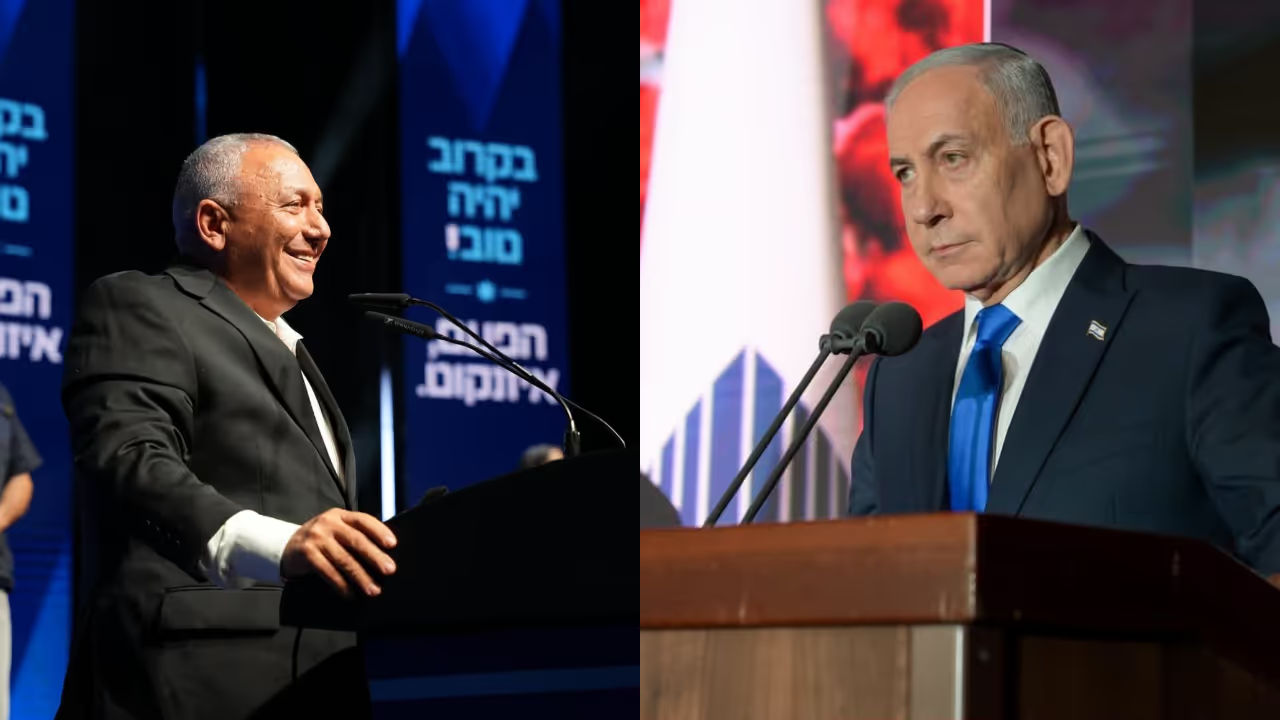
Israel's latest election delivered a highly fragmented outcome, setting the stage for intense political bargaining as competing camps seek a path to power without a clear parliamentary majority.
Israel entered a new period of political uncertainty after election night projections showed neither Prime Minister Benjamin Netanyahu nor challenger Gadi Eisenkot securing a clear path to govern, leaving coalition negotiations likely to determine the country's next government.
Both leaders emerged after voting concluded claiming political momentum, but neither declared outright victory. Instead, each sought to frame the results as evidence that voters had endorsed their vision for the country's future.
Netanyahu called for the creation of a strong right-wing administration, while Eisenkot argued that the electorate had delivered a message against the continuation of Netanyahu's leadership and urged the veteran politician to step away from public life.
Early projections pointed to an exceptionally close outcome.
Exit polls from major Israeli broadcasters suggested the two main political camps were effectively tied, with neither bloc approaching the 61 seats required for a parliamentary majority in the 120-seat Knesset. One projection gave Netanyahu's alliance a slight advantage, while others showed an even deadlock.
The result highlighted the persistent fragmentation of Israeli politics and raised the prospect of prolonged coalition talks involving multiple parties.
Even if the projections hold, Netanyahu could benefit from the immediate aftermath of the vote because he would remain in office as caretaker prime minister while negotiations continue. Such coalition-building efforts have frequently taken weeks or even months in previous Israeli elections.
The outcome also underscored how difficult it remains for any single political force to establish dominance within Israel's parliamentary system.
Smaller parties are once again expected to play an outsized role in shaping the next government, potentially acting as kingmakers during negotiations.
Among the most closely watched groups are Arab political parties, which could influence the parliamentary arithmetic despite remaining outside the two principal camps.
However, Eisenkot's reluctance to rely on those parties for government formation could complicate his efforts to assemble a governing coalition.
Security Issues Dominate Debate After Close Election Outcome
National security remained at the centre of both campaigns and continued to shape post-election messaging.
Addressing supporters in Jerusalem, Netanyahu highlighted Israel's military operations and regional security posture. He also emphasised future cooperation with the United States concerning Iran, presenting security challenges as a central issue facing the country in the years ahead.
Eisenkot responded by warning against using national-security questions for political purposes. The former military chief argued that decisions affecting Israel's security should remain separate from partisan considerations.
The election attracted exceptionally strong voter participation.
The Central Elections Committee reported turnout of 77.7 per cent, representing the highest level in more than two decades and significantly exceeding participation recorded during the previous national election.
The high turnout reflected the significance many voters attached to the contest.
The election for Netanyahu has represented another test of political durability after years at the centre of Israeli public life. He entered the race confronting criticism linked to security failures preceding the October 2023 Hamas attack, ongoing legal challenges that he denies, and growing debate over the direction of his governing coalition.
Eisenkot, meanwhile, campaigned as both a security-focused alternative and a domestic political change candidate. The former military commander argued that a new leadership approach was necessary after years of political division and continuing conflict.
Yet the election delivered no decisive mandate for either side.