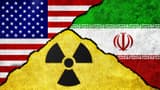
President Donald Trump could be forced to flee to one of the government's top secret bases across the United States if a global nuclear war broke out, doomsday plans have revealed.
US President Donald Trump could be rushed to a network of secret, heavily fortified government bunkers across the United States if a global nuclear war were to erupt. With tensions involving Iran threatening to spiral into a broader international conflict, the US government has long maintained a detailed emergency framework known as the Continuity of Operations Plan (COOP). The plan is designed to ensure that the machinery of government continues to function even if catastrophic attacks wipe out major American cities.
Under this doomsday blueprint, essential state operations including national defense, economic stability, and public safety would continue from deeply protected command centers hidden within mountains in states such as Colorado, Pennsylvania, and Virginia. These fortified complexes would allow the administration or any future White House to govern the country even amid the devastation of a potential World War III.
Cold War Bunkers Still Guard America’s Leadership
Three secretive installations have long been publicly acknowledged as critical pillars of the COOP framework: The Mount Weather Emergency Operations Center, the Raven Rock Mountain Complex, and the Cheyenne Mountain Complex.
Related Articles

Originally constructed during the Cold War era, these facilities are far from outdated relics. They remain fully staffed, regularly funded in federal budgets, and equipped with advanced communications technology to coordinate with the military and inform the public during national emergencies.
The complexes were even placed on alert during the September 11 attacks, underscoring their continued relevance in America’s crisis-response infrastructure.
Built deep within mountain ranges, these installations are engineered to shield national leaders from direct nuclear strikes. Their underground architecture, reinforced structures, and sophisticated communications networks are designed to withstand devastating blasts while ensuring command continuity.
Mount Weather: FEMA’s Secret Command Hub
The Mount Weather Emergency Operations Center in Virginia has been operated by the Federal Emergency Management Agency since 1979.
The sprawling complex reportedly houses a bunker specifically designed for civilian leadership and contains advanced communication systems that allow multiple government agencies to maintain contact with the public during national crises.
Operational since 1959—initially under the US Army—Mount Weather remains a central element of America’s emergency preparedness framework. The US Department of Homeland Security says the facility not only “provides reliable support” and “resilient capabilities” for the president but also functions as a command center for “classified programs.”
Raven Rock: Military’s Wartime Headquarters
During a large-scale war, the Raven Rock Mountain Complex in Pennsylvania is expected to serve as the military’s command hub. The bunker would function as an alternate headquarters for senior defense leadership, including the Secretary of War and the Joint Chiefs of Staff.
A 2025 report on the site stated: “The RRMC supports COOP operational readiness by providing a safe and secure environment for DoD essential functions.”
Millions of dollars have been allocated this year to maintain and upgrade the facility, highlighting its enduring strategic value.
Cheyenne Mountain: Nuclear-Resistant Fortress
The Cheyenne Mountain Complex in Colorado—once the primary headquarters of the North American Aerospace Defense Command (NORAD)—remains one of the most formidable bunkers ever built.
The massive underground facility reportedly includes more than a dozen structures buried roughly 2,000 feet beneath solid rock. To absorb the shockwaves from nuclear blasts or earthquakes, the buildings were constructed atop enormous steel springs—an engineering strategy also used at the Raven Rock site.
Hidden Shelters Beneath Washington
Beyond these mountain fortresses, additional emergency shelters exist across the United States. One such bunker lies directly beneath the East Wing of the White House.
A government report from 2004 revealed that Dick Cheney and other officials took refuge there during the attacks on the Pentagon on September 11.
Other locations—including Peters Mountain and Offutt Air Force Base—are also believed to house facilities capable of sheltering the president and cabinet members during extreme emergencies.
While the prospect of nuclear escalation involving powers such as China and Russia has alarmed global observers, COOP is not designed primarily to protect ordinary citizens.
Instead, the strategy focuses on preserving government leadership—ensuring that the nation retains command and stability even if catastrophic attacks occur.
The plan outlines detailed succession procedures so that if the president, vice president, or other senior officials are killed, designated successors can immediately assume authority. Maintaining this chain of command is considered vital for coordinating military operations and emergency responses during a global crisis.
According to FEMA, COOP ensures “the capability exists to continue essential agency functions across a wide range of potential emergencies.”
A Cold War Legacy Still Active Today
The origins of this secretive framework date back to the Cold War, when the threat of nuclear confrontation with the Soviet Union loomed daily.
President Dwight D. Eisenhower first laid the groundwork in the 1950s by directing federal agencies to prepare for governance after a nuclear strike. His directives led to the construction of hardened bunkers and resilient communication networks.
The Federation of American Scientists noted that Eisenhower’s initiatives sparked the development of secure facilities capable of surviving nuclear blasts.
Later administrations expanded the framework through policies such as Presidential Decision Directive 67, while today the program is guided by the Federal Continuity Directive 1, which incorporates modern threats including cyberattacks and infrastructure shutdowns.
Though the overall structure of COOP is publicly acknowledged, many operational details remain strictly classified.
However, a 2002 report from the Congressional Research Service confirmed that the plan was activated after the 9/11 attacks, when between 75 and 150 officials were relocated to secure locations, demonstrating that America’s doomsday plan is not merely theoretical, but a functioning safeguard designed for the most extreme scenarios imaginable.
(This article has been curated with the help of AI)