UNHCR declares Middle East conflict a major humanitarian emergency as 330,000+ people are displaced, calling for urgent aid, safe passage, and immediate international response.
The rapidly escalating war across the Middle East has triggered a major humanitarian emergency, with hundreds of thousands of people forced to flee their homes as airstrikes, missile attacks and expanding conflict zones deepen the crisis. The United Nations refugee agency warned on Friday that the scale of displacement and growing instability now requires an urgent international response.
“UNHCR has declared the escalating crisis in the Middle East as a major humanitarian emergency requiring an immediate response across the region,” Ayaki Ito, the agency’s emergency chief and cross‑regional refugee coordinator, told reporters in Geneva.
As hostilities intensify across multiple fronts—from Iran and Lebanon to Afghanistan and Pakistan—the humanitarian toll continues to mount, leaving families scrambling for safety and aid agencies racing to scale up relief efforts.
Related Articles

More Than 330,000 People Displaced
According to the UN refugee agency, the conflict has already forced over 330,000 people from their homes, most of them displaced within their own countries.
“Intensifying hostilities across the Middle East have triggered significant population movement, while clashes along the border between Afghanistan and Pakistan have forced thousands of families to flee. Overall, more than 330,000 people have been forcibly displaced, mostly within their own countries,” Ito said.
The agency said it is already providing support to displaced populations but warned that the situation could deteriorate rapidly if the fighting continues.
“UNHCR, the UN Refugee Agency, is already supporting displaced populations and preparing to scale up its assistance as needed. We are also urgently calling for dialogue and de-escalation as violence intensifies.”
Tehran Residents Flee As Strikes Intensify
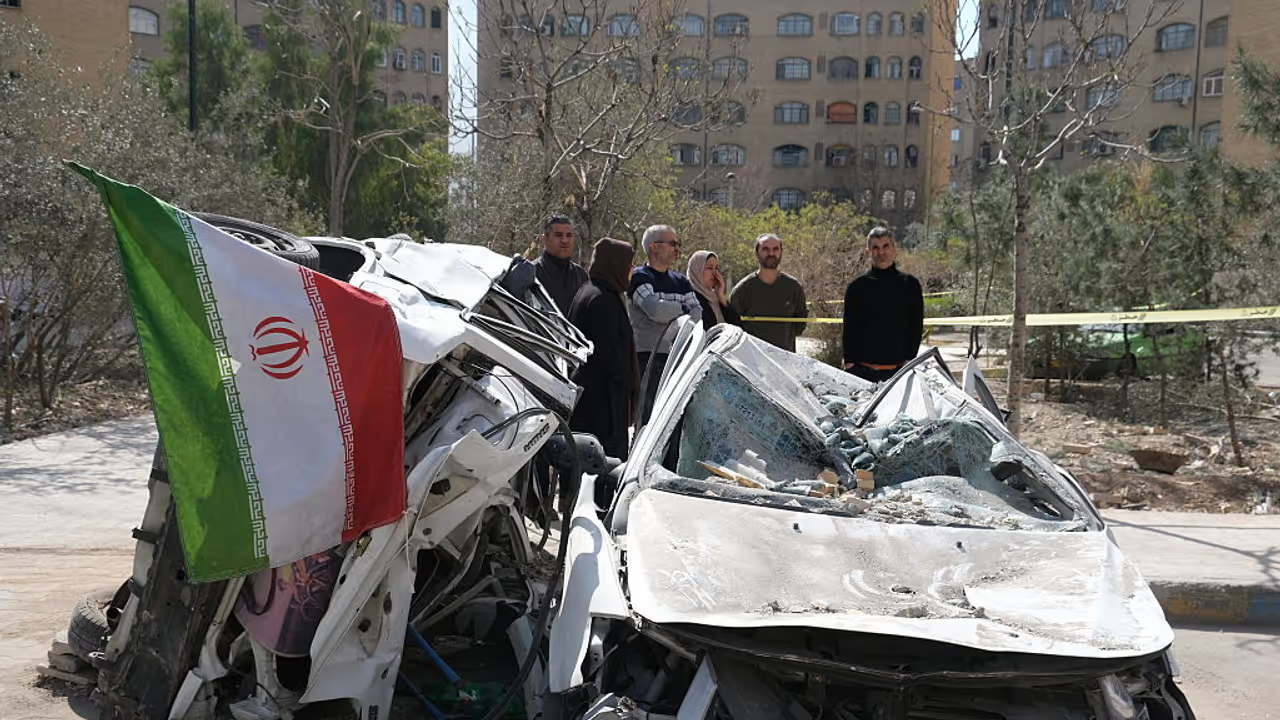
The humanitarian situation has been particularly alarming in Iran, where Israeli and US strikes have targeted key infrastructure.
Local estimates indicate that around 100,000 people fled Tehran in the first two days after the attacks, as explosions rocked the capital and panic spread among residents.
The war has dramatically altered life in the city. Streets that are normally packed with traffic have fallen eerily quiet, while security forces maintain a heavy presence across key areas.
One Tehran resident told AFP that the Islamic Revolutionary Guard Corps (IRGC) had sealed off much of the city.
“The powerful Islamic Revolutionary Guard Corps (IRGC) has closed almost every main street with armed personnel and heavy machine guns to frighten people,” a 30‑year‑old resident said, speaking to AFP from Paris.
“The people are the real enemy in their eyes, not the Americans. Their extremists say first you have to deal with the enemy at home.”
Despite the exodus from Tehran, the UN refugee agency said there has so far been no major increase in cross‑border movement from Iran, suggesting most people are still relocating within the country.
Lebanon Faces Growing Displacement Crisis
In Lebanon, the war has opened another humanitarian front after Hezbollah launched missiles in support of Iran, prompting heavy Israeli strikes.
Entire neighbourhoods in the southern suburbs of Beirut—an area home to 600,000 to 800,000 people—have been hit by repeated bombardment.
Government figures show that over 84,000 people are now sheltering in nearly 400 collective sites, including schools and temporary shelters.
At the same time, more than 30,000 people have crossed into neighbouring Syria, most of them Syrians who had previously sought refuge in Lebanon but are now being forced to flee again.
The sudden displacement has left many families stranded with little food, shelter or medical support.
“We fled from the suburbs, we were humiliated,” one man told AFP after escaping the bombardment.
“We'll sleep on the road tonight and God alone knows what will happen to us.”
Lebanese Prime Minister Nawaf Salam warned that the country could soon face a catastrophic humanitarian situation.
He said a “humanitarian disaster is looming”, adding that the consequences of the mass displacement could be “unprecedented.”
Conflict Expands Beyond the Middle East
The widening war has also destabilised regions beyond the immediate battlefield.
Clashes along the Afghanistan–Pakistan border have forced large numbers of civilians to flee their homes, with humanitarian agencies reporting about 115,000 displaced in Afghanistan and around 3,000 in Pakistan.
Aid groups say the growing number of displaced families are facing worsening conditions as resources run thin and violence spreads across multiple regions simultaneously.
The UN refugee agency warned that civilians trying to escape the fighting must be allowed to move freely and safely.
“It is imperative that all civilians who need to move or cross borders to find safety are given safe passage,” the UNHCR said in its statement.
War Enters “Next Phase”
The humanitarian emergency comes as the war itself continues to intensify.
Fresh Israeli strikes hit Iran and Lebanon on Friday, with Israel’s military leadership signalling a broader escalation.
“We are now moving to the next phase of the operation,” Israel’s military chief Lieutenant General Eyal Zamir said.
“We have additional surprises ahead which I do not intend to disclose.”
US Defence Secretary Pete Hegseth also warned that the scale of military action could increase.
“Firepower over Iran and over Tehran is about to surge dramatically.”
The war began nearly a week ago with a massive wave of attacks that killed Iran’s supreme leader Ayatollah Ali Khamenei. Since then, the conflict has expanded across the region, drawing in global powers and triggering retaliatory missile and drone strikes.
Iran says 926 people have been killed by US and Israeli attacks, though the figure has not been independently verified.
Israel has reported at least 10 deaths from Iranian strikes, while the US military says six American personnel have been killed since the conflict began.
(With inputs from AFP)