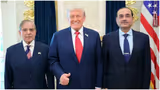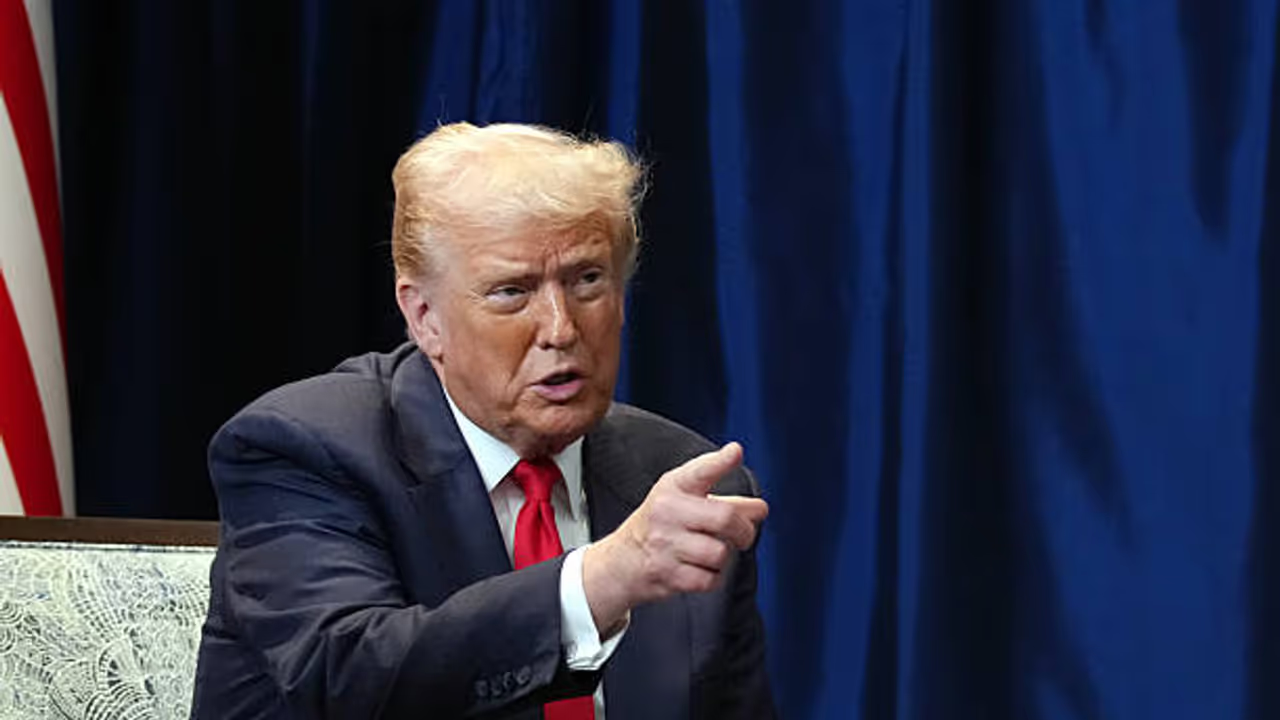
Donald Trump on Monday threatened 200 percent tariffs on French wine and Champagne over France's intentions to decline the US leader's invitation to join his Board of Peace.
US President Donald Trump has escalated diplomatic tensions with France by threatening to slap a staggering 200 percent tariff on French wine and Champagne, after Paris signalled it was unlikely to join his newly announced international body, the “Board of Peace.” The warning came even as Trump confirmed that Russian President Vladimir Putin had been invited to participate in the same forum.
Tariff threat aimed at Macron
Speaking to reporters on Monday, Trump made it clear he was prepared to use economic pressure to force French cooperation. “I’ll put a 200 percent tariff on his wines and champagnes. And he’ll join. But he doesn’t have to join,” Trump said, referring directly to French President Emmanuel Macron.
The remark followed confirmation from Paris that France was reluctant to be part of the initiative. A source close to Macron told AFP that France “does not intend to answer favourably” to the invitation extended by Washington.
Related Articles

The threat immediately raised concerns in European capitals, where French wine exports are seen as both an economic asset and a symbol of national identity. Industry groups warned that such duties could devastate centuries-old trade links between the two allies.
Putin invited to join
Only minutes before the comments on France, Trump confirmed that he had formally asked Vladimir Putin to take a seat on the proposed body. “Yes, he’s been invited,” Trump told a reporter in Florida when asked about the Russian leader’s involvement.
The inclusion of Moscow has added to the controversy surrounding the project, particularly among European Union members that continue to impose sanctions on Russia over the Ukraine conflict.
What is the ‘Board of Peace’?
Details of the organisation emerged from a charter seen by AFP. According to the document, the Board of Peace is “an international organization that seeks to promote stability, restore dependable and lawful governance, and secure enduring peace in areas affected or threatened by conflict.”
Initially conceived to oversee the rebuilding of war-torn Gaza, the mandate appears far broader and could extend to conflicts worldwide. The charter states that the body will “undertake such peace-building functions in accordance with international law.”
Trump would sit at the top of the structure. The text makes clear that “the Chairman shall have exclusive authority to create, modify, or dissolve subsidiary entities as necessary or appropriate to fulfill the Board of Peace’s mission.” He would also appoint members of an executive board described as “leaders of global stature,” serving two-year terms and removable at his discretion.
A price tag for membership
Perhaps the most contentious element is the financial requirement. Countries can secure permanent membership if they contribute more than USD $1,000,000,000 in the first year. Otherwise, terms are limited to three years.
Although decisions would require “a majority of Member States present and voting,” they remain “subject to the approval of the Chairman,” giving Trump decisive control. In the event of a tie, he may also cast the deciding vote.
Who is already involved?
The White House has listed several high-profile figures as part of the initial structure, including Secretary of State Marco Rubio, special negotiator Steve Witkoff, Jared Kushner, former UK prime minister Tony Blair, billionaire financier Marc Rowan, World Bank president Ajay Banga, and Trump aide Robert Gabriel.
A long roster of nations says it has received invitations, among them India, Pakistan, Germany, Italy, Brazil, Egypt, Argentina, Canada, Poland, Hungary, Greece, Morocco, Uzbekistan, Belarus and others.
Uncertain road ahead
The charter states that the organisation will come into force “upon expression of consent to be bound by three States,” meaning it could technically begin operations quickly. Yet the sharp reaction from France suggests the path will be anything but smooth.
Diplomats in Brussels described the tariff threat as an attempt to strong-arm allies into a structure that concentrates unprecedented power in the hands of one leader. Supporters within Trump’s circle, however, argue the board could cut through slow multilateral processes and deliver rapid results in places like Gaza.
For now, the clash over French wine has become the first real test of whether the Board of Peace will unite governments—or deepen the fractures it claims it wants to heal.
(With inputs from AFP)