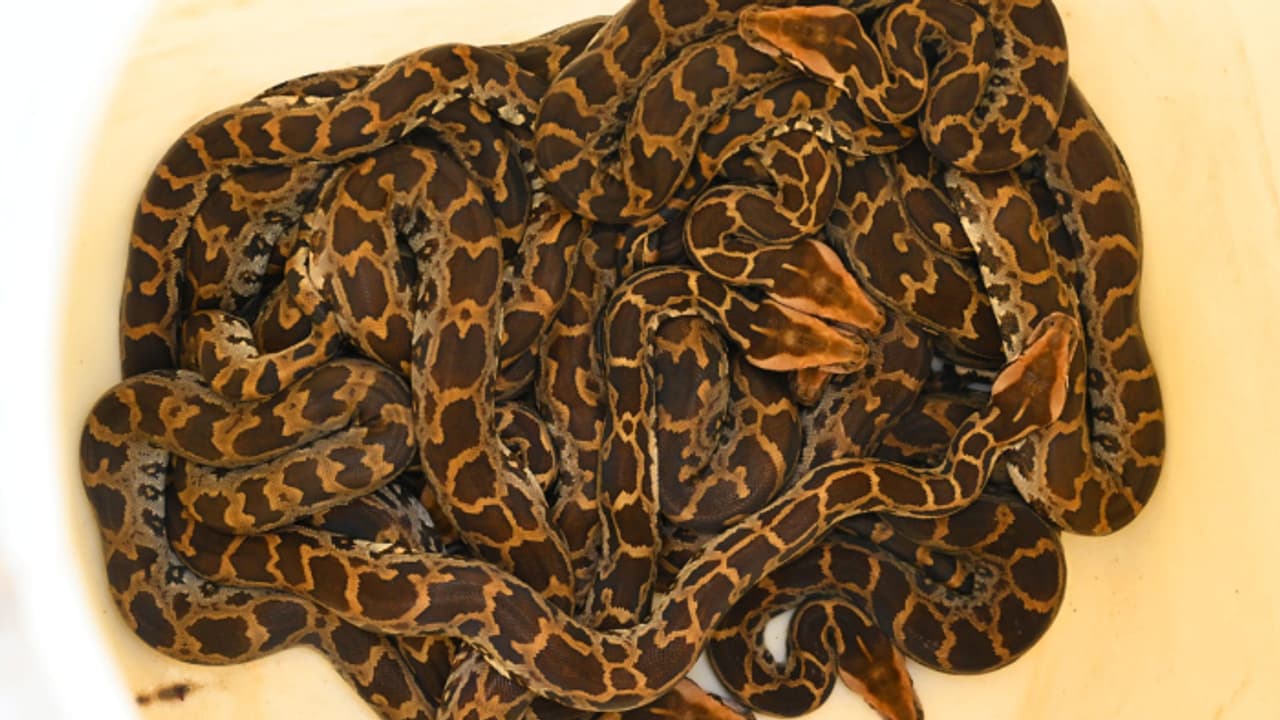
A shocking illegal wildlife racket was exposed in China after police discovered 309 pythons inside a residential flat. The investigation began when an unusually high electricity bill and a snake sighting led authorities to a major breeding operation.
Just imagine believing your neighbour is an ordinary man living a normal life, only to discover later that he was allegedly breeding hundreds of pythons inside his house. What appeared normal from the outside turned into a shocking illegal wildlife operation involving 309 pythons kept inside a residential flat. The case came to light in a most unusual way, triggered by an unusually high electricity bill that eventually exposed the entire racket.
Discovery Begins With A Suspicious Snake Sighting
The incident took place in Taizhou city, Zhejiang province, China. It began when an elderly man spotted a large snake near a hill and suspected that it was not a local species. He immediately informed the authorities.
Wildlife officials identified the snake as a python, a species not native to the region. As pythons are not typically active outdoors in March, officials suspected that the reptile may have escaped from a private enclosure or breeding facility.
Related Articles

Investigation Leads To Unusual Electricity Usage
Based on expert input, police learned that pythons require a warm and humid environment, typically maintained at around 20 to 30 degrees Celsius. This requires continuous electricity usage, which led investigators to examine local consumption records.
The investigation pointed towards a flat belonging to a man named Guo, who lived alone and had no stable employment. Despite this, his electricity usage was unusually high compared to neighbouring households.
Courier Clues And Online Activity Raise Suspicion
Further investigation revealed another suspect, Di, who frequently visited Guo’s residence and collected courier parcels. These parcels were later found to contain white mice, commonly used as feed for pet snakes.
Police also discovered Guo’s online activity, where he shared images of snakes and allegedly hinted at selling pythons. Records suggested that Di had previously sold two pythons for around 1,000 yuan.
Police Raid Uncovers Massive Python Collection
Acting on growing suspicion, police raided Guo’s flat and were shocked by what they found inside. The apartment was divided into sections, with most rooms converted into snake enclosures.
Hundreds of plastic containers were stacked throughout the house, each holding one or more pythons. After a detailed count, authorities seized a total of 309 pythons from the premises.
Wider Network And Total Seizure
During interrogation, Guo reportedly admitted that he had developed an interest in snakes from a young age and began breeding them in 2014 after purchasing four pythons. Investigators found that Guo and Di had allegedly sold around 80 pythons over time.
Police also arrested Deng, the shopkeeper who originally sold the first four pythons to Guo. A further 47 pythons were recovered from Deng’s residence.
In total, authorities seized 436 pythons connected to the network, with an estimated value exceeding 30 million yuan.
Legal Action And Wildlife Protection Laws
Authorities confirmed that pythons are protected wildlife under Chinese law. Their purchase, sale, breeding, or transport requires official permission. Violations of these regulations can result in severe legal penalties, including imprisonment.
The case highlights how routine checks, including electricity usage patterns, can uncover large-scale illegal wildlife operations hidden in plain sight.