China's air force chief visits Pakistan to reaffirm ties after Indian strikes expose weaknesses in Chinese defence systems, prompting Islamabad to rekindle defence talks with the US.
In the aftermath of India’s Operation Sindoor — which saw deep air strikes on terrorist and military targets inside Pakistan — a high-level Chinese defence delegation landed in Islamabad in what experts believe is a critical attempt to salvage Beijing’s waning influence in the region.
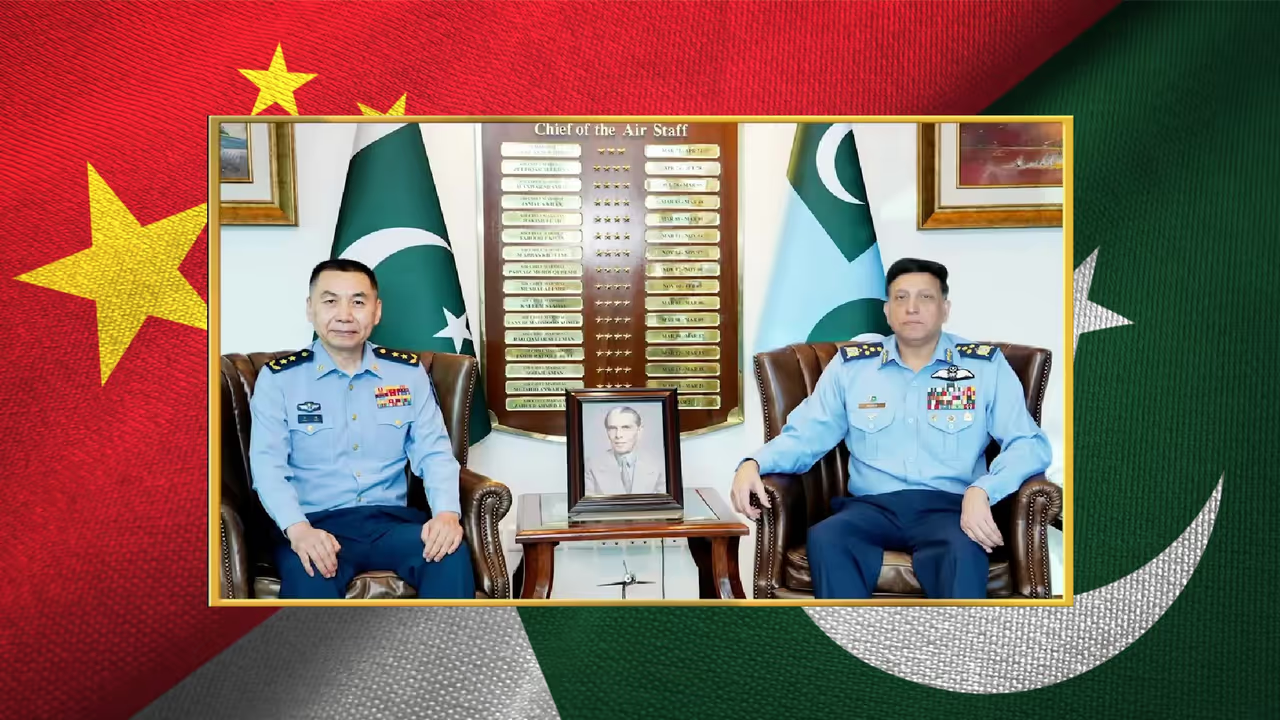
Lt General Wang Gang, Chief of Staff of the People’s Liberation Army Air Force (PLAAF), met with Pakistan’s Air Chief Marshal Zaheer Ahmed Baber Sidhu in Islamabad on Tuesday. The Pakistan Air Force (PAF) described the discussions as focused on “matters of mutual interest, regional security dynamics, and avenues for enhanced bilateral cooperation, particularly in airpower and operational synergy.”
But behind the diplomatic niceties, the visit carries deeper significance.
Related Articles

‘Operational Readiness’ Praised—But Questions Linger
According to an official PAF statement, Lt Gen Wang Gang "expressed deep appreciation for the high state of operational readiness and the cutting-edge capabilities of the Pakistan Air Force.” He was also given a detailed briefing on the PAF’s force structure and operational doctrine.
In turn, Air Chief Marshal Sidhu underscored the historic nature of Pakistan-China ties, calling them “rooted in mutual trust, strategic convergence, and shared aspirations for regional peace and stability.”
But even as the two air forces vowed to deepen collaboration in training, technology, and operations, military observers suggest the visit is aimed at damage control.
India’s Operation Sindoor Exposes Chinese Hardware
India’s air strikes during Operation Sindoor, conducted from May 7 to 10, bypassed and destroyed several Chinese-supplied air defence systems deployed by Pakistan.
Major General Sudhakar Jee (Retd) told Asianet News English, “During India's Operation Sindoor, its missiles and drones bypassed Pakistan's China-supplied defence systems to strike military targets deep inside the country. Chinese-made HQ-9P and HQ-16 missile defence systems were also destroyed in Indian counterstrikes.”
This, he noted, triggered growing unease within Pakistani defence circles regarding the reliability of Chinese weaponry.
A Rare US Outreach By Pakistan
In what appears to be a strategic pivot, Pakistan has quietly reopened defence channels with the United States.
"Amid unease in Pakistan over the reliability of Chinese defence equipment used during the recent hostilities with India, Pakistan Air Force (PAF) chief Zaheer Ahmed Baber Sidhu arrived in Washington to bolster its dormant defence ties with the US," said Maj Gen Sudhakar Jee (Retd).
“The visit - the first by a PAF chief in over a decade - comes weeks after Pakistan Army Chief Asim Munir held a meeting with US President Donald Trump. During his visit, the Air Marshal met top US military and civilian leaders, including General David Allvin, Chief of Staff of the US Air Force,” he added.
Pakistan Eyes Advanced US Hardware
Sidhu’s meetings with the Pentagon and State Department is said to have been focused on military interoperability and tech-based exchanges.
"According to sources, Pakistan is eyeing several advanced US military platforms to modernise its air force, including F-16 Block 70 fighter jets, and air defence systems, following concerns over the reliability of Chinese equipment," Maj Gen Sudhakar Jee (Retd) revealed.
“Pakistan is also looking to acquire additional AIM-7 Sparrow air-to-air missiles, and even batteries of the US-made High Mobility Artillery Rocket System (HIMARS),” he further said.
China’s 'Devil Triangle' and PLA's Non-Kinetic Support
Behind the scenes, Chinese and Pakistani air forces have been working more closely than ever — especially since the abrogation of Article 370 by India in August 2019.
"Pakistan’s Air Force pilots have been undergoing extensive joint training on 'Advanced Realistic Combat Training' on 'Multi-domain operations – for a successful Kill Chain' with not a few aircrafts but with a large number of aircrafts; 'Data-linked supported by a Digital eco-system'; a classified activity in progress since post abrogation of Article 370," said Maj Gen Sudhakar Jee (Retd).
He added that there was non-kinetic support by the PLA Air Force during Operation Sindoor as part of orchestrating a "one front reinforced war" against India.
Furthermore, China appears to be planning a broader strategic alignment in South Asia.
"China lately has gone in for a 'Devil Triangle' from economic grouping to a military alliance amongst Pakistan, Bangladesh and itself, maybe to organise a replacement of SAARC under its leadership," he noted.
US Looks to Undermine China-Pakistan Axis
With around 81-82% of Pakistan's defence imports currently coming from China, Washington may view Islamabad’s disillusionment as an opportunity.
"USA would always desire to reduce Pakistan’s dependence on China for its defence warheads or any grouping so to remain on top of the strategic rivalry as a dominant force in the region," said Maj Gen Sudhakar Jee (Retd).
CPEC At The Heart Of China's Concerns
Beyond military cooperation, China’s core concern may be the safety of its infrastructure investments in Pakistan — particularly the China-Pakistan Economic Corridor (CPEC) and the Gwadar deep-water port.
"The visit of the PLAAF delegation is to be seen from the perspective of arresting the downward trend of China’s dominance in Pakistan, especially with regard to restoration of its 'deeper than ocean and higher than Everest' relations with Pakistan, especially safety of CPEC including Gwadar deep water port," Maj Gen Sudhakar Jee (Retd) concluded.