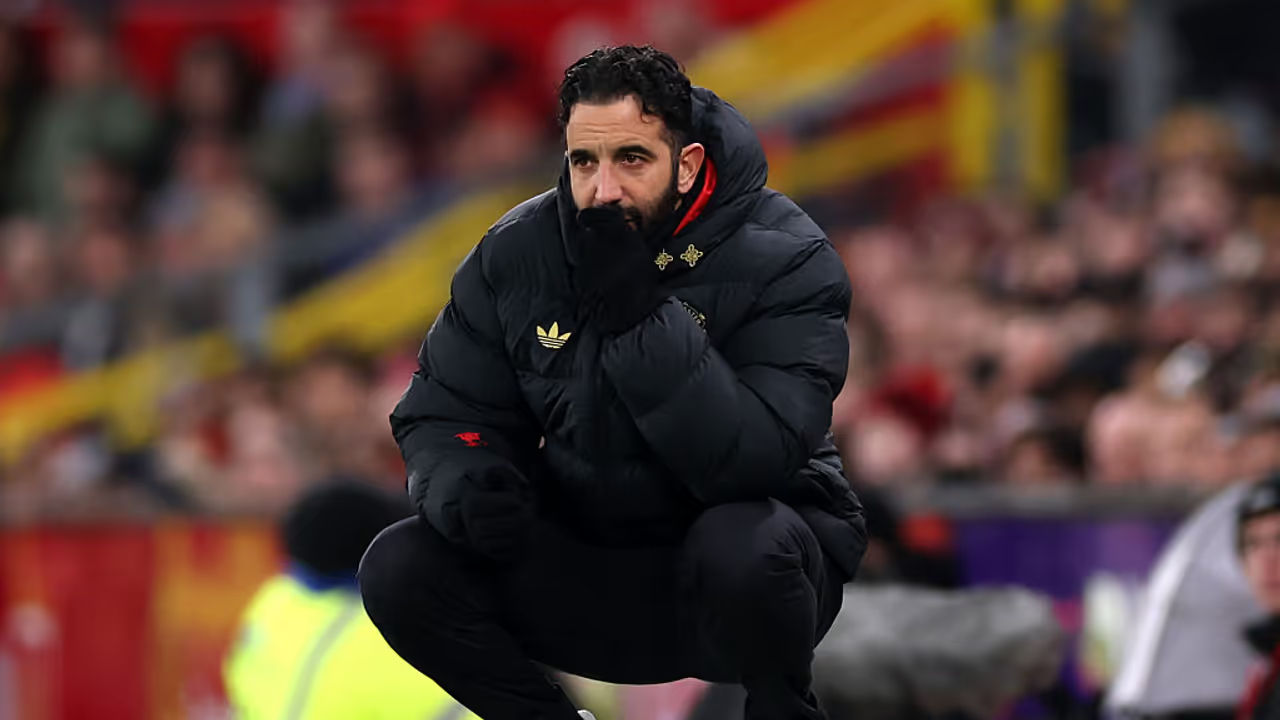
Ruben Amorim’s reign at Manchester United ends in disaster. With a disastrous win rate, rigid tactics and public clashes with the board, he leaves as one of the club’s worst modern-era managers.
Ruben Amorim arrived at Old Trafford as a compelling talker, a charismatic presence who mixed humour, introspection and a bleak honesty about how far Manchester United had fallen. But behind the stirring words lay a belief system that simply didn’t translate. His devotion to a rigid 3-4-2-1 formation — a system he once suggested not even the Pope could talk him out of — became both his ideology and his downfall.
That stubbornness helped drag United to their worst-ever Premier League finish last season. And when, late last year, he sent out yet another defence-heavy side against struggling Wolves, even the most patient supporters began to see the project for what it was: a remedy that never worked.
The Emperor With No Clothes
Amorim was the tenth man to sit in the dugout since Sir Alex Ferguson departed, if you include caretakers and interims. Yet somehow, he felt the least prepared for the scale of the institution he inherited. His achievements at Sporting Lisbon were real — for instance the time when Sporting demolished Manchester City 4-1 in the Champions League in 2024. That stadium loved him. His aura was magnetic. But in England, the job swallowed him.
Related Articles

His press conferences were gripping, sometimes raw, but often veered toward melodrama. When he called his squad the worst United team ever, it didn’t feel brave — it felt inflammatory, unnecessary and tactically naive. Was he looking for protection? Or trying to inflate a later redemption arc? Either way, he looked emotionally ill-equipped for a job of this scale.
Failure on the Pitch — and When It Mattered Most
Yes, he reached the Europa League final last season — but United still contrived to lose to an average Spurs side in one of the most forgettable European finals in history. There was no momentum, no spark, no sense that progress — real progress — was being made.
United’s form at Old Trafford told its own story. One win in five against Everton, West Ham, Bournemouth, Newcastle and Wolves. Six points from a possible 15. A team drifting.
So when Amorim publicly challenged the hierarchy, hinting at frustration over recruitment and authority, he misjudged the power dynamic badly. Unlike Enzo Maresca at Chelsea, he didn’t even have trophies at United to fall back on. He overestimated his standing — and underestimated Sir Jim Ratcliffe, Omar Berrada and Jason Wilcox.
His last post-match tirade at Leeds — where United once again failed to beat a side near the bottom — felt like watching an actor still delivering lines on a stage after the set had collapsed around him. It was compelling theatre. But he no longer had a leg to stand on.
The Numbers That Condemn Him
Amorim’s sacking, confirmed after that Leeds draw, officially ends one of the worst managerial reigns in United’s modern history. His record:
24 wins in 63 games across competitions.
His win rate was worse than Erik ten Hag and Louis van Gaal — and only marginally better than Ralf Rangnick, who was an interim and managed fewer than 30 games. In league terms, he was worse than Rangnick too.
You have to go back decades — in some cases more than a century — to find United managers with worse records: AH Halbut (1900), Jack Robson (1921), Hebert Bamlett (1931), Walter Crickmer (1945) and Wilf McGuinness (1970).
Since Amorim’s appointment in November 2024, only Wolves, West Ham and Tottenham have earned fewer Premier League points than United’s 58. Two of those sides are likely to be relegated. United’s goal difference in that time? Minus six.
His team scored just 1.4 goals per league game — better only than Rangnick’s much-criticised 2021-22 side. Defensively, they were worse than any United team in Premier League history, conceding 1.53 goals per game and keeping just seven clean sheets in 47 league matches — the lowest percentage of any United boss.
And the lowlights kept piling up:
- Worst start by a United manager in more than 100 years
- Record-low Premier League points tally (42)
- Record league defeats in a season (15)
- Record home defeats (9)
- Lowest-ever league finishing position (15th)
December alone brought six league defeats — the most in a single month since 1930 — and 18 goals conceded, the worst since 1964.
Backed — but Still Beaten
The summer brought more than £215m worth of signings, including Bryan Mbeumo and Matheus Cunha. Nothing changed.
Seven points from six matches this season — United’s worst start in 33 years.
Even more damning? Amorim refused to abandon his back three in all but two Premier League games. The first time he finally tried a back four, United beat Newcastle and kept one of those rare seven clean sheets.
He didn’t just tinker — he churned. Only Spurs and Chelsea rotated more starting XIs than Amorim. In time, the club lost faith in him — just as he seemed unsure of his own players.
The Final Break
Behind the scenes, the end was already in motion. A meeting following the Wolves draw — where Jason Wilcox told him the squad was capable of more — reportedly triggered a furious response. The board had seen enough.
He was dismissed on Monday morning at Carrington. Darren Fletcher, the former midfielder and current U18s coach, now takes charge on an interim basis.
Amorim was entitled to £12m in compensation if sacked before November 1 — although the final severance figure remains unclear.
A Club Searching — Again
And so United move on. Again.
Some of the names in the frame to take over Amorim's place include Enzo Maresca and Darren Fletcher, along with Oliver Glasner, Xavi, Gareth Southgate, Cesc Fabregas, Marco Silva, Michael Carrick, Kieran McKenna, Robin van Persie, Julian Nagelsmann, Zinedine Zidane, Jose Mourinho, Mauricio Pochettino, Graham Potter, Eddie Howe, Brendan Rodgers, Thomas Frank, Nuno Espirito Santo, Carlo Ancelotti, Roy Keane and Gary Neville.
For now, the club insists the squad — built for Amorim’s 3-4-2-1 — is adaptable. Europe remains the target.
Legacy of a Man Who Spoke Well — and Delivered Little
Amorim will leave Old Trafford remembered as someone who talked a good game, who carried an aura — but never the results to justify it. He began poorly and ended worse. The job was too big, the strategy too rigid, the returns too meagre.
In a decade-long search for stability after Ferguson, United have assembled a near-full XI of failed successors. Amorim takes his place in that grim procession — a manager who inspired belief, but produced disappointment.
It’s over now. For United, the cycle continues. For Amorim, the Premier League will remain the stage where his ideas — and his ego — simply didn’t fit.