
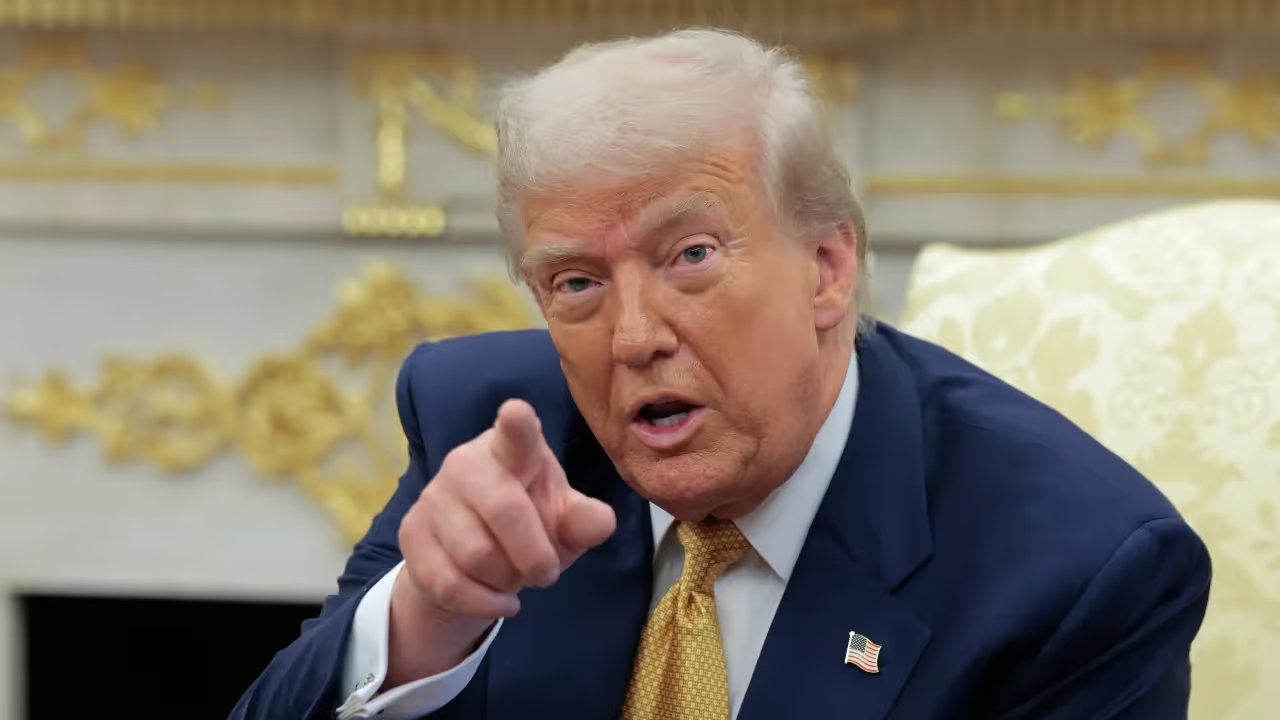
Export-driven sectors like auto are likely to bear the brunt of Trump’s latest trade move. However, domestic-facing stocks, FMCG and IT may show relative resilience, analysts note.
In a surprise blow, U.S. President Donald Trump announced a steep 25% tariff on Indian imports, effective Aug. 1, sparking fears of renewed trade tensions and potential capital outflows. He also imposed an additional unspecified penalty related to India’s acquisition of Russian oil and military supplies.
According to SEBI-registered analyst Rajneesh Sharma, the markets may react sharply as policy risk rises and global sentiment shifts.
The market sentiment has shifted towards a risk-off stance, following concerns that Trump’s trade penalty could spark Foreign Institutional Investors (FII) outflows from Indian equities. Sharma added that it is likely to impact export-heavy sectors such as pharmaceuticals, automobiles, and manufacturing.
Additional pressures include rupee volatility, concerns about banking stocks, and risks associated with global market correlations, which will also likely weigh on near-term sentiment.
Technical Picture: Nifty At Crucial Zone
From a technical perspective, the Nifty index at 24,855 is sitting just above key trendline support. The weekly candlestick pattern displays an upper wick, indicating rejection near recent highs. Although the rising channel remains intact, momentum appears to be fading. A bearish divergence is emerging. Sharma added that this warranted close observation for confirmation.
Support Levels To Track If Selling Accelerates
According to him, key levels to monitor include the immediate trendline test at 24,482; a breakout retest zone between 24,000 and 23,896; and a near-term support at 23,600 from prior consolidation. Below this, 23,355 represents a strong horizontal and trendline confluence, followed by 23,000, which serves as a structural target if panic persists.
Last support is seen at a multi-month rising support zone between 21,800 and 22,000
Market Outlook For Thursday
Sharma said that the short-term bias on the market turns bearish if the 24,482 support level is broken, while a medium-term outlook remains cautiously neutral as long as the 23,900 to 23,600 range is held. The longer-term bullish structure has not been broken yet.
Overall, he believes that markets are digesting the tariff shocks, and periods of panic create opportunities. He advised traders to closely monitor these critical levels, remain nimble, and avoid making emotional trading decisions.
Analyst Vinay Taparia noted that the 25% tariff imposition on Indian imports will create some market uncertainty. Still, based on Trump’s history of trade actions, there is a strong likelihood that these issues will be resolved or negotiated over time.
He added that markets tend to price in such events of global and geopolitical uncertainties. The Nifty’s 4% decline from its recent high, despite a strong global market performance, already reflects some anticipation of the tariff impact.
Taparia expects certain domestic-focused companies, FMCG firms, and those with less exposure to the US to remain resilient to the Trump ‘tariff drama’. He believes that they may outperform if this tariff pain persists.
Additionally, IT companies may see improved performance because tariffs do not directly impact their services, and the weakening Indian Rupee (INR) may provide a further boost to their export competitiveness.
He concluded that there is no need to panic. Tariffs, while disruptive, can be overcome, and do not outweigh national self-respect and sovereignty concerns, which were cited as underlying reasons for India’s trade stance.
For updates and corrections, email newsroom[at]stocktwits[dot]com.<
