
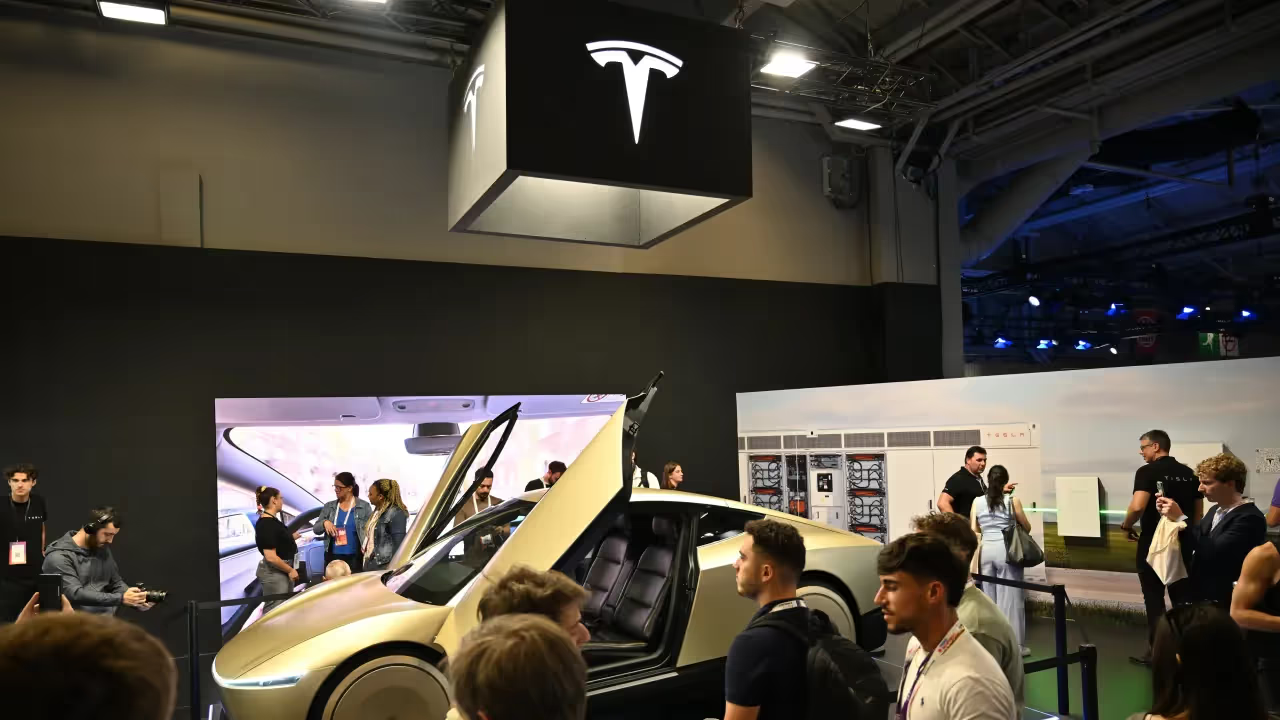
The EV maker is laying the groundwork for Cybercab manufacturing ahead of a broader production push in April this year.
- Musk said Cybercab manufacturing will follow an S-curve, with output starting slowly before accelerating.
- He noted that both Cybercab and Optimus involve mostly new parts and processes, limiting early production speed.
- Tesla is currently testing the production system, with the main manufacturing ramp expected to begin in April.
Tesla Inc. shares were in focus on Tuesday after CEO Elon Musk moved to temper expectations around the company’s much-anticipated Cybercab robotaxi, cautioning that early production would be slow despite claims around fast manufacturing speeds.
Production Claims Spark Buzz
The clarification came after Tesla investor and influencer Sawyer Merritt said on X that Cybercab production would begin in less than 100 days, using Tesla’s unboxed manufacturing process for the first time.
Merritt added that a Cybercab could eventually roll off the production line in under 10 seconds, compared with roughly 34 seconds for the Model Y, with a long-term cycle-time target of around 5 seconds.
Musk Flags Reality Of Early Ramp
Responding to the post, Musk said initial production is always slow and follows an S-curve. “The speed of the production ramp is inversely proportionate to how many new parts and steps there are,” Musk wrote on X.
He added that for Cybercab and the company’s Optimus humanoid robot, almost everything is new, which would make early production “agonizingly slow,” even though it would eventually become “insanely fast.” Musk earlier clarified in December 2025 that Tesla is currently testing the production system, with the real production ramp expected to begin in April.
April Production Plans In Texas
The Cybercab is a dedicated robotaxi vehicle with no pedals, steering wheel, or side-view mirrors. Musk has said he expects the vehicles to be “everywhere in the future.”
During Tesla’s annual general meeting in November 2025, Musk said the company is targeting volume production of the Cybercab starting in April at its Texas gigafactory. He also said the production lines would ultimately be capable of making one vehicle every 10 seconds once fully ramped.
Tesla’s Robotaxi Push
Tesla has positioned the Cybercab as a central part of its broader push into autonomous driving, robotics, and AI. The company began deploying robotaxis in Austin in June 2025, with a small fleet of Model Y vehicles equipped with its Full Self-Driving technology. Those vehicles were initially rolled out with a safety monitor in the front seat.
In December, Musk said Tesla had started testing fully autonomous driving in Texas with no safety drivers, as the company works to scale its robotaxi ambitions. Tesla is now looking to complement its existing fleet with the two-seat Cybercab.
2026 In Focus
In a yearly recap video released last month, Tesla said it has already started production of the Cybercab ahead of its planned 2026 launch. The company also highlighted several milestones achieved during the year, including the launch of cheaper Standard variants of the Model Y and Model 3, the rollout of its robotaxi network, the unveiling of the Megablock energy storage product, and the refreshed Model S and X.
“See y’all in 2026 - the best is yet to come,” Tesla said in the video. According to Tesla’s third-quarter update, both the Cybercab and the Tesla Semi truck remain on track for volume production starting in 2026.
How Did Stocktwits Users React?
On Stocktwits, retail sentiment for Tesla was ‘bearish’ amid ‘low’ message volume.

Tesla’s stock is down over 6% this year, trailing the benchmark S&P 500 and Nasdaq indices.
For updates and corrections, email newsroom[at]stocktwits[dot]com.<
