
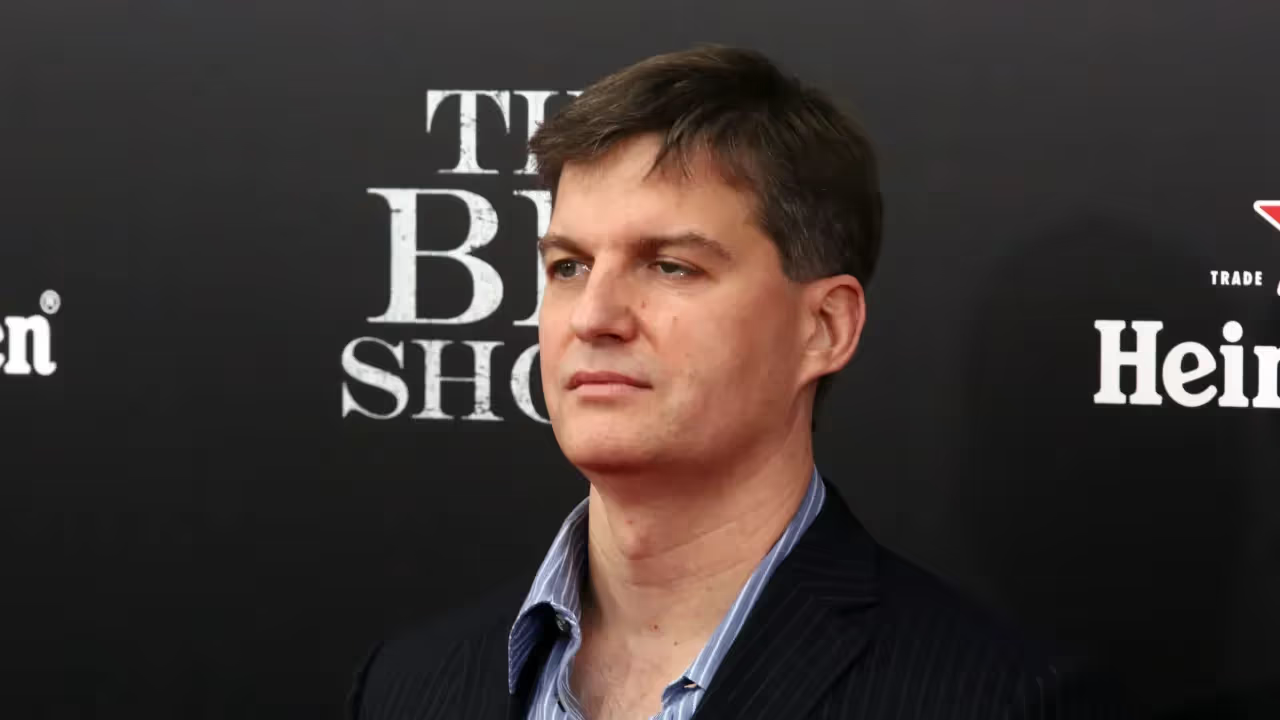
Burry believes CoreWeave’s limited float, retail popularity, and short-squeeze potential make it too dangerous to bet against.
- He is steering clear of CoreWeave despite concerns about its debt and business model, calling CRWV the leading candidate for “memesville.”
- Burry replaced his losing SOXX put options with a larger QQQ put position representing 6% of his portfolio.
- He retained Nvidia and Palantir puts, increased his Micron short, and kept an outright SOXX short as his largest bearish position.
“Big Short” investor Michael Burry says his current short exposure rivals — or may even exceed — his positioning during the 2020 crash, but he is steering clear of CoreWeave because its “meme vibe” could make betting against the AI stock especially dangerous.
Burry Builds Aggressive Short Book
Asked whether CoreWeave’s heavy leverage made it more shortable than fellow AI infrastructure provider Nebius, Burry pointed to the danger of retail-driven momentum. “CRWV has more of a meme vibe,” Burry said. “Both are volatile, but I’d rather not short the leading candidate for memesville.”
Burry said his current positioning resembles the bearish wagers that paid off during the 2008 financial crisis and the COVID-19 crash.
“In 2008 and 2020, I timed being heavily short well, and both times it converted to cash when I needed it most,” he said. “I am now carrying a similar short load, maybe even more aggressive in some way than 2020.” The difference is that Burry was also heavily short index futures in 2020, which he is not doing now.
In his Thursday portfolio update, he disclosed that he had exited his losing iShares Semiconductor ETF (SOXX) put options and exchanged them for a much larger position in Invesco QQQ Trust (QQQ) puts. The QQQ put position now accounts for 6% of the portfolio. Burry retained puts on Nvidia and Palantir, increased his Micron short as the stock approached $1,000 and kept his outright SOXX short as his largest bearish position at about 7%. This was followed by Micron, Nebius, Nvidia, Oracle and Palantir.
He covered profitable shorts in Tesla and Applied Materials, calling quick, sizable short-sale gains as “gift horses in this market.”
Why CoreWeave Gets A Pass
Burry’s reluctance to short CoreWeave does not signal confidence in its business. In February, he called the AI neocloud as an “off balance sheet SPV designed to lose money” and compared it unfavorably with Level 3 Communications during the dot-com bubble. His concerns are related to debt-funded GPU spending, rapid hardware depreciation, customer concentration and circular financing within the AI ecosystem.
Yet CoreWeave’s limited float, retail popularity and potential for a short squeeze make the stock tactically dangerous. Since its March 2025 initial public offering, CRWV has repeatedly drawn meme-stock comparisons as AI enthusiasm, Nvidia ties and elevated short interest have fueled big price swings. Burry offered a similar explanation when asked whether he had avoided SpaceX above $200 for the same reason. “Same deal,” he replied. “Tiny little float.”
Burry: AI Bubble Is ‘On A Clock’
Burry remains broadly skeptical of the AI infrastructure boom. He said on Thursday that AI companies are increasingly investing in one another and then using that capital to purchase each other’s products, turning funding back into reported revenue.
“This is a concentrated effort to inject capital into the AI ecosystem that literally comes back to these companies as revenue,” he said. With a growing share of that spending financed by debt, Burry believes the boom now carries a concrete cost of capital and a potential expiration date. “My base case is 2028,” he said. “That is when I think compute becomes too much. History says markets catch on well before that sort of turn.”
Burry Recalls Missing Trump’s Buy Call
Burry also recalled being nearly perfectly positioned during the DeepSeek scare and the volatility preceding “Liberation Day” last year. His fund was up almost 100% by April before U.S. President Donald Trump urged investors to buy stocks.
“We were printing,” Burry said. “Then Trump said to buy stocks and I did not listen.” Although the fund still finished with a solid double-digit return, Burry said it surrendered much of its gain because he failed to convert the bearish payoff into cash. Unlike the COVID crash, stocks never reached “firesale” valuations at the bottom.
With parts of his current short portfolio now tipping into losses, Burry has reduced gross exposure, trimmed his long positions and built a cash position of 12%. “If this looks like preparation for a larger fall in the market, that is because it is, to an extent,” he said. “I am more comfortable with some cash in hand at the moment.”
How Do Retail Traders Feel About CRWV?
On Stocktwits, retail sentiment for CRWV jumped to ‘extremely bullish’ from ‘bullish’ levels a week ago amid ‘extremely high’ message volume.

CRWV stock has fallen 10% over the past year but remains up 48% since January.
For updates and corrections, email newsroom[at]stocktwits[dot]com.<
