
In early Asian trading, Dow futures climbed 1.45%, while the S&P 500 futures gained 2.10% and Nasdaq-100 futures increased 3.02%.
- At the end of last week, U.S. benchmark indexes were down sharply amid a broader selloff as Anthropic’s record IPO squeezed liquidity and concerns around the sustainability of the AI trade weighed on sentiment.
- South Korea’s KOSPI and Japan’s Nikkei 225 continued to decline in early trade despite the respective countries’ governments announcing measures to help boost stock markets.
- The Kobeissi Letter noted in a post on X that the reality is that AI truly is the "next big thing" and the AI buildout is only accelerating.
Last week, a widespread selloff in artificial intelligence and technology stocks weighed on global markets, including the U.S. and Asia, where benchmark indexes posted sharp declines.
However, in early Asian trading on Monday, U.S. futures posted a reversal to green, while Chinese and Taiwanese stocks edged higher. However, South Korea’s KOSPI continued to decline in early trade despite the country’s government announcing measures to help boost stock markets.
US Futures Turn Green After Deep Red Last Week
As of 1:18 a.m. EST, Dow futures climbed 1.45%, while the S&P 500 futures gained 2.10% and Nasdaq-100 futures increased 3.02%.
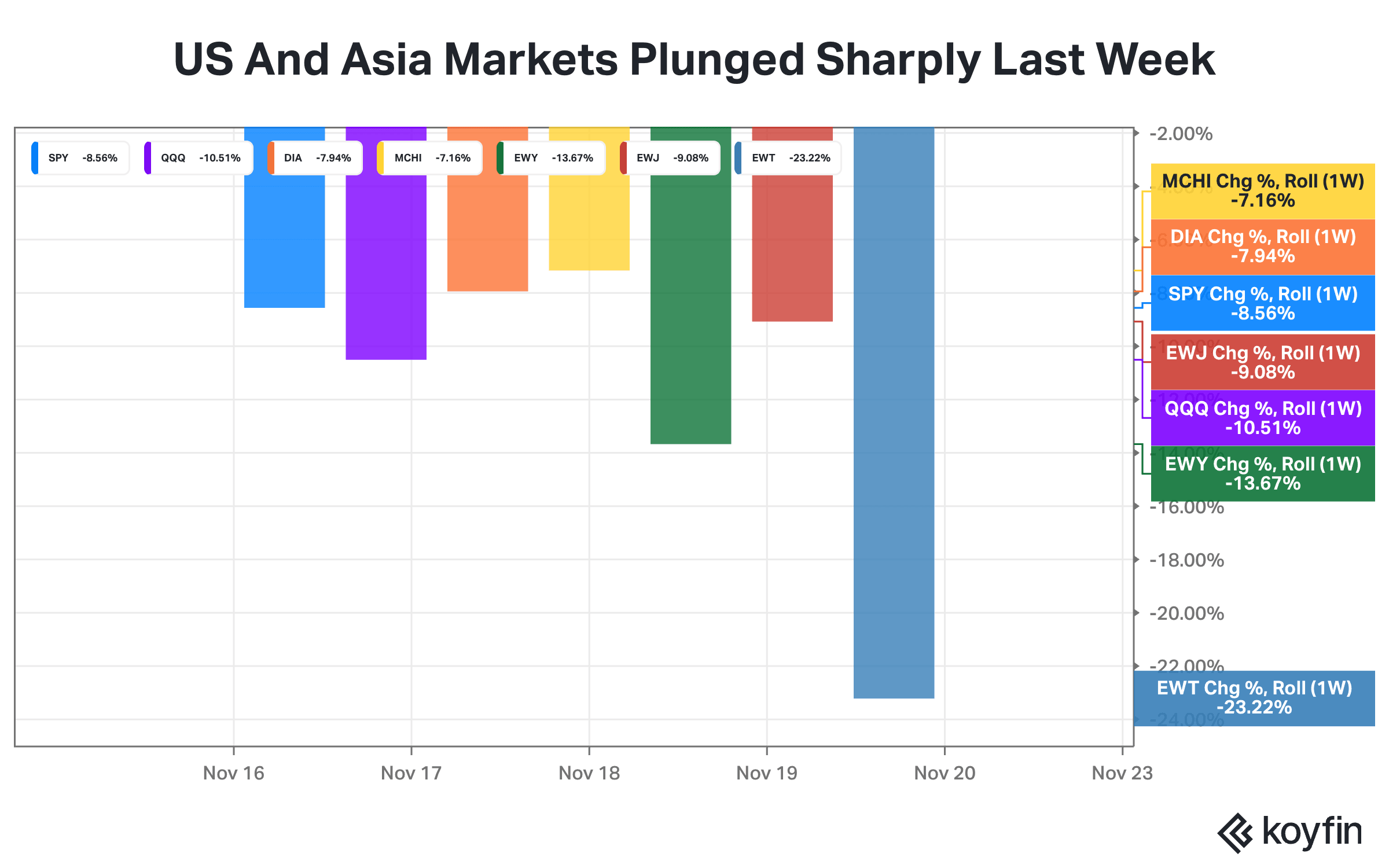
At the end of last week, the benchmark indexes fell sharply amid a broader selloff in AI and technology stocks, as Anthropic’s record IPO squeezed liquidity and concerns about the sustainability of the AI trade weighed on sentiment. The Nasdaq Composite fell 10%, while the S&P 500 and Dow fell more than 8% each.
Ben Bowler, head of global equity derivatives at Bank of America Global Research, told Bloomberg over the weekend, “Index volatility has been relatively subdued despite the turmoil under the surface, given multi-decade low stock correlation.”
“Idiosyncratic risk has dominated and markets have chosen to rotate, rather than rupture, under stress. Nonetheless, a broad-based shock that drives a meaningful pickup in stock correlation, and hence index volatility, remains a risk,” Bowler added.
However, at the time of writing, the SPDR S&P 500 ETF (SPY) was up more than 2%, while the Invesco QQQ Trust (QQQ) gained 3.04% and the SPDR Dow Jones Industrial Average ETF Trust (DIA) edged 1.4% higher.
The Kobeissi Letter noted in a post on X that while “bears are having their moment, bulls will make money.”
The market commentator said, “The S&P 500 has posted three consecutive quarters with earnings growth above 25% and eight straight quarters of double-digit growth. And, sentiment flipped so quickly that the S&P 500 closed the week 4.1 standard deviations below its 50-day moving average on Friday. Not even 2020 and 2008 saw such an occurrence.”
It added that the reality is that AI truly is the "next big thing" and the AI buildout is only accelerating.
Asian Stocks Post Mixed Open On Monday
South Korea’s KOSPI was down 3.22% at the time of writing, extending last week’s selloff after it plunged to its lowest close in 10 months.
Over the weekend, the South Korean government announced measures, including a stock stabilization fund to respond when needed, and easing daily share buyback limits for listed companies for three months to provide some relief to markets.
Jeong-Woo Park, an economist at Nomura Holdings Inc., told Bloomberg, “After the announcement, investors appeared to conclude there was nothing substantial and resumed selling.”
“Under the government risk management framework, it’s difficult for the government to step in because the stock-market retreat isn’t being driven by fundamentals or a liquidity crunch in financial markets,” he added.
At the time of writing, South Korea-listed shares of Samsung were down nearly 3%, while SK Hynix was down more than 13%.
Japan's stock market is closed Monday for the Labour Thanksgiving Day holiday. xTaiwan’s Taiex and China’s SSE Composite index edged slightly higher at the open after announcing support measures.
Taiwan increased the curbs on short sales of local stocks and also announced that it has been buying shares in an attempt to revive confidence after its benchmark index Taiex had its worst weekly fall in 35 years, slumping more than 9%.
In China, three local stock markets said over the weekend that the minimum margin requirement for investors buying stocks with leverage will fall to 80% from 100% on Nov. 30.
“These interventions are circuit breakers rather than a turning point,” Dilin Wu, a strategist at broker Pepperstone Group, told Bloomberg. “These steps may help stabilise prices in the near term, but they can’t reverse a broader reassessment of AI valuations or bring foreign investors back on their own.”
How Did Asian Stocks Perform Last Week?
The iShares MSCI Taiwan ETF (EWT) was hit the hardest last week, losing more than 23%. The iShares MSCI South Korea ETF (EWY) fell more than 13% as the heavily AI-weighted market witnessed a steep selloff in SK Hynix and Samsung following the AI rout in the U.S.
Meanwhile, the iShares MSCI China ETF (MCHI), and the iShares MSCI Japan ETF (EWJ) fell more than 7% and 9%, respectively, last week.
Retail Stance: US Vs Asia Markets
On Stocktwits, retail sentiment around SPY was ‘bearish’ at the time of writing, while it was ‘extremely bullish’ for QQQ. Sentiment around DIA was in the ‘bearish’ territory.
Meanwhile, retail sentiment around MCHI, EWY and EWJ was ‘bullish’ while writing. Sentiment around EWT was ‘neutral’ at the time of writing.
For updates and corrections, email newsroom[at]stocktwits[dot]com.<